
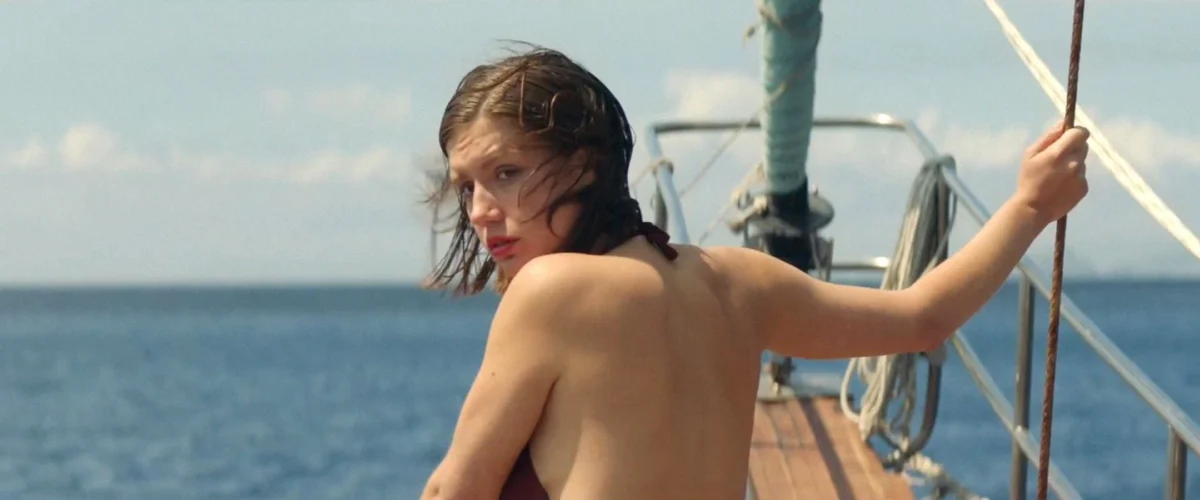
Since her explosive international breakthrough in 2013, Adèle Exarchopoulos has transitioned from a teenage prodigy into a cornerstone of the French film industry. At 31, the Paris-born actress has spent more than a decade navigating the complexities of fame while carefully selecting roles that challenge the traditional boundaries of French drama. Her career, which began in earnest with the Palme d’Or-winning Blue Is the Warmest Colour, has moved beyond the shadow of that controversial production to encompass a diverse portfolio of psychological thrillers, social realism, and high-concept science fiction. Today, Exarchopoulos is regarded not merely as a muse for contemporary directors but as a powerhouse performer whose presence in a project often signals a commitment to emotional authenticity and narrative risk.
The Legacy of Blue Is the Warmest Colour and the Transition to Maturity
In 2013, the Cannes Film Festival took the unprecedented step of awarding the Palme d’Or to both the director, Abdellatif Kechiche, and the two lead actresses, Adèle Exarchopoulos and Léa Seydoux. For Exarchopoulos, then only 19, the win was accompanied by the César Award for Most Promising Actress. However, the film’s success was complicated by reports of grueling production conditions and the intense scrutiny of its explicit content.
Rather than succumbing to the pressures of Hollywood typecasting or retreating from the industry, Exarchopoulos utilized the following years to refine her craft. Her trajectory has been defined by a refusal to stay within the "ingenue" archetype. Instead, she has gravitated toward directors who utilize her "naturalistic intensity"—a quality characterized by a raw, unpolished delivery that many critics argue has revitalized the often-formalist tradition of French acting.
Psychological Depth and Collaborations with Auteurs (2019–2021)
The year 2019 marked a significant turning point in Exarchopoulos’s filmography with the release of Sibyl, directed by Justine Triet. In this psychological drama, Exarchopoulos played Margot, a distressed young actress whose tumultuous personal life becomes the "source material" for her therapist, played by Virginie Efira. The film explored the ethical boundaries of creativity and the parasitic relationship between artist and subject. Under Triet—who would later win the Palme d’Or for Anatomy of a Fall—Exarchopoulos demonstrated a capacity for vulnerability that was both volatile and calculated, proving she could hold her own alongside established veterans of the European screen.
Following this, the 2021 film Zero Fucks Given (Rien à foutre), directed by Emmanuel Marre and Julie Lecoustre, provided Exarchopoulos with one of her most culturally resonant roles. Playing Cassandre, a flight attendant for a budget airline, she portrayed the hollowed-out existence of a digital nomad seeking to escape grief through the banality of low-cost travel. Exarchopoulos described the film as an "autopsy of our generation," highlighting the precarity of the gig economy and the emotional detachment of the Tinder era. The performance earned her a César nomination for Best Actress and was praised for its documentary-like realism, with much of the film shot in actual airports and planes with non-professional actors.
Genre Fluidity and International Reach (2022–2023)
As her reputation grew, Exarchopoulos began to experiment with genre-bending narratives. In 2022, she starred in Léa Mysius’s The Five Devils (Les Cinq Diables). Shot on 35mm, the film blended elements of magical realism with a family drama. Exarchopoulos played Joanne, an aquagym instructor whose past secrets are unearthed by her daughter’s supernatural sense of smell. The film was a critical success at the Directors’ Fortnight at Cannes, further establishing Exarchopoulos as an actress capable of anchoring high-concept, atmospheric cinema.
In 2023, Exarchopoulos expanded her international footprint with Passages, directed by American independent filmmaker Ira Sachs. Set in Paris, the film featured her as Agathe, a schoolteacher who becomes the third point in a volatile love triangle involving a gay married couple (played by Franz Rogowski and Ben Whishaw). The film was a masterclass in subtlety, with Exarchopoulos providing a grounded, quiet contrast to the narcissistic chaos of the male leads. Passages was widely acclaimed at Sundance and the Berlinale, reinforcing her status as a talent who transcends linguistic and national borders.
Social Realism and the Restorative Justice Phenomenon
One of the most significant milestones in recent French cinema was Jeanne Herry’s 2023 ensemble drama All Your Faces (Je l’verrai toujours vos visages). The film tackled the complex subject of restorative justice—a system that facilitates dialogue between victims and offenders. Exarchopoulos delivered a harrowing performance as Chloé, a survivor of incestuous abuse seeking to confront her past.
The film was a major cultural event in France, drawing over 1.1 million spectators to theaters—a rare feat for a dialogue-heavy social drama. Industry analysts pointed to the film’s success as evidence of a growing public interest in cinema that addresses systemic social issues. For her role, Exarchopoulos won the 2024 César Award for Best Supporting Actress, a victory that many saw as official validation of her evolution into one of the country’s most respected dramatic weights. Herry and Exarchopoulos have continued their professional relationship, recently debuting the project Garance at the 2024 Cannes Film Festival.
Innovation in French Science Fiction: The Animal Kingdom
The 2023 release of The Animal Kingdom (Le Règne animal), directed by Thomas Cailley, showcased Exarchopoulos’s willingness to engage with big-budget, imaginative filmmaking. The film is set in a world where humans are mysteriously mutating into animals. Exarchopoulos played Julia, a police officer navigating the social and political fallout of these mutations.
The film was a massive critical and commercial success, garnering 12 César nominations and winning five. It represented a significant shift in French cinema, which has historically favored domestic realism over speculative fiction. By lending her star power to such a project, Exarchopoulos helped bridge the gap between "prestige" acting and genre cinema, proving that high-concept stories can still be rooted in deep emotional truth.
Dystopian Futures and Upcoming Projects (2024–2025)
Exarchopoulos’s recent work suggests an increasing interest in dystopian themes and political commentary. In Aude Léa Rapin’s Planet B (2024), she stars as Julia Bombarth, an activist who finds herself in a virtual prison in the year 2039. The film explores the erasure of political dissidents and the dangers of state-controlled technology.
Looking forward to 2025, the actress is set to lead Dog 51 (Chien 51), directed by Cédric Jimenez. Adapted from Laurent Gaudé’s noir novel, the film is set in a fractured, walled-off Paris of the future. Exarchopoulos plays Salia Malberg, an ambitious officer in a world divided by class and architecture. This role marks a reunion with Jimenez, who previously directed her in the police thriller The Stronghold (BAC Nord), which was one of the highest-grossing French films of 2021.
Industry Impact and the "Adèle" Effect
The "Adèle effect" in the French film industry refers to her ability to draw audiences to demanding, often difficult films. Data from the CNC (Centre national du cinéma et de l’image animée) indicates that films starring Exarchopoulos have a high "crossover" appeal, attracting both art-house aficionados and younger audiences who follow her through fashion and social media.
Her presence has also been a boon for female directors. By consistently working with figures like Justine Triet, Léa Mysius, Jeanne Herry, and Aude Léa Rapin, she has become a central figure in a movement that is re-centering the female gaze in French cinema. Critics often note that she brings a "modernity" to her roles that feels disconnected from the classical "femme fatale" or "heroine" tropes of the 20th century.
Broader Implications for French Cinema
The career of Adèle Exarchopoulos serves as a roadmap for the current state of French filmmaking. It reflects a move away from the rigid boundaries of the "New Wave" toward a more eclectic, globalized, and genre-literate approach. Her filmography suggests that the future of the industry lies in its ability to marry deep, psychological character studies with innovative storytelling formats.
As she moves into the second decade of her career, the focus remains on her ability to maintain "intensity" without becoming a caricature of herself. With several high-profile projects in development and a proven track record at both the box office and major festivals, Exarchopoulos has solidified her position as the definitive face of 21st-century French cinema. Her journey from the raw, uninhibited debut in Blue Is the Warmest Colour to the disciplined, authoritative performances of the 2020s highlights a rare trajectory of sustained artistic growth in an often-fickle industry.

0 Comments