
The tomahawk, a tool and weapon deeply embedded in the fabric of North American history, has transitioned from a necessity of frontier survival to a prominent fixture in modern recreational sport. While popular media often depicts the tomahawk as a projectile frequently hurled in the heat of 18th-century combat, historical evidence suggests a more nuanced reality. For the Indigenous peoples who originated the design and the European mountain men who later adopted it, the tomahawk was primarily a tool for utility and hand-to-hand engagement. To throw one’s weapon in the midst of a skirmish was to risk being disarmed, a tactical error that few seasoned warriors were willing to make. Today, however, the art of the throw has seen a massive resurgence, moving from the isolated mountain "rendezvous" of the 1800s to specialized urban throwing ranges and competitive leagues across the globe.
Historical Context and the Evolution of the Tomahawk
The word "tomahawk" is derived from the Algonquian term tamahaac, which translates roughly to "that which is used for cutting." Originally, these implements featured heads crafted from stone, bone, or deer antler, secured to wooden handles with sinew. With the arrival of European traders in the 17th and 18th centuries, the stone heads were largely replaced by iron and steel versions manufactured in Europe specifically for trade. These metal heads were lighter and more durable, making them indispensable for the fur trade era.
During the 19th century, the "mountain man" era solidified the tomahawk’s place in American folklore. Fur trappers and explorers gathered annually at events known as "rendezvous." These were large-scale commercial and social gatherings where pelts were traded for supplies like gunpowder, lead, and tobacco. Because these men spent months in solitude, the rendezvous became a venue for intense competition. While marksmanship with long rifles was a primary draw, tomahawk throwing emerged as a popular test of skill and finesse. Native American tribes frequently participated in these gatherings, engaging in both trade and competitive games of skill. This era established the tomahawk throw not as a lethal combat maneuver, but as a prestigious demonstration of hand-eye coordination and mechanical mastery.
The Mechanics of the Throw: A Technical Breakdown
Modern tomahawk throwing relies on a fundamental understanding of rotational physics and body mechanics. Unlike throwing a baseball or a javelin, the success of a tomahawk throw is determined by the relationship between the distance to the target and the number of rotations the tool completes in the air.
The Grip and Stance
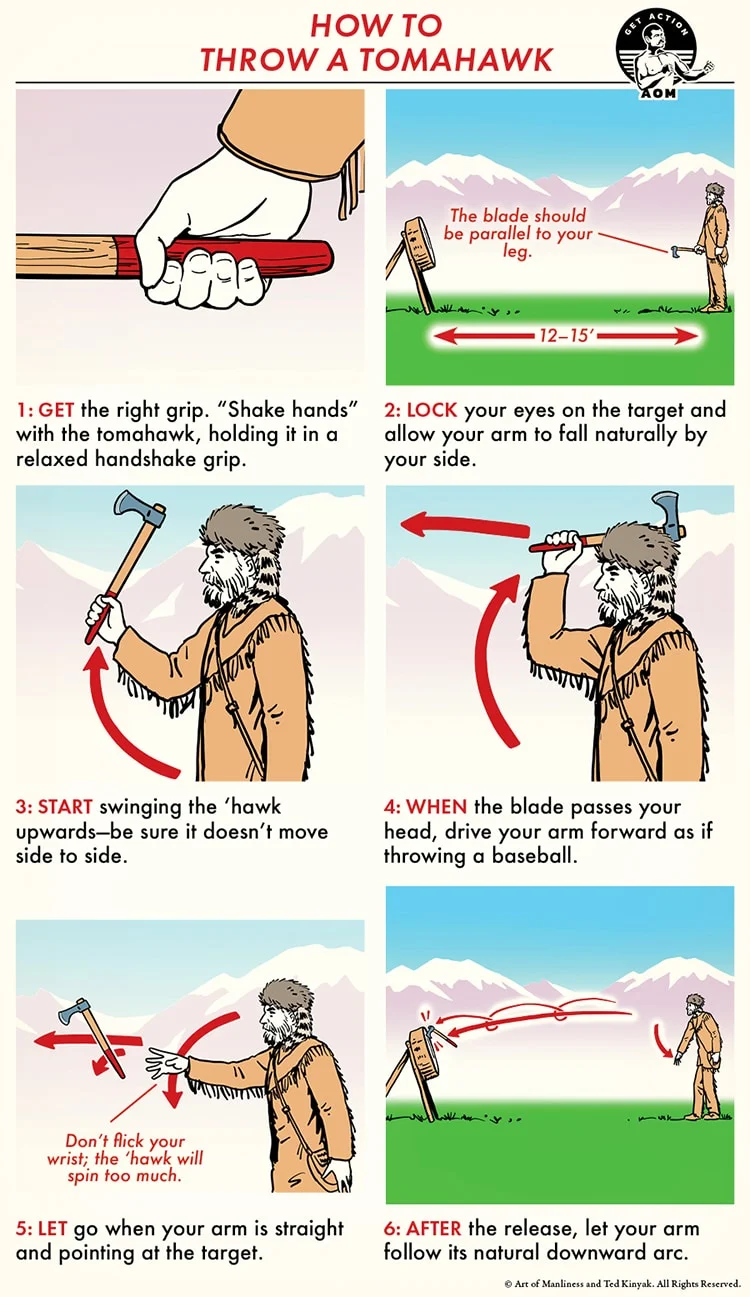
The foundation of a successful throw begins with the grip. Experts recommend a "hammer grip," where the handle is held firmly but not with excessive tension. The thumb should be wrapped around the handle rather than placed along the back, which can interfere with a clean release.
The stance is typically a "staggered" position. For a right-handed thrower, the left foot is placed forward, pointing toward the target, while the right foot is positioned slightly back for balance. This alignment allows the thrower to utilize their entire kinetic chain—moving energy from the legs through the torso and out through the arm—ensuring a smooth, consistent delivery.
The Motion and Release
The throwing motion is characterized by a fluid, overhead arc. The tomahawk is brought back over the shoulder, keeping the elbow tucked in to prevent the blade from wobbling or "canting." As the arm moves forward, the thrower steps into the motion.
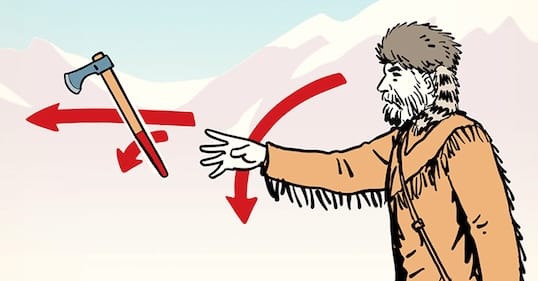
The most critical moment is the release. A common mistake among beginners is to "flick" the wrist at the end of the motion, which adds unpredictable spin. Instead, the release should be a natural extension of the arm’s arc. As the arm reaches a point parallel to the ground, the hand simply opens, allowing the tomahawk to slide out of the palm. The goal is to let the tool’s center of gravity dictate its own rotation.
The Physics of Rotation and Distance
In competitive and recreational throwing, the standard distance for a single-rotation throw is approximately 12 to 15 feet. This distance allows the tomahawk to flip exactly 360 degrees, ensuring the bit (the sharp edge of the head) impacts the target perpendicularly.
If the tomahawk hits the target with the top of the handle, the thrower is likely too close, and the tool has not had enough time to complete its rotation. Conversely, if the bottom of the handle hits the target, the thrower is too far away. Adjusting one’s distance by as little as six inches can be the difference between a solid "thunk" and a harmless bounce.
Supporting data from the World Axe Throwing League (WATL) indicates that consistency in the release point is the primary factor in high-scoring competitors. Professional throwers often spend hours calibrating their "step-and-release" timing to ensure that the blade arrives at the target at the optimal angle every time.
Safety Protocols and Equipment Standards
As the popularity of tomahawk throwing has grown, so has the emphasis on safety and standardized equipment. A traditional tomahawk differs from a standard hardware store hatchet in its construction. Tomahawk heads are typically "friction-fit," meaning the handle is tapered and the head is slid on from the bottom, tightening as it moves toward the wider top. This design allows for easy handle replacement, which is necessary as handles frequently break during practice.
Target Selection
Safety begins with the target. Professional ranges use "end-grain" targets, typically cross-sections of logs (rounds) or planks of softwoods like pine, spruce, or cottonwood. Hardwoods like oak or maple are generally avoided because they are too dense, causing the tomahawk to bounce back toward the thrower rather than sticking.
Range Safety
The "danger zone" at a throwing range extends not just in front of the thrower, but to the sides. Modern commercial facilities utilize floor-to-ceiling chain-link fencing or heavy wooden barriers to contain "drop-offs" and "kick-backs." Standard safety protocols dictate that only one person should be in the throwing lane at a time, and no one should approach the target until all tomahawks have been thrown and come to a complete rest.
The Modern Industry: Growth and Implications
The 21st century has seen the transformation of tomahawk and axe throwing from a niche hobby into a multi-million-dollar "experience economy" industry. According to market analysis, the indoor axe-throwing industry saw a growth of over 300% between 2016 and 2021. What was once confined to backyard stumps is now a staple of corporate team-building events and urban nightlife.
Organizations such as the International Axe Throwing Federation (IATF), founded in 2016, have established standardized rules for competition, including target dimensions, scoring zones, and sanctioned equipment. These leagues have turned a frontier skill into a legitimate sport, complete with televised championships and professional rankings.
Industry experts attribute this boom to a broader cultural shift. In an increasingly digital world, there is a growing demand for "analog" experiences that provide tactile feedback and a sense of physical accomplishment. The "thunk" of a blade burying into wood provides an immediate, visceral satisfaction that few digital activities can replicate.
Psychosocial and Cultural Impact
The resurgence of tomahawk throwing also touches on the concept of "functional fitness" and stress relief. Psychologists have noted that repetitive, skill-based physical activities can induce a "flow state"—a mental condition where a person is fully immersed in an activity with energized focus. For many, the focus required to stick a tomahawk serves as a form of active meditation, clearing the mind of external stressors.
Furthermore, the sport has fostered a unique community. Modern "rendezvous" take the form of league nights where people from diverse professional backgrounds gather to share techniques and compete. While the buckskin clothing of the 19th-century mountain man has been replaced by modern casual wear, the spirit of the gathering remains remarkably similar: a celebration of a specific, difficult-to-master skill that connects the practitioner to a deeper historical lineage.
Conclusion: A Skill for the Ages
The tomahawk remains a potent symbol of American history, representing a bridge between Indigenous innovation and the rugged lifestyle of the frontier. While its role has shifted from a vital survival tool to a centerpiece of recreational sport, the fundamental requirements for mastering the tool have not changed. It still demands a calm mind, a steady hand, and a respect for the laws of physics.
Whether practiced in the woods or in a high-tech urban facility, tomahawk throwing continues to offer a unique blend of history, physical discipline, and gratification. As the sport continues to evolve with new technology and growing international participation, the fundamental "thunk" of the blade remains a timeless testament to a skill that has survived the transition from the wilderness to the modern age. Master the fundamentals—the grip, the rotation, and the release—and you participate in a tradition that spans centuries, proving that some skills are indeed timeless.

0 Comments