
Compound interest is frequently characterized as a fundamental pillar of personal finance, often described as a force that can either accelerate wealth creation or deepen the burden of debt depending on an individual’s understanding and application of its principles. While a popular adage often attributed to physicist Albert Einstein labels compound interest as the "Eighth Wonder of the World," the practical reality of the concept is rooted in rigorous mathematical formulas and economic behavior. For the modern consumer, the distinction between simple interest and compound interest is not merely academic; it is a critical factor that determines the trajectory of net worth over a lifetime. Financial literacy experts argue that failing to grasp how interest accumulates can trap individuals in a "paycheck mentality," where earnings are consumed by debt service rather than being utilized for asset growth.
Defining the Mathematical Framework: Simple vs. Compound Interest
To understand the transformative power of compounding, it is necessary to first establish the baseline of simple interest. Simple interest is a straightforward calculation based only on the principal amount—the original sum of money borrowed or invested. It is most commonly found in short-term personal loans, car loans, and certain types of student debt. The formula for simple interest is defined as the Principal multiplied by the Interest Rate and the Term of the Loan. For example, a $10,000 loan with a 5% simple interest rate over four years results in a total interest payment of $2,000 ($10,000 x 0.05 x 4). The total repayment amount remains linear and predictable.
In contrast, compound interest is calculated on the principal amount plus all of the accumulated interest from previous periods. This creates a feedback loop where "interest earns interest," leading to exponential rather than linear growth. The mathematical formula for compound interest is expressed as A = P(1 + r/n)^(nt), where "A" represents the future value of the investment or loan, "P" is the principal, "r" is the annual interest rate, "n" is the number of times interest is compounded per year, and "t" is the number of years.
When applying this formula to the same $10,000 loan at a 5% interest rate compounded annually over four years, the interest total rises to $2,155.06. While the difference of $155.06 may seem marginal over a short duration, the gap between simple and compound interest widens drastically as the principal increases or the time horizon extends. This mathematical reality serves as the engine for modern banking and investment portfolios.
The Role of Compounding Frequency and its Economic Impact
A critical variable in the compound interest equation is the frequency of compounding, denoted as "n" in the standard formula. Financial institutions utilize different compounding schedules, ranging from annual and quarterly to monthly and daily. The frequency of these periods has a significant impact on the effective annual yield (EAY) or the total cost of a loan.
In the consumer credit sector, compounding frequency is often leveraged to the detriment of the borrower. Credit card companies, for instance, typically compound interest on a daily basis. With average credit card interest rates often exceeding 20%, the daily accumulation of interest on an unpaid balance can lead to a debt spiral. For example, a $10,000 credit card balance at a 20% interest rate compounded daily would result in approximately $2,213.36 in interest over just one year. This high-frequency compounding is a primary reason why financial advisors emphasize the urgency of paying off high-interest revolving debt before allocating funds toward savings.
Conversely, compounding frequency benefits the disciplined saver. High-yield savings accounts and certificates of deposit (CDs) often compound daily or monthly. While the national average for standard savings accounts remains low, top-tier high-yield accounts in the current economic climate have reached rates of approximately 4% to 5%. At a 4% rate compounded daily, a $10,000 deposit earns $408.08 in a single year. In the context of long-term investing, such as in index funds or exchange-traded funds (ETFs), compounding occurs as dividends and capital gains are reinvested to purchase more shares, which in turn generate their own returns.
Historical Context and the Evolution of Interest
The concept of charging interest on loans dates back to ancient civilizations, including Mesopotamia and Greece, though the formalization of compound interest as a standard banking practice evolved much later. Historically, many cultures viewed high interest, or usury, with moral suspicion. However, as global trade expanded during the Renaissance, the necessity of capital led to the development of more sophisticated financial instruments.
In the United States, the regulation of interest rates and the disclosure of compounding practices became a matter of federal law with the passage of the Truth in Lending Act (TILA) of 1968. This legislation required lenders to disclose the Annual Percentage Rate (APR), providing consumers with a standardized way to compare the costs of different loans. Later, the Truth in Savings Act of 1991 introduced the Annual Percentage Yield (APY), which accounts for the effect of compounding, allowing savers to see the actual return they would receive on a deposit over one year. These regulatory milestones reflect the government’s recognition that the complexity of compounding can lead to consumer exploitation if not clearly communicated.
The Temporal Advantage: Case Studies in Early Investment
The most significant factor in the power of compound interest is time. Because the growth is exponential, the final years of an investment period yield the highest returns. This phenomenon is often illustrated through comparative case studies of investors starting at different ages.
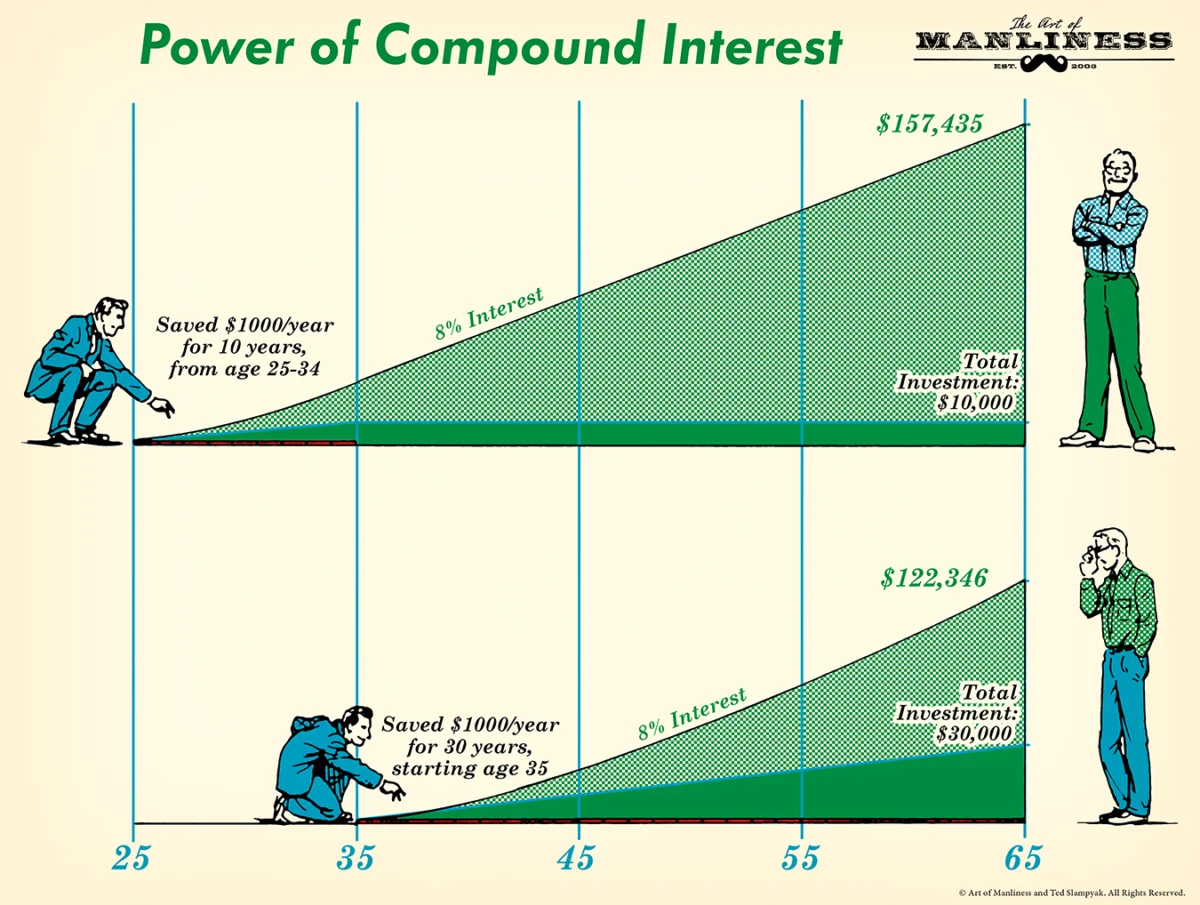
Financial expert Beth Kobliner provides a stark example of this "early start" advantage. If an individual invests $1,000 annually for only ten years between the ages of 25 and 34, assuming an 8% annual return, and then stops investing entirely, the account will grow to approximately $157,435 by age 65. However, if an individual waits until age 35 to begin and invests $1,000 every year for 30 years (a total contribution of $30,000), they will end up with only $122,346 by age 65. Despite contributing three times as much principal, the second investor cannot overcome the ten-year head start of the first investor.
This data underscores a vital economic truth: time is a more valuable asset than the amount of capital when leveraging compound interest. This principle applies to various financial decisions, from purchasing a home to daily spending habits. For instance, choosing a more modest home and investing the difference in a down payment can result in millions of dollars in additional wealth over a 30-year period. Similarly, micro-investing small daily savings—such as $10 a day—can result in a portfolio worth nearly $2 million over 40 years, assuming a standard market return.
Institutional Responses and the Retirement Crisis
The implications of compound interest extend beyond individual wealth to broader societal issues, including the current retirement crisis. As traditional pension plans have been largely replaced by defined-contribution plans like 401(k)s and IRAs, the responsibility of leveraging compound interest has shifted from the employer to the employee.
Financial institutions and government agencies, such as the Consumer Financial Protection Bureau (CFPB), have expressed concern over the "financial literacy gap." Data suggests that a significant portion of the population does not understand the mechanics of compounding, leading to insufficient retirement savings. In response, many employers have implemented "automatic enrollment" in retirement plans, recognizing that the earlier a worker enters the market, the more effectively compound interest can work to secure their future.
Economists argue that the wealth gap is exacerbated by the "compounding divide." Those with the capital to invest and the knowledge to start early see their wealth grow exponentially, while those burdened by high-interest debt see their liabilities grow at the same rapid pace. This divergence creates a structural barrier to social mobility for those who remain in a "paycheck mentality," where they are perpetually paying interest rather than earning it.
Analysis of Long-Term Implications and Strategy
The strategic use of compound interest requires a dual-pronged approach: the aggressive elimination of compounding debt and the consistent application of compounding investments. For the modern investor, this involves utilizing tools such as low-cost index funds, which allow for the broad-based capture of market growth, and tax-advantaged accounts like Roth IRAs, which protect the compounded earnings from future taxation.
The "Rule of 72" is a simplified analytical tool used by investors to estimate the impact of compounding. By dividing 72 by the annual rate of return, an individual can determine roughly how many years it will take for their initial investment to double. At a 7% return, money doubles every 10.3 years; at a 10% return, it doubles every 7.2 years. This quick calculation highlights why even small increases in interest rates or returns can lead to vastly different outcomes over several decades.
In conclusion, compound interest remains the most potent tool available for individual financial advancement. Its dual nature as both a "wealth builder" and a "debt trap" necessitates a high degree of financial awareness. As economic conditions fluctuate and inflation impacts the real value of returns, the fundamental math of compounding remains a constant. For the individual seeking financial security, the mandate is clear: minimize the periods where you are paying interest and maximize the duration during which your capital is allowed to grow. Whether one views it as a "wonder of the world" or a simple mathematical function, the mastery of compound interest is the dividing line between financial struggle and long-term prosperity.

0 Comments