
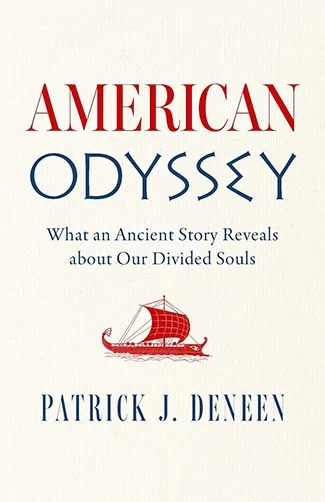
This dualistic nature is not merely a literary theme but a defining characteristic of the American national character, one that has been observed by social critics for centuries. Deneen posits that while the American spirit is often defined by the "frontier" and the desire to push beyond known horizons, it is simultaneously anchored by a profound, if often frustrated, longing for a permanent home.
The Philosophical Framework of the Restless and the Rooted
The core of Deneen’s analysis rests on the navigation of two extremes: the "more than human" and the "less than human." Throughout his ten-year journey home from the Trojan War, Odysseus encounters various temptations that would lead him away from his humanity. On one hand, he is offered immortality and eternal youth by the nymph Calypso, a state that would make him "more than human" but would strip him of his history, his struggles, and his identity as a husband and father. On the other hand, he encounters the Lotus Eaters and the Cyclops Polyphemus, representing "less than human" states of apathy and lawless savagery.
Deneen argues that the modern American often finds himself trapped between these same poles. The technological and economic "restlessness" of the 21st century offers a form of digital immortality and global connectivity that transcends physical limits—a "more than human" existence where place no longer matters. Conversely, the breakdown of community and the rise of "deaths of despair" reflect a slide into a "less than human" state of isolation.
The "heroic act" of Odysseus, in Deneen’s view, is not his prowess in battle or his cunning with the Trojan Horse, but his deliberate choice to reject immortality in favor of a difficult, mortal life in his home of Ithaca. This decision highlights the "rooted" side of the human soul, suggesting that true heroism lies in the acceptance of limits and the commitment to a specific place and people.
Historical Context: From Tocqueville to the Modern Era
The observation that Americans are uniquely defined by this tension is not new. In the 1830s, the French diplomat and historian Alexis de Tocqueville traveled across the United States and noted a peculiar melancholy among its citizens. In his seminal work, Democracy in America, Tocqueville observed that Americans seemed to be "restless in the midst of abundance." He wrote that an American "builds a house in which to spend his old age, and he sells it before the roof is on; he plants a garden and lets it as the trees are coming into blossom; he brings a field into tillage and leaves other men to gather the crops; he embraces a profession and gives it up; he settles in a place, which he soon afterwards leaves to carry his changeable longings elsewhere."
Deneen connects Tocqueville’s 19th-century observations to the current socioeconomic landscape. For much of the 20th century, the "American Dream" was predicated on geographic mobility—the idea that one must leave their hometown to find success in the city or the suburbs. However, this restlessness has come at a cost.
Supporting Data: The Decline of Geographic Mobility and Social Capital
While the American spirit remains restless, recent data suggests a shift in how this restlessness is manifested. According to the U.S. Census Bureau, geographic mobility in the United States has been on a steady decline for decades. In the 1950s, approximately 20% of the population moved each year. By 2022, that number had dropped to roughly 8.7%.
Despite moving less, Americans report feeling less "rooted" than previous generations. Data from the General Social Survey (GSS) indicates a significant decline in "social capital"—the networks of relationships among people who live and work in a particular society.

- Trust in Neighbors: In the 1970s, nearly 50% of Americans said they trusted their neighbors. By the 2020s, that figure had fallen below 30%.
- Community Participation: Membership in local civic organizations, from bowling leagues to PTAs, has seen a sharp downturn, a phenomenon famously documented by Robert Putnam in Bowling Alone.
- The "Anywheres" vs. "Somewheres": British author David Goodhart has categorized modern populations into "Anywheres"—highly educated, mobile individuals who value autonomy—and "Somewheres"—those whose identity is tied to a specific location. Deneen suggests that the Odyssey serves as a warning that a society dominated entirely by "Anywheres" loses the "rooted" stability necessary for human flourishing.
The Heroic Return: A Chronology of the Soul
Deneen’s analysis of the Odyssey follows a chronological path that mirrors the human life cycle. The "restless" phase is characterized by the departure from home (the Iliad/War) and the initial thrill of exploration. However, as the journey progresses, the "rooted" impulse begins to take over.
- The Departure: The initial drive for glory (kleos) and the pursuit of external validation.
- The Temptations: The encounters with the Lotus Eaters (forgetfulness), Circe (appetite), and Calypso (stasis). Each represents a failure to integrate the restless and rooted aspects of the self.
- The Descent: Odysseus’s journey to the Underworld, where he realizes that even the greatest "restless" heroes of the past, like Achilles, would trade all their glory for one day as a common laborer in a home they loved.
- The Return: The arrival in Ithaca, where Odysseus must shed his "restless" persona and re-establish himself as a "rooted" king, husband, and father.
Deneen emphasizes that the return is not easy. Odysseus must fight to reclaim his home from the suitors who have desecrated it. This suggests that "rootedness" is not a passive state but an active, often difficult, commitment to maintaining the integrity of one’s community.
Broader Impact and Policy Implications
The tension between being restless and rooted has significant implications for modern public policy and urban planning. Deneen argues that modern economic systems often prioritize restlessness, encouraging individuals to be "flexible" and "mobile" at the expense of local stability. This has led to the "hollowing out" of rural areas and the creation of "transient" urban hubs where residents have little stake in the long-term health of the community.

In response, some political theorists and sociologists are advocating for a "new localism" or "place-based" policies. These include:
- Tax Incentives for Long-term Residency: Encouraging homeownership and community longevity.
- Investment in Local Infrastructure: Prioritizing community centers, local libraries, and parks that facilitate face-to-face interaction.
- Educational Reform: Moving away from a "college for all" model that often necessitates leaving one’s community, and instead supporting local vocational training and regional economies.
Analysis: The "Secure Base" of Human Exploration
The conversation concludes with a synthesis of these two opposing forces, drawing on the work of New York Times columnist David Brooks and the psychological concept of "attachment theory." Brooks has frequently written that "all of life is a series of daring explorations from a secure base."
This concept suggests that the "restless" and "rooted" impulses are not mutually exclusive but are, in fact, interdependent. A person who is deeply rooted in a secure home, a stable family, and a supportive community has the psychological confidence to take risks and explore the world. Conversely, the explorer who has no home to return to is not a hero but a wanderer, prone to the "melancholy" that Tocqueville observed.

Deneen’s reading of the Odyssey suggests that the ultimate goal of the human experience is to find a balance between the two. Odysseus is a great explorer because he is trying to get home. His restlessness is given meaning by his rootedness.
As the Nolan adaptation of the Odyssey brings these themes back into the cultural mainstream, the discussion prompted by Deneen serves as a reminder that the challenges of the 21st century—globalization, digital isolation, and political polarization—may find their solutions in a 3,000-year-old poem. The "divided soul" of the American people, caught between the urge to move and the urge to stay, remains the central drama of the national story. In the end, the most heroic journey may not be the one that leads to the stars, but the one that leads back to the front door.

0 Comments