
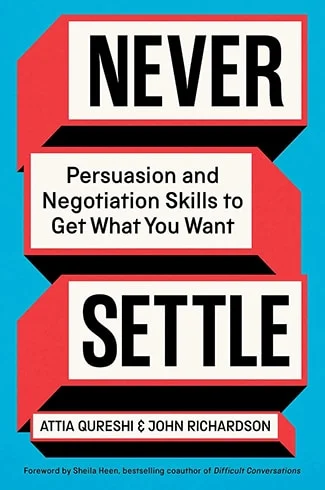
Negotiation is frequently mischaracterized as a high-stakes exercise reserved exclusively for corporate boardrooms, international diplomacy, or real estate acquisitions. However, as modern behavioral science and professional practice increasingly demonstrate, negotiation is a pervasive element of human interaction that defines the quality of both professional and personal relationships. On July 21, 2026, the Art of Manliness released an in-depth exploration of these dynamics, featuring John Richardson, a prominent lecturer at MIT’s Sloan School of Management and co-author of the influential text Never Settle. The discussion centers on the premise that negotiation is fundamentally the art of influencing decisions, ranging from multi-million dollar contracts to the domestic distribution of household labor.
The Foundation of Modern Negotiation Theory
To understand the "secret skills" of master negotiators, one must first look at the evolution of the field over the last half-century. For decades, the gold standard was "principled negotiation," a concept popularized by Roger Fisher and William Ury in their seminal 1981 book, Getting to Yes. This framework, born out of the Harvard Negotiation Project, focused on separating the people from the problem and focusing on interests rather than positions.

John Richardson’s work builds upon this foundation while integrating more contemporary, psychologically driven tactics. While Fisher provided the rational framework, modern practitioners like Chris Voss—a former lead FBI hostage negotiator—introduced the concept of "tactical empathy." Richardson bridges these two worlds, teaching students at MIT how to balance the analytical rigors of game theory with the volatile realities of human emotion.
The Psychological Mechanics of Influence
A core component of Richardson’s teaching involves the principle of reciprocity. Social psychology suggests that humans are biologically wired to return favors and match the concessions of others. In a negotiation setting, a master negotiator uses this by making the first move toward transparency or minor concessions, thereby triggering a social obligation for the other party to respond in kind.
However, Richardson warns that reciprocity can be a double-edged sword. If one party enters a negotiation with a purely "win-lose" mindset, they may exploit the other’s tendency toward fairness. Master negotiators, therefore, look for "Black Swans"—small pieces of information that, if uncovered, can change the entire utility of a deal. These are often hidden behind what people say they want (their positions) versus what they actually need (their interests).
Emotional Regulation and the Amygdala Hijack
One of the most significant barriers to successful negotiation is emotional volatility. When a person feels threatened or undervalued during a conversation, the brain’s amygdala can trigger a "fight or flight" response, effectively shutting down the prefrontal cortex—the area responsible for rational thought and complex problem-solving.
Richardson emphasizes that master negotiators are not emotionless; rather, they are experts at emotional regulation. They utilize "labeling"—a technique where one identifies and speaks the emotion the other person is feeling (e.g., "It seems like you feel this offer is unfair"). Research in neuroscience suggests that the act of labeling an emotion helps to de-escalate the amygdala’s intensity, allowing both parties to return to a state of collaborative reasoning.
Chronology of a Masterful Negotiation
Effective negotiation is rarely a single event; it is a process that follows a predictable, if often non-linear, timeline:

- The Preparation Phase: Research suggests that 80% of a negotiation’s success is determined before the parties ever meet. This involves determining one’s BATNA (Best Alternative to a Negotiated Agreement) and identifying the potential interests of the counterparty.
- The Information Exchange: This is the diagnostic phase. Master negotiators ask open-ended questions—often starting with "How" or "What"—to encourage the other party to speak, thereby revealing their underlying constraints and motivations.
- The Bargaining Phase: This is the "hard numbers" stage that many find uncomfortable. Richardson suggests that instead of viewing this as a conflict, it should be viewed as a joint problem-solving exercise.
- The Closing and Implementation: A deal is only successful if it is sustainable. Master negotiators ensure that the "Yes" is followed by a "How," detailing exactly how the agreement will be executed to avoid future friction.
Quantitative Analysis: The High Stakes of Silence
The discomfort many feel regarding salary or price negotiations has measurable economic consequences. Data from various labor statistics and management studies highlight the "cost of not negotiating." For instance, a landmark study by Linda Babcock for her book Women Don’t Ask found that only about 7% of female MBA graduates negotiated their starting salaries, compared to 57% of their male counterparts. Those who negotiated increased their starting salaries by an average of 7.4%.
Over a 40-year career, failing to negotiate an initial salary can result in a cumulative loss of between $500,000 and $1.5 million in total earnings, depending on the industry. Richardson’s insights into "anchoring"—the psychological tendency to rely too heavily on the first piece of information offered—provide a tactical countermeasure to these losses. By setting a high but justifiable anchor, a negotiator can shift the entire range of the conversation in their favor.
Official Responses and Academic Perspectives
The academic community at MIT and beyond has increasingly recognized that "soft skills" like negotiation are, in fact, "hard skills" with direct impacts on organizational efficiency. In response to the growing demand for these competencies, many MBA programs have shifted their curricula to include mandatory negotiation simulations and emotional intelligence training.

Management experts argue that in a decentralized, modern economy, the "command and control" style of leadership is becoming obsolete. Influence, rather than authority, is the primary currency of the 21st-century workplace. John Richardson’s synthesis of FBI-style tactics and MIT-style analysis represents a new standard in professional development, focusing on the "human element" that algorithms and AI cannot yet replicate.
Broader Impact and Implications
The implications of mastering negotiation extend far beyond personal financial gain. In a societal context, the ability to navigate conflict through dialogue is a stabilizing force. As political and social polarization increases, the skills of the negotiator—active listening, empathy, and the search for "integrative" solutions (where the pie is expanded rather than just divided)—become essential for civic health.
Furthermore, in the domestic sphere, the application of these skills can lead to higher relationship satisfaction. When couples view disagreements over chores or finances not as battles to be won, but as negotiations to be resolved for mutual benefit, the long-term stability of the partnership increases.

Analysis of Modern Barriers
Despite the clear benefits, several barriers prevent the widespread adoption of master-level negotiation skills. The primary barrier is the "niceness trap," where individuals avoid negotiation for fear of appearing greedy or confrontational. Richardson’s work seeks to decouple negotiation from aggression. By framing negotiation as a quest for information and a desire for fairness, he provides a moral and social license for individuals to advocate for themselves.
Additionally, the rise of digital communication has complicated negotiation. The lack of non-verbal cues in email or text-based negotiations increases the risk of misunderstanding and "hostile attribution bias," where one assumes the worst intentions from the other party. Richardson’s emphasis on vocal tone and "tactical empathy" serves as a reminder that high-stakes influence is still most effectively conducted through direct, human-to-human interaction.
Conclusion
The insights shared by John Richardson on the Art of Manliness highlight a critical shift in how we perceive interpersonal influence. Negotiation is not a dark art used to swindle others; it is a sophisticated toolkit for navigating a complex world. By mastering the balance between empathy and assertiveness, and by understanding the neurological underpinnings of human decision-making, individuals can achieve better outcomes in every facet of life. As the data suggests, the cost of remaining a passive participant in life’s many negotiations is too high to ignore. Whether at the car dealership, the office, or the kitchen table, the secret skills of master negotiators remain the most potent tools for personal and professional advancement in 2026 and beyond.

0 Comments