
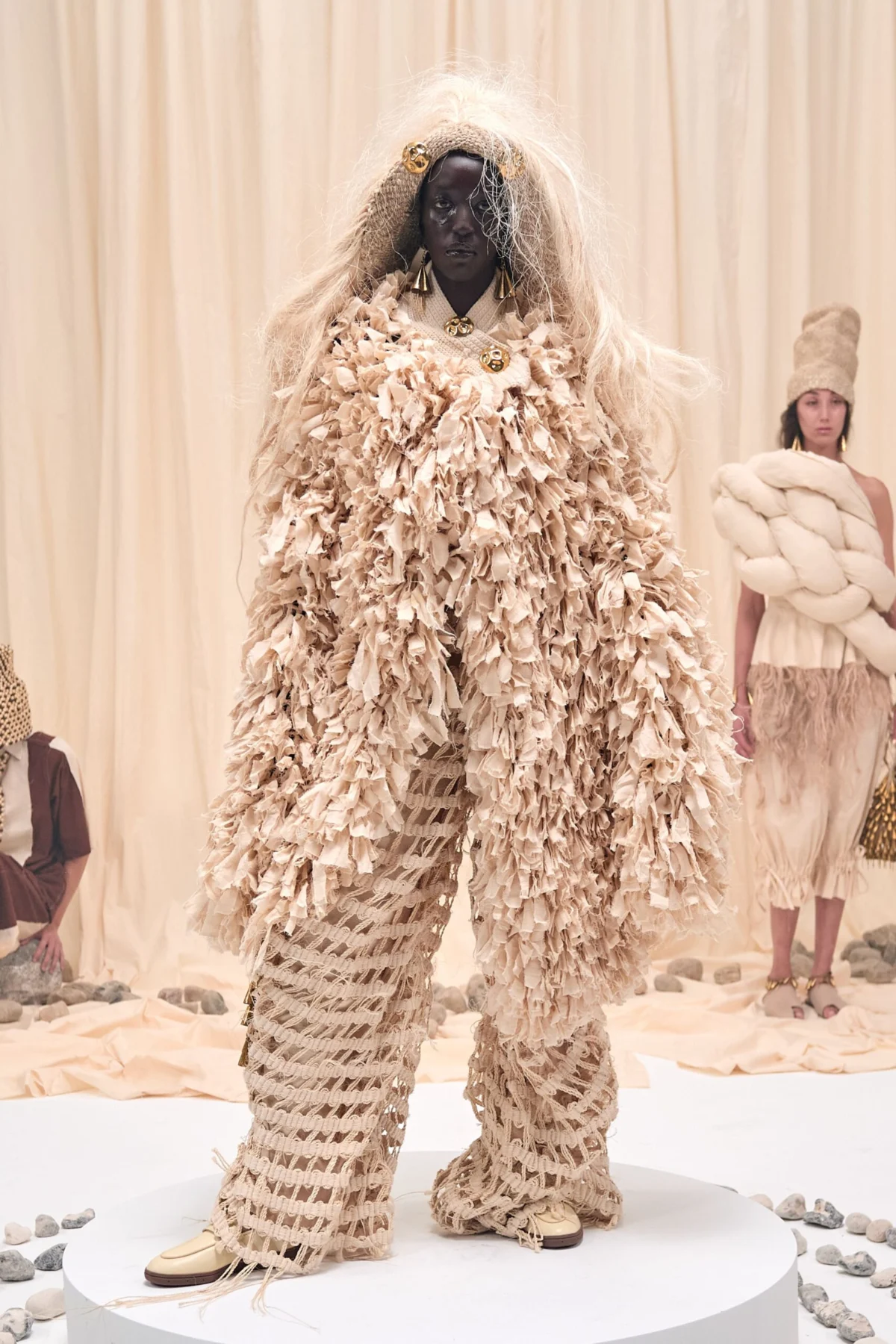
In a hazy, industrial venue in Copenhagen, IAMISIGO founder Bubu Ogisi unveiled a collection that functions as both a sartorial display and a historical preservation project. The presentation, part of the official Copenhagen Fashion Week schedule, marks a significant moment in the brand’s evolution as it bridges the gap between ancient African mnemonic traditions and contemporary sustainable fashion. By synthesizing the "lukasa" memory boards of the Luba people with the regalia of the Asante royal heralds, Ogisi has constructed a narrative that challenges the fluid nature of human recollection through the permanence of textiles.
The collection serves as a direct response to the philosophical inquiry of how societies record history. Ogisi’s research led her to the 19th-century Luba Kingdom, located in what is now the Democratic Republic of the Congo. There, the Mbudye society utilized "lukasa"—hand-held wooden boards studded with beads, shells, and metal pins—to map out complex histories, genealogies, and migration paths. Simultaneously, the designer drew inspiration from the "nsēnefoɔ," the royal heralds of the Asante Empire in modern-day Ghana. These figures wore ornate headdresses made of colobus monkey hide, decorated with gold repoussé and silver chains, symbolizing their role as living vessels of state knowledge. "The first is an object that holds knowledge. The second is a human who carries it," Ogisi explained during the post-show briefing, highlighting the duality of the collection’s structural foundation.
The Aesthetic of Remembrance and Spiritual Connection
The silhouettes presented on the Copenhagen runway were intentionally exaggerated, utilizing high hats and structural volume to allude to the proximity of African royalty to the spiritual realm. These designs are not merely aesthetic choices but are rooted in the belief that those of high rank serve as intermediaries between the physical and ancestral worlds. The garments themselves were treated as "conceptual maps," with heavily embroidered trousers featuring color palettes that mimicked the natural environment. Shades of deep mountain green, sandy dune ochre, and vibrant aquatic blues were used to illustrate the theory that the earth itself functions as a massive storage device for historical memory.
A recurring motif throughout the collection was the 3D snake, integrated into elongated ties made from IAMISIGO’s signature beaded textiles. In many African mythologies, the snake is revered as one of the oldest living creatures, a silent witness to the earth’s transformation. Ogisi noted that the patterns on a snake’s skin often mirror the configuration of lukasa memory boards, reinforcing the theme that nature provides the ultimate blueprint for data storage. The use of beads and shells throughout the collection further reinforced the connection to the Luba tradition, where every tactile element serves a specific mnemonic purpose.
Chronology of IAMISIGO’s International Expansion
The Spring 2027 presentation represents a pivotal step in a timeline of international growth for IAMISIGO. Founded in Lagos, Nigeria, the brand has spent over a decade establishing itself as a leader in the "de-colonization" of African fashion.
- November 2023: IAMISIGO began a deep-dive research phase in Uganda, focusing on the harvesting and processing of bark cloth, an ancient textile tradition recognized by UNESCO as a Masterpiece of the Oral and Intangible Heritage of Humanity.
- Summer 2024: Bubu Ogisi won the Zalando Visionary Award, a prestigious accolade that recognizes designers who demonstrate a commitment to social impact, innovation, and sustainability. This victory secured her place on the Copenhagen Fashion Week calendar, providing a global platform for her "indigenous sustainability" model.
- Late 2024 – Early 2025: The brand expanded its network of artisans across the continent, incorporating specialists in banana and pineapple fiber weaving in East and West Africa.
- Spring 2027: The current collection debuted in Copenhagen, solidifying the brand’s presence as a recurring force in European fashion while maintaining its strictly African production roots.
Material Innovation and Indigenous Sustainability
While Copenhagen Fashion Week is globally recognized for its rigorous sustainability standards, Ogisi is using her platform to broaden the definition of the term. For IAMISIGO, sustainability is not merely about carbon offsets or recycled polyester; it is about the preservation of "intellectual heritage" and the utilization of biodegradable, indigenous materials.
The brand’s recent experiments with Ugandan bark cloth highlight the complexity of this approach. Bark cloth is produced from the inner bark of the Mutuba tree (Ficus natalensis), which is beaten with wooden mallets until it becomes a soft, terracotta-colored fabric. To achieve specific aesthetic results, Ogisi’s team experimented with burying the cloth underground for varying durations to utilize clay dyes. This process is inherently slow and subject to environmental variables, contrasting sharply with the rapid-fire production cycles of the global fashion industry.
Furthermore, the collection utilized fibers derived from banana and pineapple waste. Transitioning traditional artisans to these new materials required a significant investment in time and training. "I love seeing our artisans get excited about new materials and ideas," Ogisi stated. "That’s the most fulfilling thing for me." By repurposing agricultural by-products into high-fashion textiles, IAMISIGO addresses both waste management and economic empowerment for rural craft communities.
Data and Industry Context: The Copenhagen Standard
Copenhagen Fashion Week (CPHFW) has established itself as the most sustainability-focused event in the global fashion circuit. Since 2023, all participating brands have been required to meet 18 minimum standards, which include:
- Zero-Waste Show Sets: No single-use plastic or non-recyclable materials in runway presentations.
- Material Composition: At least 50% of the collection must be made from certified, preferred, or recycled materials.
- Ethical Sourcing: Clear transparency regarding the labor conditions of the supply chain.
- Circular Design: Commitment to creating garments that are durable and repairable.
IAMISIGO’s performance in these categories is particularly notable because it achieves these benchmarks through ancient technology rather than high-tech industrial solutions. By using bark cloth (which requires no chemicals or irrigation) and natural dyes, the brand often exceeds the minimum requirements of the CPHFW Sustainability Action Plan. Industry analysts suggest that Ogisi’s success proves that "low-tech" indigenous methods are often more ecologically sound than the "high-tech" recycled solutions currently favored by Western brands.
Official Responses and Strategic Implications
The reception of the Spring 2027 collection has been overwhelmingly positive among industry stakeholders and sustainability experts. Cecilie Thorsmark, CEO of Copenhagen Fashion Week, has previously emphasized that the inclusion of visionary designers like Ogisi is essential for the event’s mission. "We want to be a platform that doesn’t just talk about sustainability in a European context but understands it as a global necessity," a spokesperson for the event noted.
Market analysts suggest that IAMISIGO’s approach is tapping into a growing consumer demand for "authentic luxury." According to recent luxury market reports, there is a 15% year-over-year increase in consumer interest in "heritage-based" products that offer a story beyond the physical garment. By positioning her clothing as "knowledge-holding objects," Ogisi is moving the brand into the territory of wearable art, which commands higher price points and fosters long-term brand loyalty.
The collaboration with artisans across Uganda, Ghana, and Nigeria also serves as a case study for "circular social impact." By providing consistent work for weavers and dyers, IAMISIGO helps maintain local economies that might otherwise be threatened by the influx of cheap, imported fast fashion. This socio-economic aspect of the brand is a key component of why it was selected for the Zalando Visionary Award, which prioritizes brands that integrate social justice into their business models.
Broader Impact on the Global Fashion Narrative
The significance of IAMISIGO’s presence in Copenhagen extends beyond the clothes themselves. It represents a shift in how African fashion is perceived on the global stage. Historically, African designers were often pigeonholed into "ethnic" categories or expected to focus solely on wax prints (which have colonial origins). Ogisi’s work disrupts this by focusing on pre-colonial technologies and philosophical frameworks.
By showcasing the Lukasa and Asante traditions in a minimalist, industrial Copenhagen setting, Ogisi asserts that African history is not static or "traditional" in a way that excludes it from modernity. Instead, she presents these histories as advanced systems of thought that offer solutions to contemporary problems, such as data storage, environmental preservation, and ethical production.
As the fashion industry continues to grapple with its environmental impact, the IAMISIGO model suggests that the future may lie in the past. The collection proves that by looking back at how societies once interacted with their environment and their history, modern designers can find a path toward a more responsible and meaningful creative practice. The "slippery, unreliable" nature of memory may remain a human challenge, but through her work, Bubu Ogisi is ensuring that the technical and spiritual heritage of the African continent is pinned down firmly in the fabric of the future.

0 Comments