
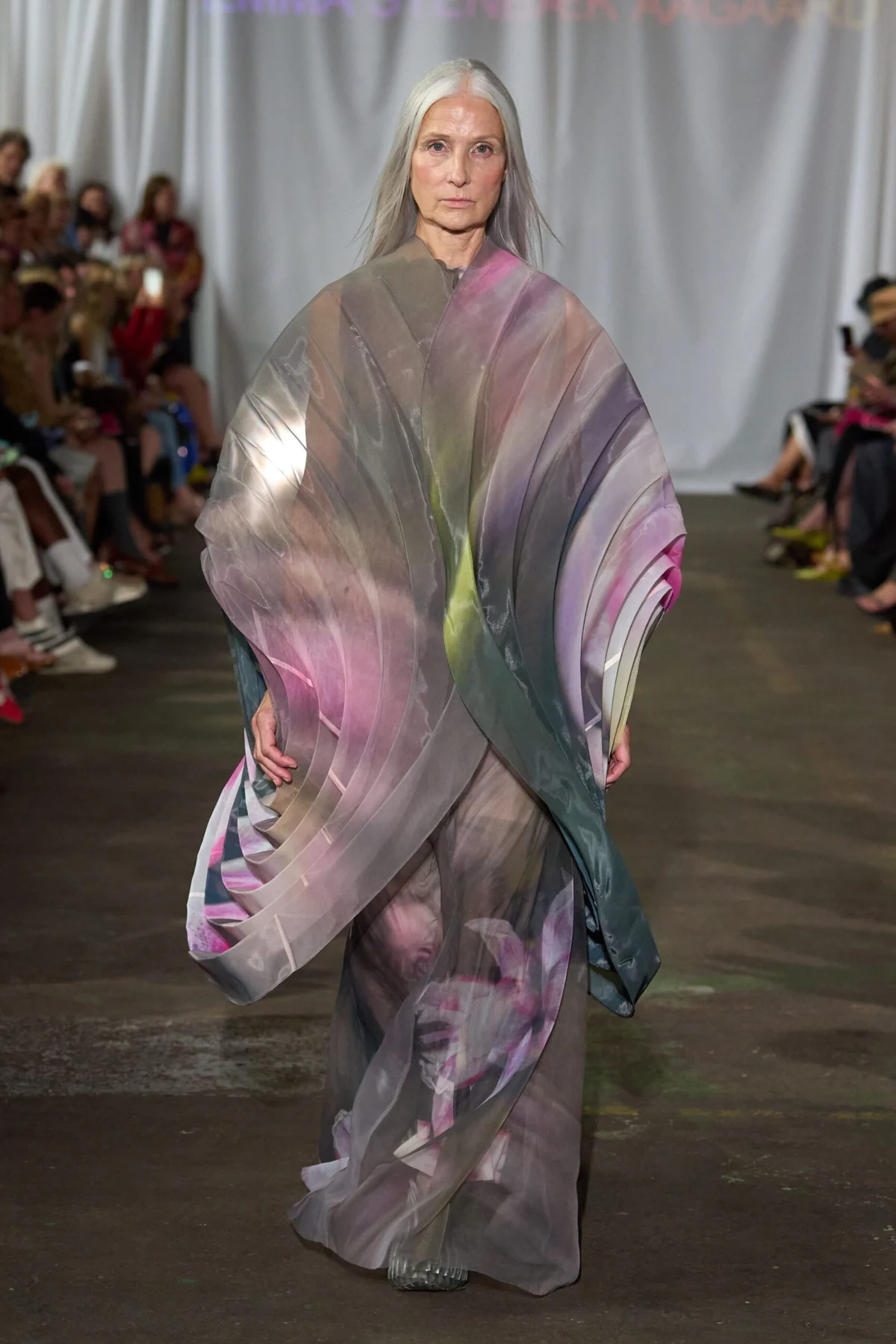
The Royal Danish Academy’s graduation showcase for the Class of 2026 has emerged as a pivotal moment for the Copenhagen Spring 2027 fashion cycle, signaling a profound shift toward value-driven aesthetics and an unapologetic embrace of chromatic vibrancy. Assistant Professor Marcus Aminaka Wilmont, overseeing this cohort, characterized the collective spirit of the graduates as one rooted in a passionate redefinition of "true value" within the medium of clothing. This transition toward extroverted, joyous shades mirrors a broader trend observed in recent international menswear collections, where seasoned designers and emerging talents alike have pivoted away from the somber palettes of previous seasons in favor of an uplifting, emotive use of color.
Geometric Foundations and Zero-Waste Methodologies
A significant portion of the Class of 2026 focused on the intersection of mathematics and materiality, utilizing geometric constraints to solve traditional problems of textile waste and garment structure. David Sierstad distinguished his collection through a rigorous application of zero-waste principles, a methodology that is becoming increasingly critical as the global fashion industry faces mounting pressure to reduce its environmental footprint. By basing his patterns exclusively on squares and rectangles, Sierstad eliminated the off-cut waste typically associated with curved pattern cutting. This approach not only addresses sustainability but also creates a unique architectural silhouette that challenges conventional draping.
In contrast to the linear rigidity of Sierstad’s work, Emma Stenbæk Aagaard utilized the circle as her primary structural unit. Her collection explored the kinetic potential of curved folds and pleating, resulting in garments that exhibited a "slinky-like" movement when in motion. This focus on circular geometry allows for a dynamic relationship between the wearer and the fabric, emphasizing the three-dimensional nature of the human form.
The exploration of form extended into more experimental territory with the work of Shurong Coa and Yu Lin Eain. Coa’s collection reimagined the garment as a "mobile home for the body," utilizing wrapped foam to create voluminous, snail-like structures. This work navigates the boundary between wearable art and soft architecture, questioning the traditional protective functions of clothing. Meanwhile, Yu Lin Eain drew inspiration from childhood nostalgia, specifically the folding techniques used to create paper "fortune tellers." By translating these complex, angular folds into fabric, Eain demonstrated how traditional origami principles can be adapted to create intricate, modular textures in high-fashion contexts.
The Reimagining of Masculinity: Country, City, and Subculture
Masculinity served as a central thematic pillar for three prominent members of the graduating class, each exploring the psychological and physical transition from boyhood to adulthood. A recurring motif among these designers was the dichotomy between rural origins and urban destinations—a narrative arc that reflects the lived experiences of many young creatives in the Nordic region.
Lukas Viering expanded on this narrative by introducing a third tension: the relationship between hand-craftsmanship and machine-led precision. His work showcased a sophisticated synthesis of these two worlds. One notable piece, a pair of sweatpants, featured over 400 laser-cut flowers in four distinct sizes. These were arranged in a meticulous degradé pattern, set by hand, and secured with industrial rivets. This juxtaposition of "Cecilie Bahnsen-esque" delicacy with rugged, functional hardware creates a poetic tension that redefines modern menswear. By pairing these ornate bottoms with draped knot tops, Viering challenged the traditional boundaries of masculine silhouettes, leaning into a more fluid and expressive aesthetic.
Nicolaj Gotthelf, who refined his craft through an internship with the acclaimed designer Duran Lantink, explored the concept of the "country kid" dreaming of distant subcultural movements. Gotthelf’s work is characterized by a heavy reliance on upcycled materials, which he uses to evoke a sense of nostalgia. By repurposing existing textiles, he links the act of creation to the preservation of memory, suggesting that the future of fashion lies in the creative reinterpretation of the past.
Nis Kongsgaard took a more historical approach to the theme of identity, grounding his menswear collection in the heritage of Danish textiles. His thesis was described as a search for "sensuous ties to Earth and kin," a response to a world that feels increasingly fragmented. By utilizing local materials and referencing historic weaving patterns, Kongsgaard created a collection that felt both grounded and urgent. Despite the existential weight of his thematic inspiration, the resulting garments were noted for their high degree of wearability and wholeness, offering a pragmatic yet poetic vision for the future of regional design.
Chronology of the Spring 2027 Showcase and Academic Cycle
The development of the Class of 2026 collections followed a rigorous three-year curriculum at the Royal Danish Academy, an institution renowned for its integration of traditional craft and avant-garde theory.
- Year 1 (2023-2024): Students focused on foundational technical skills, including pattern making, textile science, and the history of dress. This period established the geometric and material literacy evident in the final collections of Sierstad and Aagaard.
- Year 2 (2024-2025): The curriculum shifted toward conceptual development and internship placements. Nicolaj Gotthelf’s time with Duran Lantink during this phase was instrumental in shaping his approach to upcycling and subcultural commentary.
- Year 3 (2025-2026): The final year was dedicated to the graduation thesis. Students were tasked with synthesizing their personal philosophies into a cohesive collection. This culminated in the Spring 2027 showcase held in Copenhagen, where the industry first viewed the results of their three-year evolution.
The timing of this showcase is significant, as it coincides with the implementation of stricter sustainability mandates within the Copenhagen Fashion Week framework. The Academy’s emphasis on zero-waste and upcycling ensures that these graduates are prepared to enter a market where environmental compliance is no longer optional but a prerequisite for participation.
Data and Industry Context: The Rise of Sustainable Luxury
The focus on sustainability and value-driven design within the Class of 2026 is supported by broader industry data. According to recent market analysis reports, the sustainable apparel market is projected to grow at a compound annual growth rate (CAGR) of 9.1% through 2030. In the Nordic region specifically, consumer demand for "slow fashion" and transparency has outpaced global averages.
The use of local materials, as seen in Nis Kongsgaard’s collection, aligns with the growing "near-shoring" trend in the fashion supply chain. By reducing the carbon footprint associated with material transport and supporting local economies, designers are finding that "heritage" is as much an environmental strategy as it is an aesthetic one. Furthermore, the emphasis on hand-finishing—exemplified by Lukas Viering’s 400 hand-set flowers—caters to a luxury market that increasingly prizes the "human touch" over mass-produced uniformity.
Official Responses and Inferred Industry Impact
While formal reviews from the Spring 2027 season are still being synthesized, the initial reaction from faculty and industry observers has been one of cautious optimism. Assistant Professor Wilmont’s remarks regarding the "passion for true value" suggest that the Academy is successfully pivoting its pedagogy toward a more holistic definition of fashion—one that balances artistic expression with social and environmental responsibility.
Industry analysts have noted that the Class of 2026 represents a "post-minimalist" generation. After years of dominant "quiet luxury" and neutral palettes, the academy’s embrace of color and complex geometry indicates a desire for fashion to return to its role as a medium for joy and extroverted identity. This shift is expected to influence the commercial sector by 2028, as these graduates move into design roles at established houses or launch their own independent labels.
Broader Implications for the Future of Design
The Royal Danish Academy Class of 2026 showcase serves as a microcosm of the challenges and opportunities facing the global fashion industry. The work of these students suggests that the future of design will not be defined by a single aesthetic, but by a diverse array of responses to the "unravelling" of the modern world.
Whether through the mathematical precision of zero-waste patterns, the emotional resonance of upcycled subcultural attire, or the reimagining of masculinity through local heritage, these designers are seeking "wholeness" in an era of fragmentation. Their success in the Spring 2027 season highlights the enduring relevance of Copenhagen as a hub for innovation, where the next generation of talent is proving that sustainability and high-concept artistry are not mutually exclusive, but are instead the twin pillars of 21st-century value.

0 Comments