
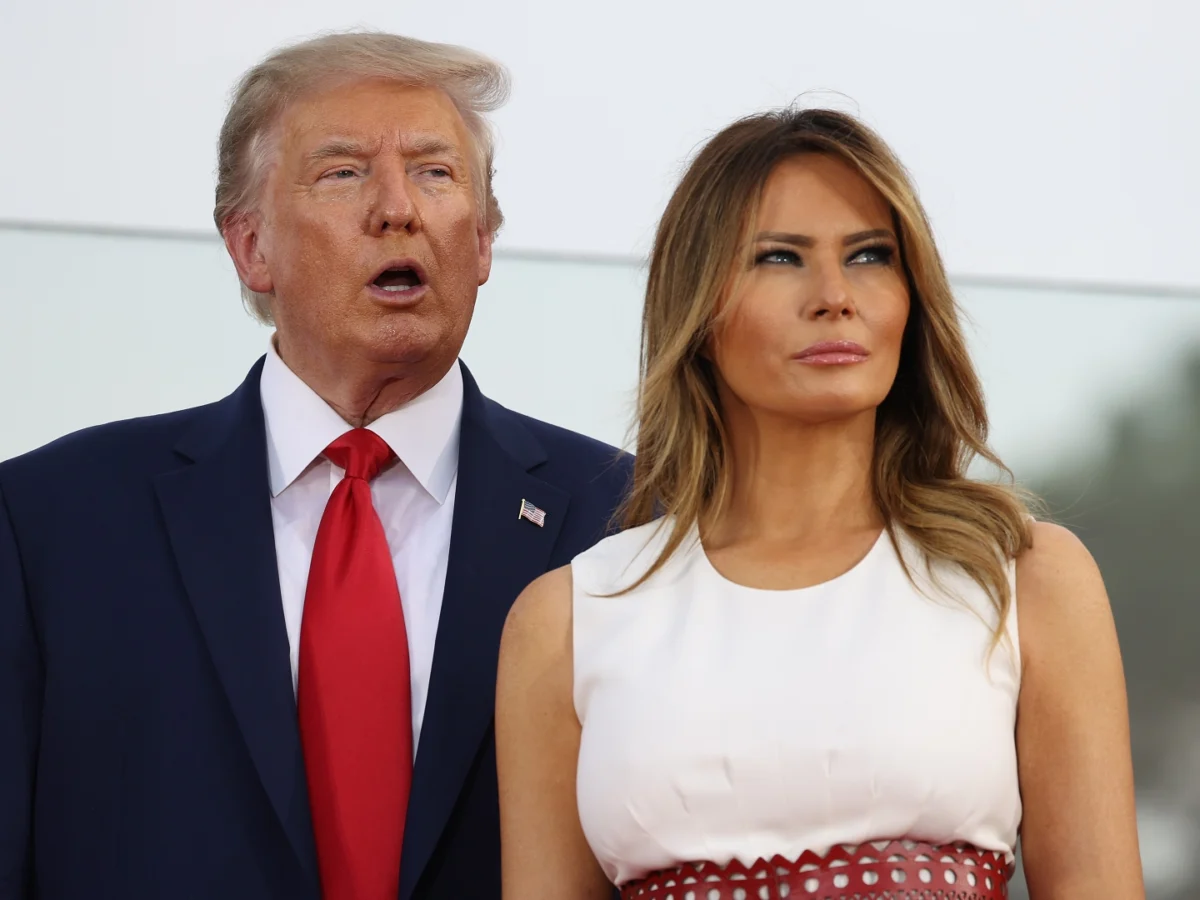
The Rose Garden of the White House served as the stage for a high-stakes display of political optics on August 20, 2026, as First Lady Melania Trump made a rare and pointed public appearance. Stepping out of a period of prolonged seclusion, Mrs. Trump joined President Donald Trump to promote her "Fostering the Future" initiative, an extension of her advocacy for children in the foster care system. While the official agenda focused on educational opportunities for aging-out foster youth, the subtext of the event was widely interpreted by political observers as a definitive reassertion of her status within the administration’s inner circle.
The First Lady’s appearance follows weeks of intense media scrutiny regarding her absence from the public eye and burgeoning reports of an internal "power struggle" involving Natalie Harp, a prominent senior aide to the President. By walking hand-in-hand with her husband to the podium, Mrs. Trump utilized the traditional imagery of the executive branch to project unity and authority, effectively silencing, for the moment, rumors of administrative displacement.
The Strategic Reappearance
Dressed in a patriotic ensemble of red and blue, the First Lady exhibited a degree of levity that stood in contrast to the often-stoic persona she maintained during the earlier years of the administration. Addressing the gathered press and guests, she opened her remarks with a self-aware nod to the speculation surrounding her whereabouts. "I heard you missed me," she said with a smile, prompting laughter from the audience. "Here I am."
This moment of humor was viewed by communications experts as a calculated move to reclaim the narrative. For much of the summer of 2026, headlines had been dominated by the "limited visibility" of the First Lady. Her return to the Rose Garden was not merely a ceremonial duty but a "power move," according to multiple political analysts, designed to demonstrate her continued influence over the President’s public image and the administration’s social agenda.
Notably absent from the event was Natalie Harp. Harp, a former host on the One America News Network (OANN), has become a constant presence by the President’s side, often traveling with him and managing his immediate media intake. The absence of the aide during a high-profile joint appearance by the President and First Lady was cited by sources within the West Wing as a significant indicator of the current internal hierarchy.
The Rise of Natalie Harp and the Leaked Correspondence
The backdrop to this appearance is a series of reports detailing the extraordinary influence Natalie Harp has wielded within the Trump administration. Harp first gained national attention as a "Right to Try" advocate before transitioning into a communications role where she became known for providing the President with a steady stream of positive news coverage and social media feedback.

On August 20, 2026, The Daily Beast published the contents of several letters written by Harp to the President, which painted a picture of deep personal and professional devotion. In one letter dated from 2023, Harp reportedly expressed a desire to return to a "synergy" where they could "talk about everything and nothing," lamenting that they "shouldn’t have to talk about work all the time."
Another correspondence revealed an intense level of loyalty, with Harp writing: "I never want to bring you anything but joy. I’m sorry I lost my focus. You are all that matters to me. I don’t want to ever let you down. Thank you for being my Guardian and Protector in this Life." These letters, characterized by some as "unsettling" in their intensity, have reportedly been a source of friction within the First Lady’s office.
Michael Wolff’s Analysis of the Secret Power Struggle
The tension between the First Lady’s office and the President’s personal staff was further illuminated by presidential biographer Michael Wolff. Writing in his Substack newsletter, Howl, Wolff alleged that Melania Trump has been engaged in a "secret power struggle" with Harp that dates back to the 2024 presidential campaign.
According to Wolff, the First Lady’s appearances during the campaign were "carefully negotiated and choreographed." He claimed that Mrs. Trump established a firm boundary: she would not appear at events where Harp was present. "Since Harp was always around, Melania never was—appearing with her husband only in the last week of the campaign," Wolff wrote.
This history suggests that the First Lady’s decision to headline the Rose Garden event was contingent on the exclusion of certain staff members, reinforcing the idea that her presence is a tool of negotiation and a signal of her terms of engagement with the administration’s daily operations.
Fostering the Future: The Policy Focus
Despite the surrounding drama, the stated purpose of the August 20 event was the "Fostering the Future" initiative. This program, which Mrs. Trump launched as a pillar of her broader "Be Best" legacy, aims to provide scholarships and career opportunities for children who are transitioning out of the foster care system.
The initiative focuses on three primary areas:

- Educational Grants: Partnering with private sector tech companies to provide tuition assistance for vocational and university programs.
- Mentorship Programs: Establishing a network of professionals to guide foster youth in life skills and career planning.
- Digital Literacy: Ensuring that foster youth have access to the hardware and software necessary to compete in the modern economy.
During her speech, Mrs. Trump emphasized the importance of providing a stable foundation for the approximately 20,000 young adults who age out of the foster care system annually in the United States. "Every child deserves the opportunity to achieve the American Dream," she stated. "Our goal is to ensure that these resilient young people have the tools they need to succeed independently."
A Chronology of Public Presence: 2024–2026
To understand the weight of the Rose Garden appearance, one must look at the timeline of Melania Trump’s public engagement over the last two years:
- Late 2024: Mrs. Trump makes a rare appearance in the final days of the presidential campaign, delivering a speech in Pennsylvania and attending the final rally.
- January 2025: She attends the Inauguration but remains largely out of the spotlight during the first 100 days of the new term, focusing on the relocation of her son, Barron, and the establishment of her private office.
- January 2026: The World Premiere of the documentary "MELANIA" is held at the Trump-Kennedy Center. The First Lady attends, marking one of her only major public outings of the year.
- Spring 2026: Reports begin to surface regarding the "Natalie Harp influence," coinciding with a total lack of public sightings of the First Lady for nearly eight weeks.
- August 20, 2026: The Rose Garden press conference marks her return to active policy advocacy and a public display of marital and administrative unity.
Broader Implications and Institutional Optics
The First Lady’s re-emergence is more than a human-interest story; it has practical implications for the Trump administration’s standing. Internal polling has historically shown that Melania Trump maintains high favorability ratings among key demographic groups, including suburban women, a cohort the administration is keen to court ahead of the 2026 midterm elections.
By re-engaging with "Fostering the Future," the First Lady provides a "soft power" counterweight to the more aggressive political rhetoric often associated with the West Wing. However, the reports of a "power struggle" suggest a fractured internal environment where the First Lady must compete for the President’s attention and the control of her own public narrative.
Political analysts suggest that the "I heard you missed me" remark was a message directed as much toward the internal staff as it was to the public. It signaled that while she may choose to be absent, her return is always on her own terms. As the administration moves into the latter half of the year, the frequency of Mrs. Trump’s appearances will likely serve as a barometer for the stability of the West Wing’s internal dynamics and the success of her efforts to marginalize competing influences within the President’s inner circle.

0 Comments