
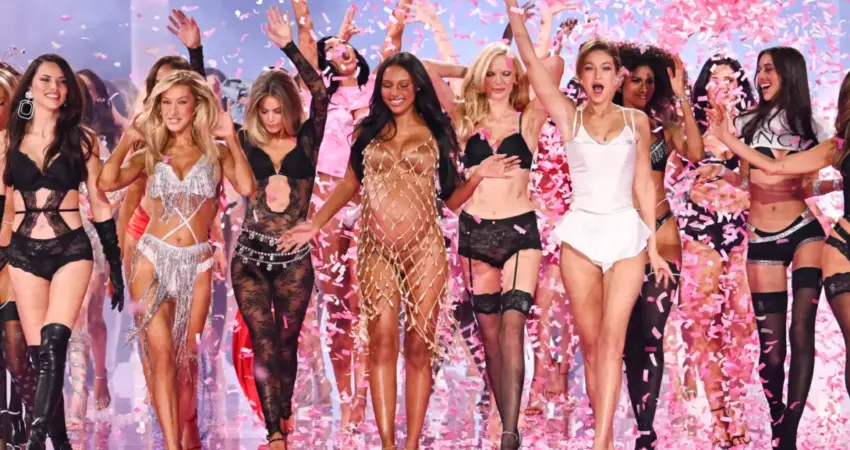
The Victoria’s Secret Fashion Show is scheduled to make its highly anticipated return on Sunday, Oct. 18, 2026, streaming globally via YouTube. This year’s event marks a significant milestone in the company’s ongoing effort to reclaim its cultural relevance while distancing itself from a decade defined by corporate scandal, executive controversy, and a perceived failure to adapt to evolving social norms. The 2026 lineup features a blend of legacy icons and modern trailblazers, including Gigi Hadid, Ashley Graham, Alex Consani, Paloma Elsesser, Adriana Lima, and Precious Lee. Accompanying the runway presentation is a high-profile musical roster featuring Katseye, Megan Moroney, Megan Thee Stallion, and Tate McRae. However, as the brand prepares for this latest iteration of its "fantasy" marketing, industry analysts and consumers alike remain focused on the institutional shifts following years of public relations crises.
For over two decades, Victoria’s Secret dominated the global intimate apparel market, reaching its zenith in the early 2000s when its annual televised special drew millions of viewers. However, the brand’s rigid adherence to a narrow definition of beauty—characterized by the "Angel" archetype—eventually led to a disconnect with a consumer base increasingly prioritizing inclusivity, body positivity, and ethical corporate governance. The journey from the brand’s 2019 cancellation of its runway show to the 2026 revival is a complex narrative of financial decline, leadership overhaul, and a fundamental restructuring of its brand identity.
The Shadow of the Epstein Connection
Perhaps the most damaging chapter in the company’s history emerged in 2019, when the ties between Leslie Wexner, the longtime CEO of Victoria’s Secret’s parent company, L Brands, and convicted sex offender Jeffrey Epstein became public. Epstein served as Wexner’s personal financial advisor for several decades, a relationship that granted Epstein unusual access to Wexner’s vast fortune and corporate sphere. According to investigative reports from The Wall Street Journal and The New York Times, Epstein’s influence extended into the modeling world, where he allegedly used his connection to the Victoria’s Secret brand to coerce aspiring models into sexual acts.
The fallout was immediate and severe. In July 2019, following Epstein’s arrest on federal sex trafficking charges, Wexner issued a memo to employees stating he had "completely severed" ties with Epstein in 2007 and was unaware of the illegal activities cited in the indictment. Despite these denials, the proximity of the brand to such a high-profile criminal case triggered a massive internal investigation and a loss of consumer trust. Wexner, who had built L Brands into a retail empire, eventually stepped down as CEO and Chairman in 2020. This leadership transition was the first step in what would become a total overhaul of the company’s executive suite, as the brand sought to decouple its image from the scandals of its founder.
Executive Rhetoric and the Diversity Crisis
While the Epstein scandal represented a legal and ethical crisis, the brand simultaneously faced a cultural reckoning. In 2018, Ed Razek, the then-Chief Marketing Officer of L Brands and the primary architect of the Victoria’s Secret Fashion Show, participated in an interview with Vogue that became a catalyst for the brand’s downfall. When asked about the lack of diversity on the runway, specifically regarding transgender and plus-sized models, Razek responded with comments that were widely condemned as exclusionary and transphobic.
Razek argued that the show should not include "transsexuals" because "the show is a fantasy." He further dismissed the growing demand for body diversity by defending the extreme fitness levels of the models, suggesting that the industry "skinny-shamed" the women who met the brand’s traditional standards. The backlash was swift, with competitors like Rihanna’s Savage X Fenty and Aerie seizing the opportunity to highlight their own inclusive casting and unretouched marketing.
The financial impact of this cultural tone-deafness was quantifiable. By late 2019, Victoria’s Secret’s market share in the U.S. had dropped significantly, and L Brands’ stock price reflected the investor anxiety surrounding the brand’s future. The 2019 fashion show was officially cancelled, ending a 24-year tradition. The company later issued a formal apology for Razek’s comments, and he departed the company shortly thereafter.
The Path Toward Inclusivity: 2019 to 2026
In the wake of the 2019 collapse, Victoria’s Secret embarked on a multi-year rebranding strategy. The "Angels" were officially retired in 2021, replaced by the "VS Collective," a group of women chosen for their achievements and advocacy rather than their physical measurements. This group included figures such as soccer star Megan Rapinoe, actress Priyanka Chopra Jonas, and model Valentina Sampaio, who in 2019 became the first transgender model to be featured in a Victoria’s Secret campaign.

The inclusion of Valentina Sampaio and, subsequently, Alex Consani, marked a definitive shift in the brand’s casting philosophy. Sampaio’s debut was followed by her historic appearance in the 2024 fashion show, an event she described as a moment of "pride and hope" for the next generation. Consani, a rising star in the fashion industry, has become a staple of the brand’s modern era, with scheduled appearances in both the 2025 and 2026 shows.
Parallel to its progress with gender identity, the brand addressed its long-standing "Perfect Body" controversy. The 2014 "Perfect Body" campaign, which featured only thin models, had been a PR disaster that many cited as the beginning of the brand’s decline. To rectify this, the company began integrating plus-sized models into its primary marketing and runway events. Ali Tate Cutler became the first size-14 model to appear in a campaign in 2019. By 2024, industry icon Ashley Graham made her Victoria’s Secret debut, though she admitted to initial hesitation. Graham’s participation was contingent on the brand’s commitment to extending its size range, a move essential for a company seeking to appeal to the average American consumer.
Financial Recovery and Market Repositioning
The structural changes at Victoria’s Secret were not merely cosmetic; they were a necessity for survival. In 2021, L Brands completed a spin-off, making Victoria’s Secret an independent, publicly traded company. This allowed the brand to focus entirely on its own recovery without the shadow of its former parent company’s baggage.
Data from the 2023 and 2024 fiscal years suggest that the rebranding efforts have begun to stabilize the company’s bottom line. While the brand no longer enjoys the near-monopoly it held in the early 2000s, it has retained a significant portion of the intimate apparel market by expanding its product lines to include maternity bras, mastectomy bras, and a wider array of "Body by Victoria" sizes. The 2026 show is viewed by market analysts as a "litmus test" for whether the brand can successfully merge its traditional glamour with its new-found commitment to diversity.
The 2026 Fashion Show: A Strategic Pivot
The decision to host the 2026 show on YouTube rather than traditional network television reflects a strategic pivot toward digital-first consumers. By moving away from the 42-minute "fantasy" special format and toward a more accessible, social-media-integrated event, Victoria’s Secret is attempting to meet younger shoppers where they spend their time.
The musical lineup for 2026—featuring Megan Thee Stallion and Tate McRae—is specifically curated to appeal to Gen Z and Millennial audiences. These artists are known for their messages of empowerment and self-expression, aligning with the brand’s revised mission statement. Furthermore, the inclusion of models like Paloma Elsesser and Precious Lee on the 2026 runway reinforces the message that the brand’s commitment to body diversity is a permanent fixture rather than a temporary trend.
Analysis of Implications for the Fashion Industry
The evolution of Victoria’s Secret serves as a case study for the broader fashion industry. It demonstrates the high cost of ignoring cultural shifts and the immense difficulty of rebranding an entity that was once the primary symbol of an exclusionary beauty standard. The 2026 fashion show represents a "middle ground" strategy: it retains the high-production value and celebrity allure that made the brand famous, but it attempts to filter those elements through a lens of modern social awareness.
However, challenges remain. Critics argue that the brand’s transformation is performative, noting that the retail stores still struggle to provide a truly inclusive shopping experience for all body types. Others suggest that by moving away from its "fantasy" roots, the brand risks losing the aspirational quality that originally drove its sales.
As the lights dim and the music starts on Oct. 18, 2026, the world will see a Victoria’s Secret that looks very different from the one that dominated the 1990s and 2000s. Whether this version of the brand can achieve the same level of cultural dominance remains to be seen, but the 2026 show stands as a definitive statement that the company has, at the very least, listened to its critics and chosen a path of adaptation over obsolescence.

0 Comments