
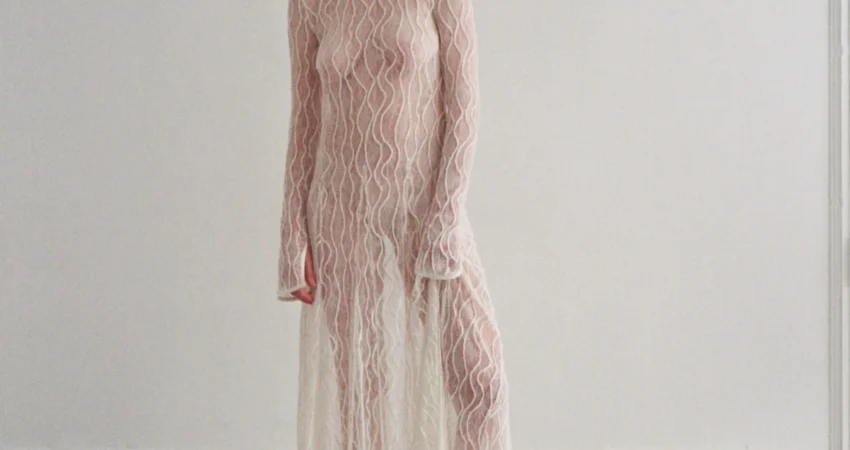
Stephen Biga, a designer whose pedigree includes tenures at some of New York’s most influential fashion houses, has unveiled his latest collection for Melusine, a brand that continues to carve out a distinct niche by merging historical romanticism with contemporary technical execution. For the Spring season, Biga has transitioned his focus from the tapestry-laden aesthetics of his previous work toward a more austere, yet emotionally resonant, interpretation of the Middle Ages. Drawing inspiration from the seminal 1928 silent film The Passion of Joan of Arc, the collection serves as a meditation on martyrdom, gender fluidity, and the enduring allure of chivalric aesthetics in a modern wardrobe.
The Mythological Foundation of the Melusine Brand
The brand’s identity is inextricably linked to the legend of Melusine, a figure from European folklore whom Biga first encountered during a visit to the Metropolitan Museum of Art. According to the 1393 records of French author Jean d’Arras, Melusine was a water nymph of the Lusignan lineage who married a mortal man on the condition that he never witness her during her Saturday baths. When the covenant was broken and her husband discovered her true form—part woman, part serpent or dragon—she transformed fully and fled.
This narrative of hidden identity and transformation provides the thematic backbone for Biga’s design philosophy. By naming his brand after a figure who navigated the boundaries between the human and the supernatural, the designer signals a commitment to clothing that explores the dualities of the wearer. Biga, a graduate of the Parsons School of Design, brings a refined technical background to this mythological framework, having honed his skills at Rodarte, Proenza Schouler, and Gabriela Hearst. These experiences are evident in the brand’s ability to balance avant-garde storytelling with the commercial viability required for a burgeoning luxury label.
Cinematic Martyrdom: The Influence of Theodore Dreyer
For the Spring collection, Biga pivoted from the "Unicorn Tapestry" themes of his Fall lineup to the stark, high-contrast world of Theodore Dreyer’s 1928 masterpiece, The Passion of Joan of Arc. The film is renowned for its revolutionary use of close-ups and its depiction of the psychological and spiritual agony of its protagonist. Joan of Arc, a historical figure who has long occupied a central place in the fashion lexicon, represents the ultimate "he/she" archetype—a woman who adopted masculine armor and cropped hair to fulfill a divine and military mission.
The resurgence of Joan of Arc in contemporary culture is noted by industry observers. In the past year alone, Icelandic filmmaker Hlynur Pálmason released a cinematic exploration of the saint, and director Baz Luhrmann is reportedly developing a new project centered on her life. Biga’s interest lies specifically in the subversion of gender norms that Joan embodied. By refusing to renounce her faith or her masculine attire even under the threat of death, Joan became a symbol of conviction that transcends time. In the collection, this manifests as a dialogue between the "lovely ladies" and "gallant knights" of the medieval era, blending soft drapery with silhouettes reminiscent of plate armor.
Technical Execution and Design Disruptions
Biga’s design process for the Spring season focused on tempering his natural inclination toward overt prettiness. To prevent the collection from becoming "overly sweet," the designer introduced several "disruptions" intended to add a sense of grit and realism. One of the primary techniques employed was the use of raw, unfinished edges. While Biga noted that some of these elements felt more contrived than organic during the initial design phases, they ultimately served to ground the more ethereal pieces.
The collection’s standout items include a jacket constructed from two layers of soft, bonded fabric, designed to be paired with the brand’s signature ruffed-ankle leggings. This juxtaposition of structured outerwear and delicate, feminine underpinnings reflects the broader "chivalry" theme. Additionally, the designer introduced a pair of trousers featuring a thin, burgundy inner belt. This detail was inspired by the "shoelace" belts prevalent in 1990s skateboarding culture, specifically those associated with Thrasher magazine. By integrating a 20th-century subculture staple into a medieval-inspired collection, Biga demonstrates an ability to synthesize disparate influences into a cohesive aesthetic statement.
Evolution of the Melusine Signature: Metallic Knits and Historical Prints
A hallmark of the Melusine brand is its "chain mail" dresses—metallic knit garments that offer the visual weight of armor with the fluid movement of silk. For the Spring season, Biga evolved this signature by introducing asymmetrical hemlines and a new cap-sleeve armor top. These pieces represent a "slow evolution" strategy, where the designer builds upon successful silhouettes rather than reinventing the brand’s visual language every six months.
Innovation was also present in the collection’s prints. Biga developed a bespoke pattern derived from a fabric swatch dating back to the 1700s. This print was applied to a poetic, bestselling blouse and a ruched dress that offers a sophisticated alternative to traditional slip dressing. The inclusion of an 18th-century reference within a medieval-themed collection highlights Biga’s broader interest in historical textiles and his skill in adapting archival motifs for a contemporary audience. Another notable addition was a hybrid T-shirt and cape, a garment designed for "making sweeping statements" while maintaining the ease of casual wear.
Market Context and Professional Trajectory
The trajectory of Stephen Biga’s career provides essential context for the development of Melusine. Having worked under the Mulleavy sisters at Rodarte, he was exposed to the fusion of high-concept storytelling and artisanal craftsmanship. His time at Proenza Schouler likely refined his understanding of modern, urban silhouettes, while his tenure at Gabriela Hearst emphasized the importance of sustainable luxury and high-quality fabrications.
Melusine enters the market at a time when "Neo-Gothic" and "Knight-core" trends are seeing a resurgence among luxury consumers. Data from fashion analytics firms suggest an increasing demand for "heritage-rich" brands that offer a narrative beyond simple aesthetics. By positioning Melusine as a brand rooted in myth and history, Biga appeals to a demographic that values intellectual depth in their wardrobe. Furthermore, the brand’s focus on "slow evolution" aligns with a growing industry movement toward seasonless dressing and reduced waste, as pieces from previous collections remain relevant and compatible with new releases.
Broader Implications and Cultural Resonance
The choice of Joan of Arc as a central muse carries significant weight in the current cultural climate. As the fashion industry continues to grapple with themes of gender identity and the breakdown of traditional binary categories, the figure of the female knight serves as a powerful historical precedent. Biga’s exploration of the "he/she" aspects of Joan’s attire reflects a broader shift toward androgyny in high fashion, where the boundaries between menswear and womenswear are increasingly blurred.
Furthermore, the collection’s reliance on historical film and literature points to a desire for escapism that is grounded in reality. Unlike the digital-first aesthetics of many contemporary labels, Melusine’s reliance on stained-glass filters, 14th-century myths, and 18th-century fabric swatches suggests a brand that is deeply invested in the tactile and the temporal.
Summary of the Spring Collection
The Spring collection from Melusine is a comprehensive exercise in thematic world-building. By drawing from the tragic beauty of Theodore Dreyer’s cinema and the mythological complexity of Jean d’Arras’s writings, Stephen Biga has created a body of work that is both intellectually rigorous and commercially astute. The key elements of the collection—the metallic knits, the 90s-inspired "shoelace" belts, and the raw-edged tailoring—function together to tell a story of resilience and romance.
As the brand continues to grow, Biga’s commitment to a "slow evolution" suggests that Melusine will avoid the pitfalls of trend-chasing, instead focusing on the refinement of its unique medieval-modern hybridity. In an industry often criticized for its superficiality, Biga’s Melusine stands as a testament to the power of history, film, and folklore to inform contemporary design. The collection not only pays homage to the martyrs and nymphs of the past but also provides a versatile, sophisticated wardrobe for the modern individual navigating their own complexities of identity and expression.

0 Comments