
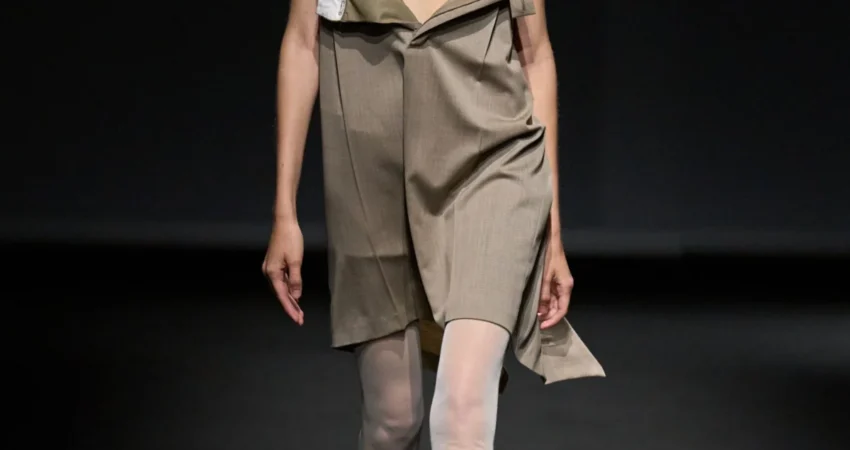
The MM6 Maison Margiela Spring 2027 Ready-to-Wear presentation recently concluded, offering a profound exploration of garment versatility and the subversion of traditional sartorial archetypes. In a season defined by a return to utilitarianism across the broader fashion landscape, the design collective at MM6—the contemporary sibling line to the house of Maison Margiela—presented a collection that did not merely redesign familiar garments but instead "persuaded" them to function in entirely new capacities. By manipulating proportions, closures, and points of entry, the house maintained the recognizable identity of wardrobe staples while radically shifting their utility. This methodology, long a cornerstone of the Margiela vocabulary, was executed with a notable lightness and a sense of experimental freedom that invited the wearer to engage in a conceptual "dressing-up game."
Technical Innovation and the Geometry of Dress
At the heart of the collection was a series of technical maneuvers that transformed the static nature of the wardrobe. A standard shirt, when folded into a precise square, was reimagined as a dress. Crucially, the garment did not lose its "shirtness"; rather, it gained a dual identity. This theme of duality extended to knitwear, where a sweater was repurposed as a skirt. To facilitate this transition, the studio introduced a "hip-paulette," a structural invention described as a cousin to the traditional epaulette. Positioned at the waist rather than the shoulder, the hip-paulette provided a crinoline-like volume, allowing the sweater-skirt to hold a structured, architectural shape that would otherwise be impossible with soft knit fabrics.
The collection’s spokesperson emphasized that these designs were intended to invite experimentation rather than demand a specific mode of wear. The philosophy was rooted in the "childhood pleasure of putting things on without worrying about where they were meant to go." This approach resulted in an aesthetic that was surprisingly delicate. While MM6 has historically prioritized conceptual deconstruction over conventional "prettiness," the Spring 2027 collection allowed a certain sweetness to emerge. This was evident in the doll-like proportions of tiny Henley tops, washed-out peacoats, and vintage-inspired shorts. Dresses were folded over themselves, intentionally revealing their internal construction and the mechanics of their assembly, thereby demystifying the luxury garment while heightening its intellectual appeal.
Menswear and the Rearrangement of Coordinates
The menswear segment of the collection applied these same instincts with a more literal, graphic execution. Standard tailoring was disrupted by migrating functional elements; collars and button plackets were shifted from the center of shirts to the side, creating an asymmetrical silhouette that challenged the eye’s expectation of balance. In a particularly subtle nod to deconstruction, the silk stripe of a tuxedo trouser was relocated to the interior of the leg, rendering a formal detail private and subversive.
Furthermore, the house’s signature low-crotch trouser underwent a significant evolution. For the Spring 2027 season, this traditionally baggy silhouette was slimmed down into a "decidedly skinnier proposition." The use of double belts and shifted proportions further reinforced the theme of items being "slightly out of place." Despite these conceptual shifts, the core of the wardrobe remained grounded in the ordinary: biker jackets, T-shirts, and tailored trousers. The innovation lay not in the invention of new items, but in the rearrangement of their coordinates, allowing each piece to reveal what the house called its "split personality."
The Semiotics of Six: Footwear and Branding
A standout moment in the presentation involved a collaboration with the Brazilian footwear brand Havaianas. In a move that turned the house’s numerical branding into a physical design problem, six Havaianas flip-flops were stacked atop one another, creating a footwear "mille-feuille." This "small monument" to the number six served as a meta-commentary on the brand’s identity. By taking a ubiquitous, familiar object and layering it into an absurdity, MM6 demonstrated its ability to make the mundane "just strange enough."
The choice of the number six is significant within the Margiela ecosystem. Since the brand’s inception, each line has been designated by a circled number on a white label. Line 6, which evolved into MM6, was originally conceived as the "essentials" line. By making the number six the literal foundation of the footwear—with six layers and six flip-flops—the design team highlighted their slightly obsessive relationship with their own history while maintaining a sense of humor.
Chronology and Context: The Evolution of MM6
To understand the impact of the Spring 2027 collection, it is necessary to look at the timeline of the MM6 line. Established in 1997 as a more accessible, "contemporary" counterpart to the main Maison Margiela line, MM6 has always focused on the "everyday" wardrobe. However, under the current design collective, the line has increasingly moved toward a high-concept exploration of "the anonymous."
- 1997: Launch of Line 6, later rebranded as MM6.
- 2014: John Galliano takes the helm of Maison Margiela, while the MM6 line continues to be designed by an anonymous collective, preserving the founder’s original ethos.
- 2020-2024: MM6 enters a series of high-profile collaborations (e.g., The North Face, Salomon), bringing deconstruction to a wider global audience.
- 2026: The house begins a pivot toward "joyful reality," moving away from the starker, more industrial themes of previous seasons.
- Spring 2027: The current collection solidifies this pivot, blending technical pattern-making with a playful, almost juvenile sense of discovery.
Market Analysis and Industry Implications
The Spring 2027 collection arrives at a pivotal moment for the luxury fashion industry. Data from recent market reports suggest a shift in consumer behavior toward "versatile luxury." According to industry analysts, the "contemporary luxury" segment, where MM6 resides, is projected to grow by 5.4% annually through 2030. Consumers are increasingly seeking garments that offer multiple styling options—a demand that MM6’s "shirt-as-dress" and "sweater-as-skirt" philosophy directly addresses.
Furthermore, the "joyful reality" described by the MM6 spokesperson aligns with a broader trend in the 2027 fashion cycle: a move away from "quiet luxury" and "minimalism" toward "expressive utility." As global economic pressures continue to fluctuate, designers are finding success by creating clothes that offer emotional value. The spokesperson’s comment that clothes should be "awfully jolly" reflects a strategic shift toward fashion as a form of psychological uplift.
Official Responses and Critical Reception
While the house of Margiela famously avoids traditional interviews, opting for collective statements, the industry response has been largely positive. Critics have noted that the collection manages to be intellectual without being inaccessible. A representative from a major luxury retail group remarked, "MM6 has successfully bridged the gap between avant-garde deconstruction and commercial viability. The Spring 2027 collection feels fresh because it doesn’t take itself too seriously, yet the technical skill involved in the pattern-making is undeniable."
Social media sentiment analysis also indicates a strong reception to the Havaianas collaboration, which went viral almost immediately following the show. The "mille-feuille" flip-flop is expected to be a major driver for the brand’s accessories division, appealing to a younger demographic that values both brand heritage and internet-ready "meme" aesthetics.
Conclusion: The Art of Misbehaving Correctly
The MM6 Maison Margiela Spring 2027 collection serves as a reminder that innovation does not always require the invention of the new. Sometimes, it simply requires a change in perspective. By allowing the existing wardrobe "a little more room to misbehave correctly," the design collective has created a collection that is both grounded in reality and delightfully incongruous.
The "hip-paulette," the migrated plackets, and the stacked footwear all point toward a future where the boundaries between garment categories are increasingly fluid. In a world that can often feel rigid and predictable, MM6’s insistence on the "pleasure of taking something utterly familiar and making it just strange enough" provides a compelling blueprint for the future of contemporary fashion. The collection does not just dress the body; it invites the wearer to participate in the ongoing evolution of the garment itself, ensuring that "reality" is anything but boring.

0 Comments