
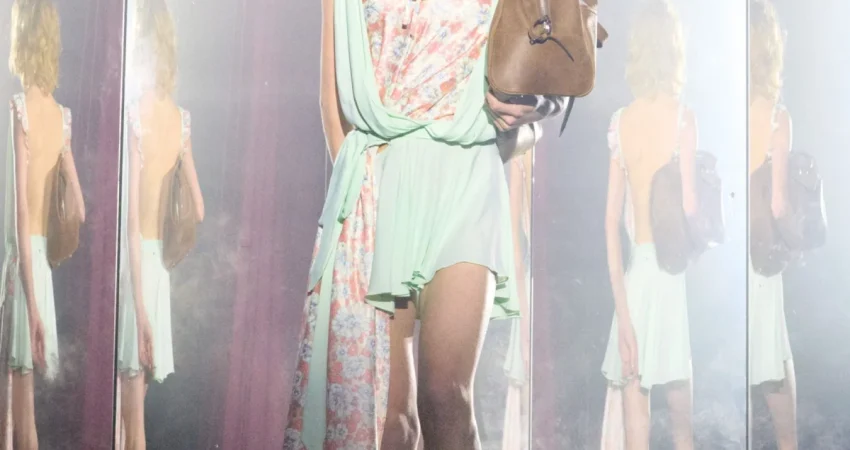
The fashion house August Barron, led by the creative duo Benjamin Barron and Bror August Vestbø, unveiled its Spring collection titled Walk of Fame at the historic La Cigale theater in Paris. This latest presentation marks a significant evolution for the brand, synthesizing the conceptual foundations laid in their previous seasons into a cohesive, high-spectacle event that bridged the gap between French cabaret traditions and the structured pageantry of American pop culture. The collection serves as a thematic successor to their Spring 2023 debutante-themed show at the Collège-lycée Jacques-Decour, transitioning from the localized innocence of a high school prom to the globalized, often fractured lens of Hollywood stardom.
The Architectural and Narrative Framework of Walk of Fame
The choice of La Cigale as a venue provided a storied backdrop for a collection preoccupied with the performance of identity. Originally opened in 1887, the theater has hosted everything from Jean Cocteau’s avant-garde productions to modern indie rock concerts, making it an appropriate site for a brand that frequently blurs the lines between fashion, performance art, and music.
Barron and Vestbø have established themselves as "character designers," a term used to describe their methodology of building collections around specific, often composite, female archetypes. In previous seasons, these figures included the "bored housewife" of a speculative Spring 2026 and the ambitious Tess McGill, the protagonist of the 1988 film Working Girl, for the Spring 2025 collection. For the Walk of Fame, the designers introduced a new iteration of this character: a fame hunter who exists simultaneously across multiple eras of the 20th and 21st centuries.
According to the designers, this season’s muse is a more mature, world-weary version of their previous iterations. "This character feels somehow a bit more mature and I feel like she’s dealt with the world a bit more. It’s not as naive," Vestbø noted in a pre-show briefing. The underlying emotional current of the collection was defined by a specific brand of "energetic melancholy"—a sadness that persists even amidst the glitz and high-tempo presentation of the runway.
Chronology of Influence and Cinematic Foundations
The development of the Walk of Fame collection involved an extensive deep dive into the history of Hollywood’s self-reflection. The designers cited a curated list of films that explore the darker underbelly of celebrity and the psychological toll of the spotlight. These influences included:
- Sunset Boulevard (1950): Exploring the delusion and isolation of fading stardom.
- They Shoot Horses, Don’t They? (1969): A depiction of the grueling, often dehumanizing nature of endurance-based performance.
- Cabaret (1972): Highlighting the intersection of decadence and impending social decay.
- All That Jazz (1979): A semi-autobiographical look at the physical and mental exhaustion of the creative process.
- Boogie Nights (1997): Examining the rise and fall of icons within a fringe industry.
By referencing these works, August Barron focused on the "decay of fame"—the moments when the gold plating of a public persona begins to wear away. This was translated into garments that represented the state of being "in between": the transition from auditioning to performing, or the frantic preparation for a show that may never actually commence.
Technical Execution and Design Specifications
The Spring collection utilized a diverse array of textiles and silhouettes to capture the "chaotic glam" aesthetic synonymous with the brand. A primary technical focus was the capture of motion within static cloth.
The Monroe and Garland References
One of the collection’s centerpieces was a dress designed to appear in a state of perpetual suspension. This garment served as a direct homage to Marilyn Monroe’s iconic subway grate scene in The Seven Year Itch (1955). Rather than a literal recreation, the dress utilized structural engineering to freeze the "upwind" movement of the fabric, symbolizing the frozen-in-time nature of cinematic immortality. Similarly, a ruby-studded dress paid tribute to Judy Garland, referencing the "Dorothy" archetype while subverting it through a more distressed, modern lens.
Sportswear and High-Fashion Hybridization
The collection integrated significant elements of activewear, reflecting the "constant readiness" required of modern celebrities.
- Footwear: Frederick’s of Hollywood-style platform heels were paired with striped gym socks, creating a visual tension between eroticized glamour and utilitarian athletic gear.
- Silhouettes: The show featured maillot shapes, hoodies paired with formal dresses, and glitzy tops worn with athletic shorts. This "Jane Fonda-ish" California influence suggested a character who is perpetually transitioning from a workout to a red-carpet event.
- Foundation Garments: Oversized bustiers were used to represent what Barron described as the "disconnect between what you want to become and what you are." These pieces highlighted the physical construction of the female form for public consumption.
Historical Homage and the "Bunny" Motif
The inclusion of wired bunny ears served as a specific nod to fashion history. The accessory was an homage to Marc Jacobs’s Fall 2009 collection for Louis Vuitton, famously worn by Madonna to the Metropolitan Museum of Art’s Costume Institute Gala that same year. By recontextualizing this "Playboy" motif, August Barron explored the recycling of cultural symbols and the way fame is often built upon the foundations of previous icons.
The Allina Project: A Multi-Media Expansion
In a move that broke the traditional "fourth wall" of a fashion show, August Barron extended the narrative of their fictional muse, Allina, into the music industry. Allina, described as an "imaginary pop star on the wane," was given a tangible presence through the release of a full-length album produced by the Norwegian indie pop duo Smerz (Catharina Stoltenberg and Henriette Motzfeldt).
The members of Smerz also participated as models in the runway show, further blurring the line between the creators and the characters they inhabit. This multi-media approach reflects a growing trend in the luxury sector where fashion houses act as content studios, producing music, film, and digital experiences to deepen the world-building of their collections. The "Allina" album serves as both a soundtrack to the collection and a standalone cultural artifact that critiques the ephemeral nature of the music charts.
Market Context and Industry Analysis
The success of the Walk of Fame show comes at a time when independent designers in Paris are increasingly tasked with competing against the massive marketing budgets of LVMH and Kering-owned heritage brands. August Barron’s strategy involves a high degree of narrative specificity that appeals to a niche, digitally-native audience.
Data and Impact Metrics
While private companies do not typically disclose specific sales figures, the brand has seen a steady increase in retail placement since its Spring 2023 "Prom" collection. Industry analysts note that the brand’s ability to generate "viral" moments—such as the Monroe-inspired "suspended" dress—is a key driver of brand equity in the current market. The integration of Smerz, who have a significant following in the electronic and indie music scenes, also expands the brand’s reach into the contemporary arts demographic.
The "character-driven" design philosophy aligns with the current consumer interest in "method dressing," a trend where individuals adopt the aesthetic of a specific character or archetype (a phenomenon seen recently in the marketing of films like Barbie and Challengers).
Broader Cultural Implications and Official Perspectives
The Walk of Fame collection addresses a contemporary psychological state often referred to as "Main Character Syndrome." In a digital landscape dominated by social media platforms like TikTok and Instagram, the gap between an individual’s curated image and their actual self has become a central part of the human experience.
Benjamin Barron noted that the show was intended to capture the "glitches" in this process. By glamorizing the moments of preparation, the sweat of the gym, and the melancholy of the "in-between," the designers offer a critique of the polished perfection often demanded by the digital world.
The collection has been received by critics as a "triumphant synthesis" of the designers’ work to date. Observers within the industry have highlighted the duo’s ability to handle complex themes like the "decay of fame" without descending into cynicism. Instead, they find a "star-dusted" quality in the human struggle to achieve and maintain status.
As the fashion industry continues to navigate a post-pandemic landscape, collections like August Barron’s Walk of Fame suggest a shift toward more introspective, story-heavy presentations. By moving away from mere garment production and toward the creation of comprehensive cultural narratives, Barron and Vestbø are positioning their brand as a significant voice in the dialogue between fashion, celebrity, and the enduring mythos of Hollywood. The show at La Cigale stands as a testament to the power of fashion to not only clothe the body but to document the evolving anxieties of the modern "main character."

0 Comments