
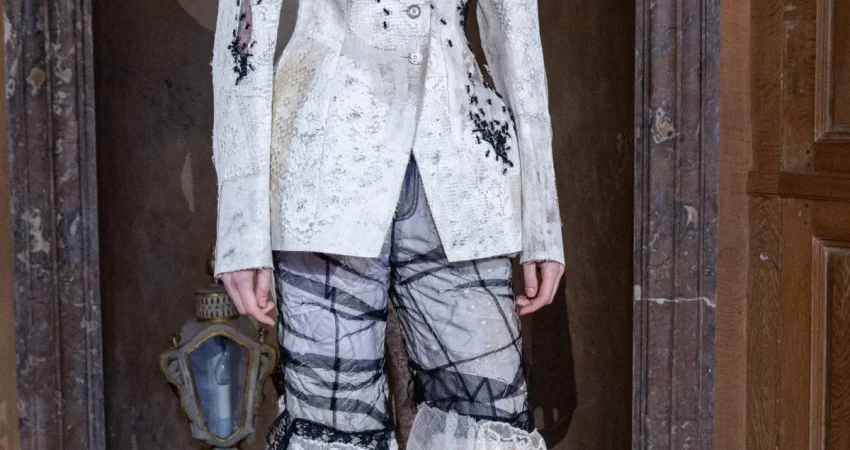
The fashion industry witnessed a profound shift in narrative during the recent presentation by designer Caroline Hu, who transformed a historic Parisian hôtel particulier into a space of contemplative storytelling and avant-garde craftsmanship. Moving away from the conventional runway format, Hu utilized the concept of tableaux vivants to showcase a collection that explored the intersection of childhood innocence, the inevitability of damage, and the hopeful process of rebuilding. The presentation, set against the backdrop of faded architectural grandeur, served as a commentary on the difficulty of maintaining romanticism in a modern world characterized by increasing complexity and visible fracture. Through a meticulously curated environment featuring bears, insects, and unfinished garments, Hu presented a vision where fragility is not a point of failure but a foundation for a new kind of beauty.
The event took place in an aging aristocratic residence, where models were positioned as living installations, appearing as characters caught in a frozen moment of a fairy tale. This stylistic choice allowed attendees to observe the intricate details of the garments up close, emphasizing the labor-intensive techniques that have become the hallmark of Hu’s brand, Reverie. The collection moved beyond mere aesthetic appeal, positioning itself as a psychological exploration of how individuals navigate a world that often feels hostile to the concept of the "ideal." By integrating elements of decay—such as broken walls and embroidered insects—with traditional symbols of romance like lace and roses, Hu challenged the traditional boundaries of high-fashion storytelling.
Historical Context and Designer Evolution
Caroline Hu’s rise in the fashion world has been marked by a consistent dedication to artisanal techniques and emotional depth. A graduate of Central Saint Martins and Parsons School of Design, Hu first gained international recognition as a finalist for the LVMH Prize and the BoF China Prize in 2019. Since the inception of her label, she has been noted for her ability to translate complex human emotions into textile art. Her previous collections often focused on the "reverie"—a state of being pleasantly lost in one’s thoughts—but the latest collection suggests a more grounded, albeit still fantastical, evolution of this theme.
While earlier works focused on the pure abstraction of romanticism, this latest iteration acknowledges the presence of "ugliness and cruelty" as an inescapable reality. This shift aligns with a broader movement in the luxury fashion sector where designers are increasingly using their platforms to address themes of resilience and mental health. According to industry analysts, the "post-pandemic aesthetic" has seen a 25% increase in the use of deconstructed and reconstructed garments, reflecting a collective societal effort to "put the pieces back together" following global instability. Hu’s work stands at the forefront of this movement, utilizing high-concept dressmaking to provide a physical manifestation of recovery.
The Chronology of the Presentation
The presentation was structured to lead viewers through a narrative arc of departure, discovery, and eventual synthesis. The sequence began with garments that suggested a departure from safety, utilizing pale, fragile surfaces and delicate lace that evoked a sense of childhood purity. As visitors moved through the various rooms of the hôtel particulier, the designs became increasingly complex and "damaged."
The middle phase of the presentation introduced the concept of the "magical mirror" and the "hidden passage," represented by more structured but fractured silhouettes. It was here that the presence of the "love letters" became prominent. These letters, some of which contained words of encouragement written by the designer to herself, were embroidered directly into the fabric using contrasting black and red threads. This phase symbolized the confrontation with reality and the acknowledgment of personal and external struggles.
The final stage of the exhibition focused on the "rebuilt" world. The garments in this section were characterized by heavy patchwork and the assembly of disparate materials. A standout piece included a black coat constructed from multiple, seemingly unrelated fabrics, and an evening dress that utilized deconstructed lace and floral patterns to create a new, cohesive whole. This progression mirrored the designer’s stated goal of building a "new world" that is positive and hopeful, despite its imperfections.
Materiality and Technical Analysis
The technical execution of the collection provided the necessary substance to ground Hu’s romantic themes. Hu is known for her mastery of smocking, shirring, and textile manipulation, often creating fabrics that appear to be floating or suspended in air. In this collection, these techniques were used to create "tension" between the delicate and the durable.
- The Use of "Infestation" as Ornamentation: One of the most discussed elements of the collection was the inclusion of tiny beaded ants on a rigid jacket. In traditional fashion, insects are often viewed with a sense of gothic dread; however, in Hu’s narrative, they represented the persistence of life and the reality of time. The meticulous beadwork required over 100 hours of labor per garment, highlighting the brand’s commitment to "slow fashion" and artisanal value.
- Reconstructive Patchwork: The patchwork fabrics were not merely decorative but served as a metaphor for resilience. By persuading different lives (represented by different fabric histories) to coexist, Hu demonstrated a sophisticated understanding of composition. Data from luxury retail platforms suggests that "upcycled-look" high-end garments have seen a 15% growth in market interest among Gen Z and Millennial luxury consumers, who value the narrative of sustainability and history.
- The Palette of Resilience: The color story moved from virginal whites and creams to somber blacks, punctuated by the "blood-red" of the embroidered love letters. This palette reinforced the idea that the "princess" in this fairy tale had survived a "difficult childhood," emerging with a wardrobe that was as much armor as it was ornament.
Industry Reactions and Market Implications
Initial reactions from fashion critics and buyers have been largely positive, noting that Hu has successfully carved out a niche that balances the commercial needs of luxury wear with the creative demands of wearable art. "Hu’s ability to make fragility feel like a position of strength is what sets her apart in a crowded market," noted one senior fashion editor during the post-show reception.
The collection arrives at a time when the global luxury market is experiencing a shift toward "emotional durability." Consumers are increasingly looking for pieces that offer a narrative connection rather than just brand recognition. Market data from 2023-2024 indicates that independent designer brands that emphasize "storytelling and craftsmanship" have maintained a more stable growth rate (approx. 4.2%) compared to some legacy brands that have struggled with "brand fatigue."
Furthermore, the "tableaux vivants" presentation style is being viewed as a strategic move to lower the environmental impact of a traditional runway show while increasing digital engagement. Static presentations allow for high-quality, detailed photography that performs exceptionally well on visual-centric social media platforms, potentially reaching a wider audience than a fleeting 10-minute runway walk.
Broader Impact: Romance as a Method of Remaking Reality
The significance of Caroline Hu’s latest work lies in its refusal to surrender to melancholy. While the collection acknowledges damage, it does not dwell on it. Instead, it proposes that the act of creation is, in itself, an act of hope. By stating that she is "trying to build a new world," Hu positions the designer as a reconstructor of the social and emotional landscape.
This approach has broader implications for the future of fashion design. It suggests that the role of the designer is evolving from a mere trendsetter to a cultural commentator who provides the tools for emotional navigation. The "princess after a difficult childhood" is a relatable archetype for a generation that has faced global health crises, economic instability, and environmental concerns.
In conclusion, Caroline Hu’s presentation was more than a display of new garments; it was a manifesto on the necessity of beauty in a fractured world. By integrating lace and love letters with ants and broken walls, she demonstrated that romance is not an escape from reality, but a sophisticated method of remaking it. As the fashion world continues to grapple with its identity in a changing global climate, Hu’s vision of active fragility and hopeful reconstruction offers a compelling and commercially viable path forward. The collection serves as a reminder that even when the fairy tale goes wrong, the pieces can be gathered, embroidered, and transformed into something entirely new and undeniably beautiful.

0 Comments