
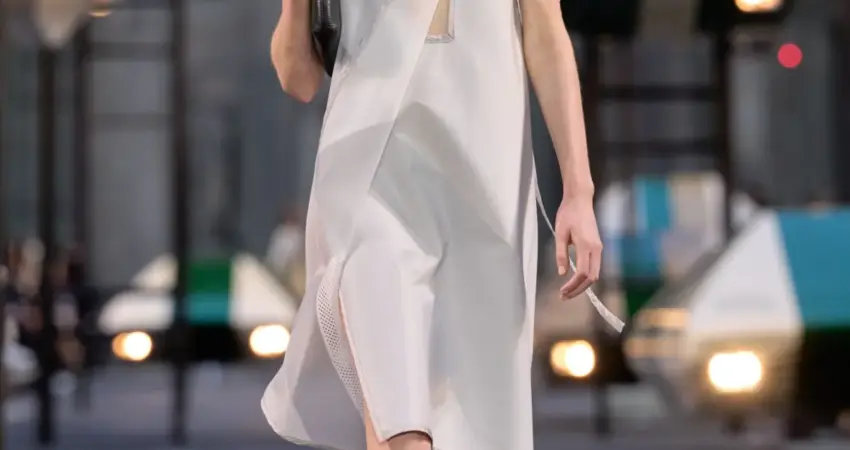
The Cour Carrée of the Louvre served as the backdrop for a significant shift in the creative trajectory of Louis Vuitton’s womenswear during the Spring 2027 presentation. While the set design featured a futuristic landscape reminiscent of mid-century space-age aesthetics—complete with flying vehicles bearing the iconic Damier check and glowing red tail lights—the collection itself marked a departure from the grand, experimental silhouettes that have defined Nicolas Ghesquière’s recent tenure. The designer, who has spent over a decade at the helm of the French maison, introduced a philosophy he described as "ergonomic," prioritizing a body-first approach that emphasizes wearability and purity of form over theatrical volume.
A Strategic Departure from Architectural Volume
For several seasons, Ghesquière has utilized the Louis Vuitton runway to explore expansive, out-of-time silhouettes. His recent portfolios have included traditional shepherd’s cloaks, 18th-century pannier-inspired dresses, and the dramatic, desert-ready robes of the Resort 2023 collection. However, for Spring 2027, the designer pivoted toward a more grounded reality. This transition was signaled by the opening look: a sleeveless white shift dress paired with black men’s oxfords. This ensemble set a tone of restraint that permeated the entire collection, moving away from the "larger than life" proportions that had become his signature.
According to Ghesquière, the intent behind this collection was to achieve a "sensation of simplicity" and a "feeling of purity." While the visual result appeared minimalist, the designer noted that the technical construction required to achieve such lightness and simplification was remarkably complex. The collection featured collarless jackets, straight-leg trousers designed with uniform-like efficiency, and layered chiffon dresses with delicate lettuce edges. The emphasis was on the movement of the fabric, particularly in checked pantsuits that were engineered to move with the fluidity of flou—a dressmaking technique usually reserved for soft, feminine draping.
The Political and Cultural Context of the Ghesquière Era
The Spring 2027 show arrived on the heels of a significant personal and professional milestone for the designer. Just one week prior to the presentation, Nicolas Ghesquière was awarded the Legion d’Honneur, France’s highest order of merit, by President Emmanuel Macron. The ceremony, held at the Élysée Palace, underscored the designer’s integral role in the French cultural and economic landscape.
Ghesquière’s relationship with the French first lady, Brigitte Macron, has been a defining element of his tenure at Louis Vuitton. Having dressed her since the President’s first election, the designer has become synonymous with modern French state style. During the award ceremony, President Macron highlighted this close professional bond, jokingly referring to Ghesquière as the "second man" in the First Lady’s life. This political proximity reflects the broader importance of Louis Vuitton as a cornerstone of the LVMH portfolio, which serves as a major driver of the French luxury sector.
Historical Chronology: From Balenciaga to the Future of Vuitton
To understand the significance of the Spring 2027 collection, it is necessary to examine Ghesquière’s historical trajectory. The designer first gained international acclaim during his tenure at Balenciaga, where he was credited with reviving the house through a blend of historical reference and futuristic innovation. Notably, 2027 marks the 20th anniversary of his iconic "C3PO" gold leggings, a piece that epitomized his fascination with science fiction and rigid, robotic structures.
Since joining Louis Vuitton in 2013, Ghesquière has successfully balanced the brand’s heritage as a luggage manufacturer with his own avant-garde sensibilities. In late 2023, LVMH announced the renewal of Ghesquière’s contract for another five years, signaling the conglomerate’s confidence in his ability to maintain the brand’s momentum. The Spring 2027 collection represents a maturation of this relationship—a move toward "wearable Ghesquière" that aligns the brand’s high-fashion output with the practical demands of its global clientele.
Industry Data and the "Great Reset" of Luxury Fashion
The shift toward a more relatable and customer-oriented collection is not an isolated event but rather a reflection of broader trends within the luxury fashion industry. Analysts have noted a "great reset" occurring across major fashion houses, driven by changing consumer behaviors and economic pressures. As a new generation of creative directors takes the lead at various heritage brands, there is an increasing emphasis on grounded, unstudied clothing that resonates with a market seeking longevity and versatility.
Market data from the previous fiscal year indicates a cooling in the rapid growth of the luxury sector, particularly in key markets like China and North America. In response, many brands are refocusing on "quiet luxury" or "investment dressing"—pieces that offer high aesthetic value without the ephemeral nature of trend-heavy designs. Louis Vuitton, as the world’s largest luxury brand by revenue, is uniquely positioned to lead this shift. By delivering a collection that is both technically sophisticated and highly wearable, Ghesquière is addressing the pragmatic needs of the modern luxury consumer while maintaining the brand’s aspirational status.
Technical Innovations and Key Pieces
Despite the minimalist aesthetic, the Spring 2027 collection showcased several technical innovations that highlight the craftsmanship of the Louis Vuitton ateliers. Key highlights included:
- Hammered Satin Tanks: These elongated evening tops featured extended trains, providing a sense of drama without the weight of traditional evening wear.
- Fluid Tailoring: The use of lightweight fabrics in traditional tailoring allowed for a hybrid silhouette that combined the structure of a suit with the ease of loungewear.
- Ergonomic Footwear: The choice of oxfords and flat shoes over high heels further emphasized the theme of practicality and movement.
- Refined Textures: The collection utilized intricate layering and fabric treatments, such as the lettuce-edged chiffon, to create visual depth in otherwise monochromatic or subtly patterned looks.
Ghesquière’s focus on the "ergonomic" aspect of fashion suggests a deep dive into how garments interact with the human body in motion. This approach aligns with a growing interest in functional luxury, where the value of a garment is measured by its comfort and adaptability as much as its visual impact.
Broader Impact and Implications for the Maison
The Spring 2027 collection suggests a strategic pivot for Louis Vuitton. By streamlining the aesthetic and focusing on the "essential," the brand is reinforcing its position as a provider of a complete lifestyle wardrobe. This move may also be seen as a way to differentiate the womenswear line from the high-energy, pop-culture-infused menswear collections led by Pharrell Williams. While the menswear division often focuses on spectacle and cultural cross-pollination, Ghesquière’s Spring 2027 output offers a sophisticated, disciplined alternative.
Furthermore, the collection’s focus on simplicity serves as a response to what Ghesquière described as the "chaos of the world around us." In times of global instability, fashion often retreats into two extremes: escapist fantasy or protective realism. With this collection, Ghesquière has chosen the latter, offering a sense of order and purity through meticulous design.
As the fashion industry continues to navigate a complex economic landscape, the success of the Spring 2027 collection will likely be measured by its commercial performance and its influence on the "wearability" trend. For Ghesquière, this season marks a successful evolution, proving that even a designer known for his futuristic visions can find profound inspiration in the most down-to-earth realities. The "ergonomic" shift does not signal a lack of ambition; rather, it represents a highly calculated refinement of the Louis Vuitton identity for a new era of luxury consumption.

0 Comments