
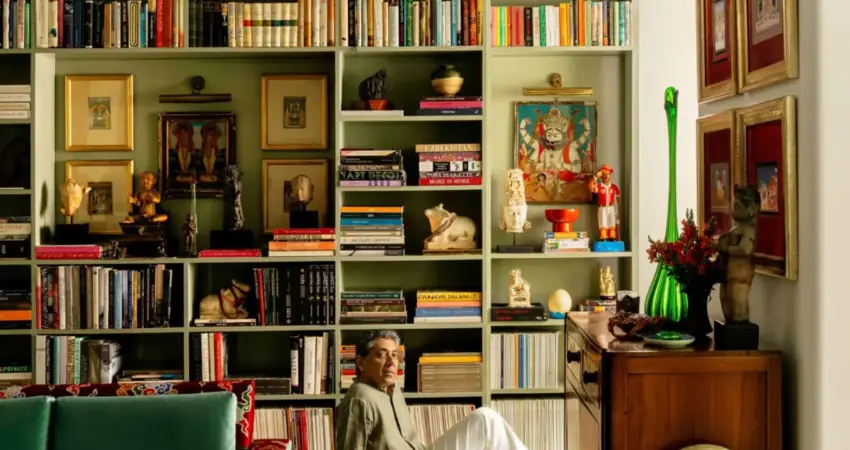
When one possesses a global perspective, as Vikram Goyal undoubtedly does, the creation of a new home becomes an endeavor steeped in rich possibility, transcending the limitations of a mere design brief. Goyal, a distinguished furniture designer and self-proclaimed "craft revivalist," has meticulously cultivated an expansive personal image bank throughout his life. As the creative force behind Vikram Goyal Studio and Viya, his influence extends to a global clientele, a testament to his artistic vision and entrepreneurial spirit. His journey into the realm of design was not a direct one; it was a path forged through diverse experiences and intellectual pursuits.

A Foundation in Economics and a Flair for Aesthetics
Goyal’s formative years were spent in New Delhi, the city he now calls home. His academic pursuits at Princeton, where he studied economics, offered him an unexpected exposure to the power of design. He found himself captivated by the Venetian-Gothic architecture of the university’s student center, an aesthetic that clearly resonated with him. Even in the utilitarian setting of his dorm room, he infused it with a distinctive flair, adorning it with block-printed textiles and silk lampshades, a playful rebellion against the conventional. He humorously recalls it as "probably the only decorated room on the entire quad."
His early career as an economist in Manhattan provided further opportunities to immerse himself in artistic expression. He frequented the hallowed halls of the Frick Collection, absorbing the masterpieces of art and design. A subsequent two-year tenure in Hong Kong led him to discover the China Club, a luxurious establishment conceived by the late David Tang. This opulent evocation of a 1930s Shanghai nightspot became a cherished "second living room," a space where he could appreciate and draw inspiration from an era of refined elegance and sophisticated social engagement. These experiences, spanning academia, global finance, and cultural immersion, laid the groundwork for his unique design philosophy.

The Allure of a Historic Neighborhood
The discovery of a villa in the heart of New Delhi marked a significant turning point for Goyal, drawing him back to his roots and a neighborhood that held deep personal resonance. This particular enclave, nestled between the historical grandeur of Delhi’s Old Fort and the majestic Humayun’s Tomb, is a location Goyal considers among India’s most architecturally significant. The area, integrated into the axial grid masterfully planned by architect Sir Edwin Lutyens, boasts a tranquil green quarter established in the early 1950s. It was within this serene setting that Goyal found his new home, a space that offers both centrality and a welcome respite from the city’s energetic pulse. "It’s central, but it’s not part of the hullabaloo," Goyal explains, emphasizing his profound appreciation for "serenity and quiet."
Unveiling the Art Deco Gem
The three-story stucco villa, Goyal discovered, was originally conceived in the Art Deco style, a design movement that found a distinct expression in India during the late 1920s. While grand palaces like Jodhpur’s Umaid Bhawan and the New Palace in Morbi exemplified the style’s opulence for Indian royalty, it was the proliferation of Art Deco in movie palaces and restaurants that truly popularized its "fizzy" aesthetic. Post-independence in 1947, Art Deco also served as a convenient symbol of modernity, a stylistic influence that continued to permeate Indian design for years to come.

A Harmonious Dialogue Between Past and Present
Upon commencing work on the villa, Goyal recognized its inherent narrative potential. The entry staircase, with its distinctive clef-shaped railings and steps clad in a striking matcha-colored terrazzo, immediately set a dramatic tone. "When I walked up the stairs the first time, I was like, ‘My gosh! I try to be bold with my interiors, but I couldn’t have imagined this,’" Goyal recalls, acknowledging the staircase’s unexpected grandeur. To amplify the sense of glamour, Goyal meticulously outlined the walls and windows with jet-black molding, creating a refined "tuxedo-piping effect" that lends a sophisticated edge to the spaces.
The interior renovations were approached with a light touch, focusing on essential repairs and expanding the kitchen and one of the two dining rooms. Goyal’s primary focus was on the furnishings, where he allowed his creative impulses to flourish. His objective was to weave a new narrative, harmonizing his extensive collection of art and objects with the villa’s bold architectural framework and its unusually high ceilings—a rarity in Delhi due to stringent height restrictions, often reaching 12 feet.

A Curated Collection: A Fusion of Indian Heritage and Global Influences
Goyal’s approach to furnishing his home is a masterclass in curated eclecticism, a deliberate fusion of his Indian heritage with a discerning global aesthetic. In the first-floor study, a Forged floor lamp and a Red Earth side table, both from Viya, stand beside an Indian tufted armchair. Botanical paintings sourced from Rome add a touch of European botanical artistry, while a 20th-century Anglo-Indian teakwood desk grounds the space with its historical gravitas. A Tabriz rug provides a rich foundation of intricate pattern and color.
The ground-floor living room is a testament to Goyal’s ability to blend diverse cultural elements. A 20th-Century Shatrunjaya Pata textile serves as a striking focal point, flanked by Vikram Goyal Studio’s Serpent’s Gaze and Crocodile’s Vigil mirrors, which add a touch of the exotic and artisanal. A Mohenjo Daro side table by Viya introduces an artifact from the ancient Indus Valley Civilization, bridging millennia.

Family heirlooms play a significant role in the villa’s narrative. A wooden chair inherited from Goyal’s grandfather, an artifact that carries whispers of a bygone era, is a cherished piece in the ground-floor main entry. Beside it rests a marble bust of Goyal’s maternal ancestor, the Late Rai Pannalal Mehta, a subtle yet powerful connection to his lineage. The Aravali bronze door handle by Viya adds a touch of contemporary craftsmanship to this historically rich tableau.
In the first-floor library, a collection of 20th-century Indian miniature paintings, also passed down through his family, adorns the walls. These intricate works, steeped in tradition, offer a glimpse into the artistic legacy that has shaped Goyal’s sensibility. A Samarkand carpet on the floor provides a vibrant and historically resonant base.

The Art of Storytelling Through Design
Goyal’s design philosophy is deeply rooted in storytelling, a narrative that unfolds through his meticulously chosen pieces. A Pichwai textile painting, another treasured family heirloom, commands a significant presence in the first-floor study, reflecting his enduring fascination with the animal kingdom. This passion is further articulated in his design work.
The dining rooms are designed to foster an atmosphere of convivial gathering and artistic appreciation. In one, a Bagh Chandelier by Vikram Goyal Studio casts a warm glow over the space. Viya’s Under the Banyan candleholders adorn the brand’s Red Earth dining table, creating an intimate and elegant setting. The rich, red-lacquered walls of this dining room are further enhanced by Gujarati mirrors, which amplify the light from Goyal’s candlesticks, creating an almost theatrical ambiance, a deliberate departure that Goyal admits might lean more "Venetian than Indian—but that’s not such a bad thing."

In a second dining room, Goyal’s Garden of Life wall panels, a collaboration with de Gournay, depict animals of the Silk Road rendered in opulent gold and bronze. This theme is echoed in the cast-bronze base of Goyal’s dining table and in the ornaments and repoussé accessories from Viya, his lifestyle brand. Adding a touch of historical intrigue are a set of chairs from Goyal’s grandfather. These chairs, a fascinating amalgamation of English Arts and Crafts, Viennese Secession, and chinoiserie, possess a curious lineage. Goyal recalls how visitors to his family’s Jaipur home would often remark on their resemblance to the work of Charles Rennie Mackintosh, a comparison he and his family were initially unaware of.
A New Collection Inspired by Ancient Narratives
Goyal’s creative endeavors extend beyond his personal residence. His recent debut in London showcased a new collection of furniture, wall panels, and decorative objects. This collection drew significant inspiration from the Ramayana, the epic saga of loyalty, friendship, and sacrifice. Pieces included furniture adorned with monkey motifs, carpets featuring turtle patterns, and vessels embellished with jasmine, all reflecting the rich tapestry of Indian storytelling. This aligns with his broader artistic direction, as he states, "I’m doing a lot of Indian storytelling these days," a sentiment that resonates with his lifelong dedication to celebrating and reviving traditional Indian crafts and narratives.

The villa itself serves as a living testament to this philosophy. From the striking Art Deco architecture to the carefully curated selection of vintage carpets and contemporary artworks by artists such as Jamini Roy, Dayanita Singh, and M.F. Husain, every element contributes to a cohesive and deeply personal narrative. The living spaces are designed to encourage a fluid transition, allowing for parties to naturally spill over into more intimate quarters, fostering connection and shared experience.
Goyal’s ability to seamlessly integrate his global experiences with his deep-rooted appreciation for Indian artistry and heritage has resulted in a home that is not merely a dwelling, but a curated museum of his life’s inspirations. The villa stands as a powerful embodiment of his lifelong commitment to craft, narrative, and the enduring beauty of artistic expression.

0 Comments