
The spirit of a place is often deeply embedded within its architecture, and some homes serve as eloquent testaments to this enduring connection. For Vincenzo Ferrieri and Stefania Faraone Ferrieri, a dynamic young Milanese couple navigating the sophisticated worlds of catering and fashion, their newly acquired apartment presented an intriguing challenge: how to infuse a space steeped in history with their own modern sensibilities. Situated on the second floor of a distinguished 1960s building in Milan’s venerable Sant’Ambrogio neighborhood, the apartment, prior to their acquisition, bore the distinct imprint of the single family that had called it home for decades. While the inherent character and original energy of the dwelling were undeniable, a thoughtful renovation was essential to align it with Vincenzo and Stefania’s contemporary vision. To achieve this delicate balance—honoring the past while embracing the future—they enlisted the expertise of Lucrezia Calvi and her esteemed LC Atelier studio, an outfit recognized for its significant contributions to Italian design and honored as an AD100 Italy honoree.

The Ferrieris’ decision to undertake a comprehensive renovation was rooted in a profound respect for the apartment’s existing narrative. "It had been neglected for years, yet it retained its soul, which led us to decide to keep some of the furnishings," Stefania explained, articulating a clear vision for their new abode. She further elaborated on the significance of this approach, stating, "For us, this wasn’t simply a design decision, but almost a sacred passing of the baton." This sentiment underscores their commitment to preserving the emotional resonance of the home. Among the many elements that contribute to the apartment’s inherent character, the original marble flooring stood out as a particularly cherished feature, a tangible link to its heritage.
The couple sought an interior designer whose philosophy resonated with their own desire for preservation and thoughtful integration. Lucrezia Calvi, renowned for her nuanced and sensitive approach to renovation projects, proved to be the ideal collaborator. Calvi articulated her design philosophy, stating, "Each element is a memory we wanted to respect. We updated the space with new materials, but always with much careful thought, shaping the project around what was already there. The old and the new are woven together in a dialogue that takes place throughout the home." This approach ensured that the renovation would not overwrite the apartment’s history but rather build upon it, creating a layered and cohesive living experience.

A Harmonious Palette Unfolds
The subtle introduction of a distinct color palette begins with the striking purple Cipollino marble portal that elegantly guides residents into the kitchen. This chromatic thread, introduced with careful consideration, weaves its way through the apartment, unifying its diverse spaces. The hallways, adorned with textured straw wallpaper, evoke an earthy, organic feel, establishing a tactile connection to natural materials. Indeed, a dynamic interplay between the apartment’s varied materials—including the rich marble and the refined Canaletto walnut—defines its aesthetic character.

Within the kitchen, Calvi’s objective was to simultaneously evoke the apartment’s original ambiance and create a highly functional space tailored to the couple’s passion for culinary pursuits. The introduction of a pristine white resin floor provides a sleek, modern counterpoint to walls finished with elegant cream-colored tiles. The central island, a focal point of the kitchen, boldly continues the subtle purple hue, reinforcing the overarching color scheme. Stefania recounted the decision-making process, admitting, "The most difficult decision was using resin for the floors. It’s not a material I know well. Then Lucrezia made me realize that it could blend harmoniously with the rest of this home." This collaborative decision-making process highlights the trust and synergy between the homeowners and the designer, leading to an outcome that seamlessly integrated modern materials with the apartment’s inherent character.
The strategic use of materials extends throughout the residence, with Canaletto walnut, a wood celebrated for its rich grain and timeless appeal, playing a significant role in defining key architectural elements. Its inclusion adds warmth and a sense of established luxury, complementing the cooler tones of the marble and the contemporary finishes. The straw wallpaper in the hallways, for instance, not only introduces a natural texture but also serves to subtly diffuse light, creating a welcoming and serene transition between rooms.

Seamless Integration of Living and Culinary Spaces
The design of the living area was conceived to foster an immediate and intuitive connection with the adjacent kitchen, promoting a sense of openness and facilitating social interaction. A prominent mirrored wall amplifies the sense of space and reflects natural light, enhancing the room’s airy atmosphere. The dining area features a custom-designed table, surrounded by an ensemble of chairs that were thoughtfully retained from the previous owners, symbolizing the project’s commitment to honoring the apartment’s past occupants.

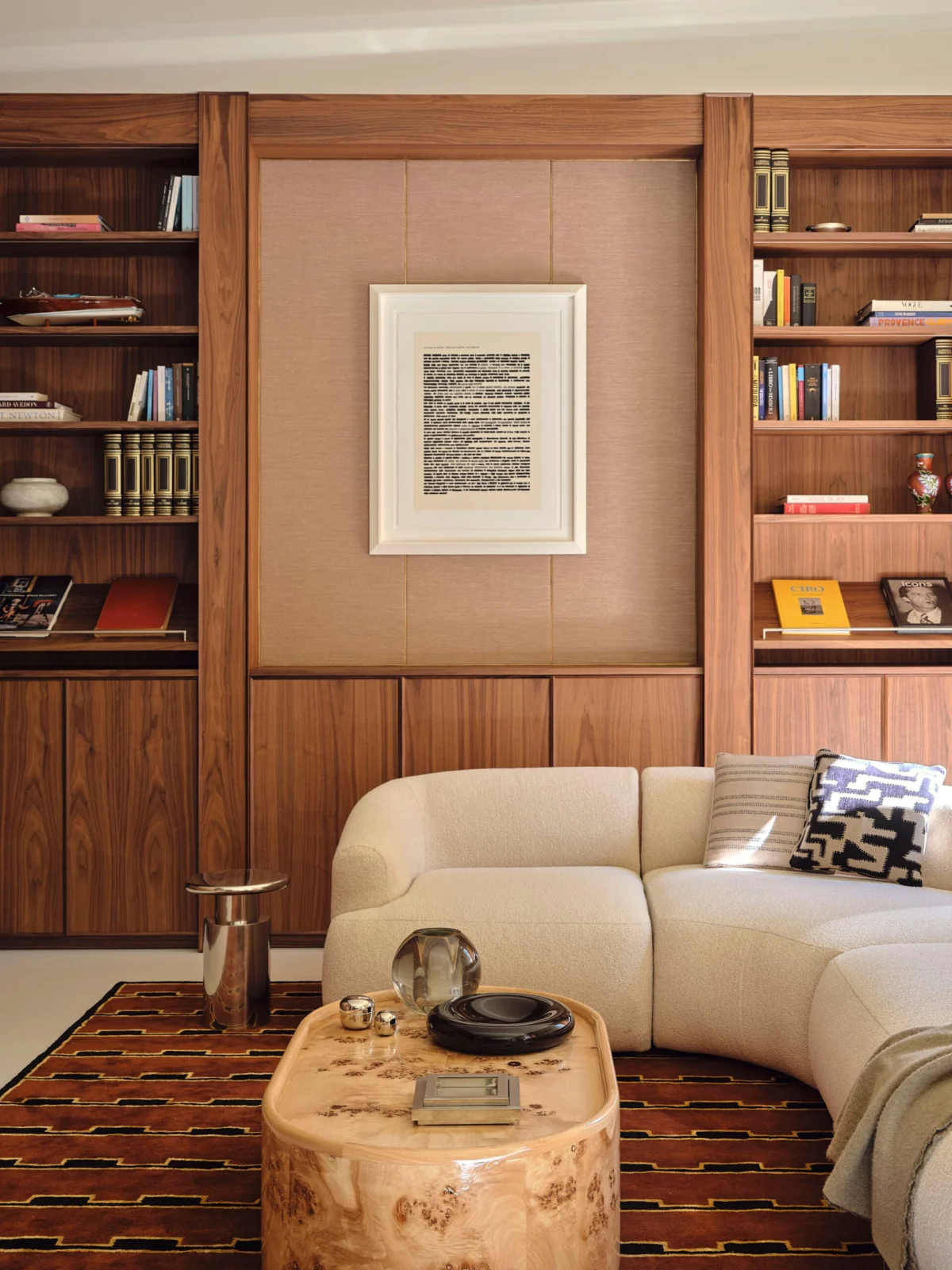
Dominating the living space is a meticulously crafted Canaletto walnut bookcase, a statement piece that serves as both an architectural feature and a repository for personal treasures. This bespoke unit was specifically designed to artfully frame a significant work by the artist Emilio Isgrò, a cherished gift for Vincenzo’s 40th birthday. The shelves of the bookcase are thoughtfully curated, displaying a miniature replica of a Riva motorboat—a nod perhaps to Milan’s proximity to picturesque lakes—alongside an eclectic collection of books dedicated to the multifaceted worlds of the sea, fashion, and gastronomy, reflecting the owners’ diverse interests and professions. This personalized display underscores the apartment’s transformation into a living narrative of the Ferrieris’ lives.
The continuity of design philosophy extends even to the private quarters, with the principal bedroom embodying the same layered approach to time and memory. Here, the principle of weaving together disparate eras is a central tenet of the interior design. The 1960s-era headboard, a piece of considerable vintage appeal, underwent meticulous restoration to reclaim its original luster. Adjacent to it, a custom-designed closet, thoughtfully upholstered in a sophisticated fabric and finished with elegant Canaletto walnut trim, offers ample storage while seamlessly integrating into the room’s refined aesthetic.

Dedicated spaces for work and family were also considered with equal care. The study, though compact, is ingeniously designed around a comfortable sofa seamlessly integrated into the paneling, creating a cozy and functional workspace. For their growing family, a nursery has been envisioned in soothing cream and rose tones, with a design that anticipates the evolving needs of a child. Even the bathrooms, which often serve as utilitarian spaces, have been imbued with a distinct character. Here, retro-style fixtures and furnishings are artfully juxtaposed with custom-built elements, creating a dialogue between vintage charm and modern craftsmanship.
The pervasive integration of vintage items—including distinctive mirrors and iconic chandeliers from the 1960s and 1970s—throughout the residence serves as a deliberate strategy to bridge the temporal gap. These carefully selected pieces act as tangible connections, weaving together the present inhabitants with the home’s historical timeline. As Calvi aptly observed, "They are real time capsules, creating a connection between today’s owners and this home." This careful curation between the old and the new ultimately ensures that the apartment’s intrinsic essence has been not only preserved but also amplified, making ample space for Vincenzo and Stefania’s individual tastes and shared vision to flourish.

A Legacy of Milanese Design and Renovation Trends
The renovation of the Ferrieri apartment reflects a broader trend in Milanese interior design, where there is a growing appreciation for preserving the architectural integrity of mid-century buildings while infusing them with contemporary comfort and style. Milan, a global epicenter of fashion and design, has long been a fertile ground for innovative architectural approaches. Buildings from the 1950s and 1960s, often characterized by their robust construction, thoughtful layouts, and distinctive aesthetic elements, are increasingly becoming canvases for reimagining. This particular project aligns with a broader movement that values authenticity and craftsmanship, moving away from purely minimalist or starkly modern interventions towards designs that acknowledge and celebrate the past.

The successful integration of vintage pieces with custom-made contemporary elements is a hallmark of high-end residential design. The specific mention of brands like Gino Sarfatti for lighting, C&C Milano for textiles, and Nordic Knots for rugs, alongside custom pieces by Natalia Criado and Emilio Isgrò, points to a sophisticated selection process. These choices not only enhance the aesthetic appeal but also contribute to the functional performance and longevity of the interior. The use of materials such as Canaletto walnut, marble, and resin demonstrates a commitment to quality and durability, reflecting a conscious decision to invest in elements that will stand the test of time.
The apartment’s location in the Sant’Ambrogio neighborhood further adds to its narrative. This area of Milan, known for its historical significance and elegant residential architecture, provides a fitting backdrop for a home that balances tradition and modernity. The ability to retain and enhance original features, such as the marble flooring and mid-century furniture, while introducing new materials and contemporary design solutions, is a testament to the skill of Lucrezia Calvi and her team. The project serves as an exemplary case study for homeowners seeking to revitalize older properties without sacrificing their inherent character. The Ferrieris’ home, as presented, is not merely an apartment; it is a curated experience, a living testament to the enduring power of thoughtful design to bridge eras and create spaces that are both deeply personal and universally appealing.

The broader implications of such renovations extend beyond the individual dwelling. They contribute to the preservation of Milan’s architectural heritage and demonstrate how contemporary design can coexist harmoniously with historical contexts. The success of this project underscores the value of collaboration between discerning homeowners and talented designers who can interpret a property’s history and imbue it with new life. This approach ensures that Milan’s architectural landscape continues to evolve while retaining the unique character that defines it. The Ferrieri apartment, a "time capsule" as described by Calvi, stands as a beacon of this thoughtful integration, offering a compelling vision for the future of residential design in historic urban settings.

0 Comments