
The house appeared to possess every desirable attribute: a coveted Tribeca address, an architecturally distinctive facade, an impressive historical lineage, and a sprawling 6,750 square feet of interior living space. With ceilings soaring up to 15 feet, a 650-square-foot roof terrace, and the rare luxury of a private garage, it presented an image of ultimate urban living. Yet, upon closer inspection, something felt incomplete, a disconnect between its potential and its execution.

Designer Nate Berkus, a prominent figure in the interior design world and a recognized tastemaker, articulated this sentiment during his initial walkthrough. "The quality of construction just wasn’t commensurate with the history of the home, or representative of the people that intended to make this their primary residence," Berkus recalled. While touring the property with prospective clients, a discerning creative couple with an international perspective, he swiftly concluded that the recent renovations and expansions "weren’t going to cut it."
This realization marked the beginning of a transformative journey for the mid-19th-century red-brick building, a structure that had witnessed a remarkable array of transformations throughout its existence. Originally serving as a warehouse, it later functioned as a tenement, a hotel, a restaurant, and a diner, embodying what Berkus poetically described as having "lived a million lives." The clients, eager to infuse the residence with a sense of timeless elegance that would seamlessly integrate with its storied exterior, turned to Nate Berkus Associates, a firm renowned for its ability to create enduringly sophisticated interiors. "No one does it like Nate, in terms of keeping it forever timeless," the wife remarked, underscoring their confidence in his design philosophy.

The Challenge of Historical Preservation and Modern Living
The inherent challenge in renovating such a historically rich property lies in harmonizing its past with the demands of contemporary living. The building’s exterior, characterized by its romantic stone details and a more recent mansard roof addition, hinted at a grandeur that the interior had failed to fully capture. The clients’ desire was to reintroduce period details not as mere ornamentation, but as an integral part of a cohesive and livable home. This meant going beyond superficial updates to address the fundamental quality of construction and design.
Berkus’s approach was rooted in a deep respect for the building’s heritage and its urban context. He began by "focusing on really beautiful materials that might have been there when the house was built" – essential elements like oak, marble, brass, bronze, and steel. His guiding principle was to ensure that "nothing had a time stamp on it." This philosophy aimed to honor New York City, the vibrant neighborhood of Tribeca, and the building’s industrial roots, while simultaneously crafting a home that offered every modern convenience. The collaboration with architect Danielle Albert was crucial in translating this vision into the interior envelope, ensuring that traditionally inspired materials and period-appropriate profiles were meticulously applied to millwork, doors, railings, and hardware. The result was a "classic, 19th-century, dentil-molding, wood-paneled vernacular" that felt both historically grounded and distinctly contemporary.

A Curated Symphony of Vintage and Contemporary Design
The interior design of the residence is a masterful dialogue between meticulously sourced vintage pieces and bespoke contemporary furnishings. In the entry hall, Berkus introduced a sense of historical continuity with a pair of hundred-year-old French doors, a deliberate "nod to historic ‘what may have been’," as he described. To imbue the expansive, high-ceilinged spaces with intimacy, an oversized mid-20th-century domed pendant from 1stDibs commands attention above a monolithic travertine center table from Le Lampade. Flanking this area, tall 1960s Stilnovo floor lamps stand guard beside a custom Estudio Furnishings sofa, upholstered in luxurious Holland & Sherry fabric. The walls are adorned with a monochrome canvas by Tina Shaw, adding a subtle artistic flourish.
Beyond the elevator, a Spanish metal table and a spherical Oscar Torlasco chandelier serve as a striking focal point. Complementing this, contemporary Studio Valle de Valle chairs surround a 1950s leather-wrapped Jacques Adnet coffee table. A custom Guéridon Design bench, upholstered in a Rose Tarlow textile, offers additional seating. The juxtaposition of eras is further evident with a pair of 1960s Maison Jansen stools positioned beneath a 1959 Yves Klein artwork, adjacent to an early-19th-century Swedish Gustavian cabinet. Berkus expressed his appreciation for this interplay, noting how the "famous color" of Klein’s work contrasted beautifully with the cabinet’s original paint, weathered by time.

The clients’ passion for entertaining significantly influenced the design, leading to the creation of a discreet, mirror-clad bar secreted behind a pair of doors. This "cocktail zone" enhances the feeling that "the house could open up and reveal itself," according to Berkus. An articulating Arredoluce wall light from the 1950s provides ambient illumination for evening gatherings.
Crafting Unique Experiences on Each Floor
Berkus’s design philosophy emphasizes creating distinct experiences on each floor, fostering a sense of discovery for both residents and guests. The team embarked on a "no-holds-barred search" across auction houses, galleries, dealers, and online platforms to unearth furnishings, art, and accessories that resonated with the clients’ appreciation for historical references that weren’t taken too seriously. This allowed for the integration of pieces that playfully challenged the architecture rather than strictly adhering to it.

The dining room showcases a custom bronze table by Costantini Design, which had to be brought in and assembled on-site due to its size. Berkus’s choice of burnished metal over wood or stone was a deliberate decision, aiming for a "living finish that will change" over time. The chairs are from Ruemmler, and the French mid-20th-century black-iron chandeliers were sourced from 1stDibs. Complementing these, sconces above a custom banquette, also from 1stDibs, are by Stilnovo.
The kitchen, described by the client as their "favorite place in the house," embodies Berkus’s signature blend of "fabulous but functional" design. The countertops feature a riotously veined Prunella marble, alive with eggplant, gray, and burgundy hues, which provides the "fabulous." Functionality is addressed through custom white-oak cabinetry painted in Benjamin Moore’s Smokey Taupe. A Lacanche range and mid-20th-century Italian lighting further merge aesthetic appeal with practical use.

A Palette of Warm Neutrals and Artisanal Touches
A consistent palette of warm neutrals and luxurious natural materials serves as a unifying thread throughout the residence, connecting its diverse spaces. The eclectic collection of found objects, spanning various eras and origins, shares an "artisanal hand, industrial edge, an elegance of form," creating a "quiet cohesion" where each piece subtly converses with its neighbors. This approach to balancing historical reference with contemporary reinterpretation was fundamental to the project. "We do the research to know what might have been, and then once we know, we can go in that direction or do the opposite," Berkus explained, highlighting the flexibility that defined the design process.
Dedicated Spaces for Family and Work
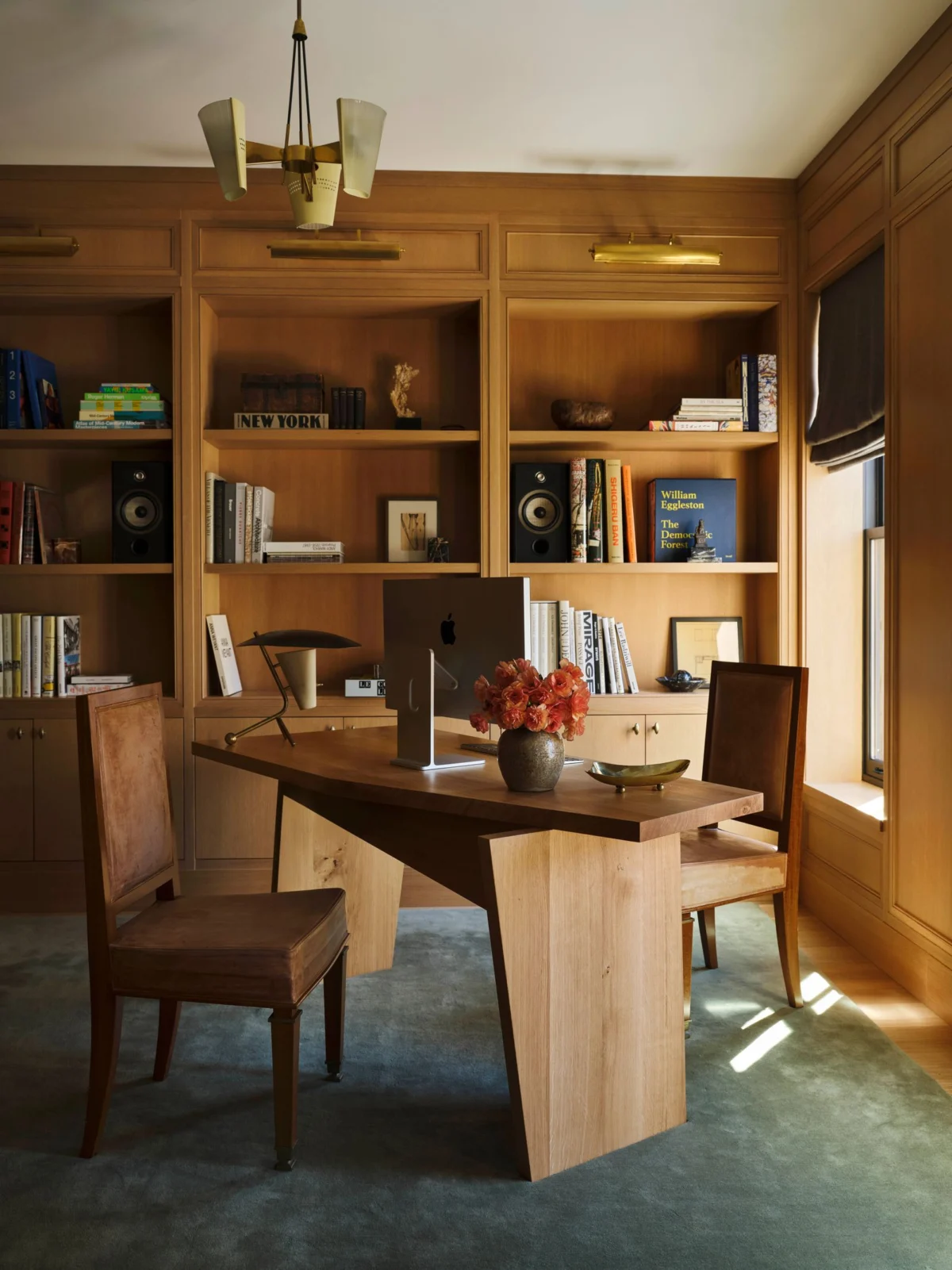
The fourth floor is dedicated to the couple’s professional lives, housing offices designed to offer both connection and separation. The husband’s office features oak paneling and bookshelves finished in a warm honey hue. This space is furnished with André Arbus chairs and a custom Nazara Lazaro Crooked desk, commissioned through Galerie Philia. A 1950s Arredoluce ceiling fixture and a Pierre Guariche table lamp from the same era, both sourced from 1stDibs, illuminate the area, while Visual Comfort picture lights complete the ensemble.

Connected to his workspace by glass doors, the wife’s office is arranged to facilitate conversation without direct visual confrontation. A custom desk and a McGee & Co. chair are oriented towards the back wall. Berkus noted the charm of this arrangement, allowing them to "be together and apart." Lighting is provided by a 1930s table lamp attributed to Pietro Chiesa and a late-20th-century Murano glass sconce. A mid-20th-century French stool and Élis wallpaper add to the room’s character.
The children’s floor represents a deliberate departure from the home’s otherwise restrained palette. "We reserved pattern and color for the kids," Berkus stated, emphasizing his belief in incorporating vintage pieces for children to cherish. A Swedish Gustavian dresser from 1750, alongside a Bitossi bird table lamp, are intended to be keepsakes for the son’s future residence. The children’s bedroom features a Pottery Barn Kids bed, Schumacher windowpane wallpaper, and a Nordic Knots carpet.

The shared bathroom for the children is adorned with Pierre Frey wallpaper, a selection process that involved several deliberations before ultimately returning to the initial choice. Flanking the Robern medicine cabinets are Maison Sciolari sconces from the 1970s, found on Chairish. A custom vanity, topped with honed Imperial Danby marble, is paired with a Robern mirrored medicine cabinet.
The fifth floor hosts the guest bedroom, featuring a pair of gray-painted mid-20th-century Swedish side tables flanking a linen-upholstered bed from Shoppe Amber Interiors. Complementing the bed are CB2 white marble table lamps, with custom shades created by Illume. A hand-dyed wool rug from Armadillo adds warmth and texture.

The Ultimate Sanctuary: The Primary Suite
The entire sixth floor is devoted to the primary suite, with a reworked layout to optimize the flow between entry, bedroom, bathroom, and storage. The bedroom itself is a bespoke creation, with closets and cabinetry seamlessly integrated into the walls behind a floating bed. Berkus ingeniously reclaimed space from two former dressing rooms to expand the bathroom, creating a luxurious retreat. A Max Ingrand pendant light hangs above, while Falkenbergs Belysning table lamps rest on nightstands built into the wingback headboard.
The primary bathroom features long Murano glass sconces from the 1950s flanking Robern medicine cabinets. Berkus designed a striking checkerboard floor in encaustic cement tiles from Clé. Plumbing fixtures and a towel ring are from Waterworks. To subtly echo the darker tones of the floor and the veining in the Paonazzo marble used for baseboards and door trims, the Water Monopoly soaking tub was custom-painted in Farrow & Ball’s Calke Green. Stone surfaces continue with a 1930s Danish alabaster ceiling pendant, a 1950s triangular table topped in limestone, and a French sandstone column dating to 1780.

An Urban Oasis: The Rooftop Terrace
The 650-square-foot roof terrace was transformed into a series of "secret garden-style rooms" with the collaboration of landscape architecture firm RKLA Studio. "When you come out onto the terrace, the first thing you are greeted with is an antique stone fountain," Berkus noted. At the center, a pergola designed by Danielle Albert provides a designated area for outdoor dining, paired with RH chairs and a table by Shoppe Amber Interiors. The lounging area is situated at the far end, furnished with a sofa from Soho Home. A metal chair facing the seating area is from Atrio, a gallery founded by Berkus’s husband, AD100 designer Jeremiah Brent.
Berkus concluded the project by emphasizing that the aim was not to create sterile historical reproductions, but rather "something that would rise up to greet the energy of the clients and what their life was really about." This Tribeca residence stands as a testament to that vision, a harmonious blend of history, artistry, and modern living.

0 Comments