
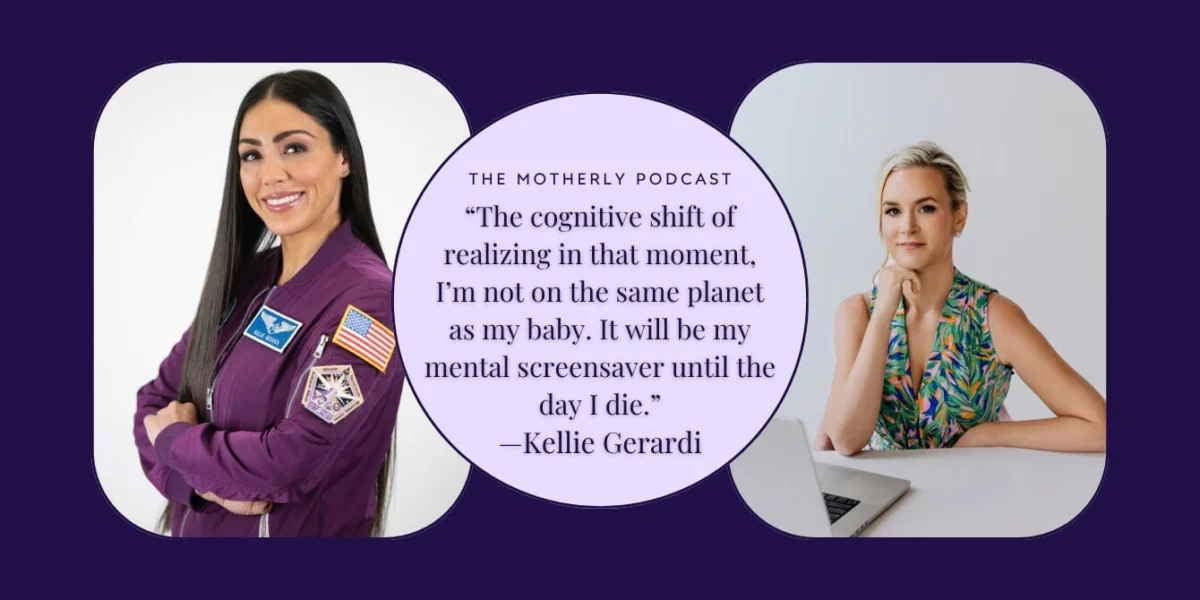
Kellie Gerardi, a pioneering research astronaut, author, and ardent advocate for women in STEM, has carved a remarkable career path, contributing significantly to civilian space exploration. Her public life is marked by groundbreaking achievements, including becoming one of the first non-government payload specialists to undertake a suborbital science mission in 2023, earning her the distinction of being the 90th woman to journey to space. Yet, running parallel to these highly visible accomplishments, Gerardi has navigated a deeply personal and often silent struggle: a nine-year battle with secondary infertility. This arduous journey, punctuated by numerous egg retrievals, intensive IVF cycles, and heartbreaking pregnancy losses, unfolded largely in the shadows, a stark contrast to the public milestones of her professional life. Gerardi recently opened up about this profound experience on The Motherly Podcast, shedding light on the "girl math" of timing IVF treatments around unpredictable spaceflight windows and the profound moment in orbit when she recognized she was physically separated from her baby. Her candid revelations aim to destigmatize infertility and pregnancy loss, transforming her fertility journey into what she describes as the "A plot" of her existence.
A Career Blazing New Trails in Space
Kellie Gerardi’s trajectory towards space exploration began early, rooted in her childhood in Jupiter, Florida. Growing up in a region synonymous with human spaceflight, the final frontier never seemed an abstract concept but rather a tangible, accessible ambition. She recalls having "front row seats" to the launches up the coast, fostering a lifelong dream of contributing to the advancement of space access for future generations of scientists. This aspiration became her unwavering "North Star."
Gerardi credits her parents, particularly her mother, with instilling in her a unique blend of humility and confidence. This mindset, characterized by the belief that "if I work hard enough for long enough, why not me?", proved instrumental in opening doors to opportunities she once considered beyond her wildest imagination. Her career exemplifies this ethos, pushing boundaries in a field traditionally dominated by government-sponsored astronauts. As a research astronaut and payload specialist, Gerardi’s role involves conducting scientific experiments and testing new technologies in microgravity environments. Her 2023 suborbital flight, facilitated by commercial space ventures, underscores the evolving landscape of space access, where private citizens and researchers are increasingly playing pivotal roles. Beyond her professional duties, Gerardi is a celebrated author and a prominent voice advocating for greater representation and opportunities for women in science, technology, engineering, and mathematics. Her influence extends beyond the scientific community, evidenced by a Barbie doll created in her likeness, a testament to her inspirational role for young girls worldwide. Her work even includes pioneering research into the postpartum body in microgravity, a unique intersection of her personal and professional life.
The Unseen Odyssey: Navigating Secondary Infertility
While Gerardi’s professional life soared to astronomical heights, her personal journey was grounded in the profound challenges of secondary infertility—the inability to conceive or carry a pregnancy to term after having had a previous successful pregnancy. This condition affects approximately one in eight couples in the United States, representing a significant portion of the overall infertility landscape. For Gerardi, the desire to give her first daughter, Delta, a sibling was a deeply held dream, on par with her ambition to explore space. However, the path to expanding her family proved far more complex than anticipated.
After the natural conception of Delta, Gerardi initially held onto hope that a second pregnancy might also occur without medical intervention. Yet, months stretched into years, revealing the persistent nature of her secondary infertility. The emotional toll of this journey is often underestimated, encompassing cycles of hope and despair, physical discomfort from treatments, and the psychological burden of repeated loss. Gerardi endured multiple pregnancy losses over the nine years separating the births of her daughters, Delta and Max. Each loss, she recounts, brought a unique wave of pain, compounded by the frustration of her body seemingly "dangling" the promise of pregnancy only to withdraw it. The experience created a deep sense of disconnect from her own body, which she felt was betraying her most profound desires.
The decision to pursue In Vitro Fertilization (IVF) came after her first spaceflight in 2023. This pivotal moment allowed her to reassess her life goals, factoring in her age, career trajectory, and the sheer importance of fulfilling her dream of a second child. Recognizing the dwindling chances of natural conception and unwilling to leave such a crucial desire to chance, Gerardi and her husband committed to the intensive and demanding process of IVF. This journey, spanning multiple years, involved numerous egg retrievals and IVF cycles, each fraught with uncertainty and emotional investment. The physical and emotional demands of IVF are well-documented, often requiring significant time commitments, medication regimens, and resilience in the face of variable success rates. For Gerardi, this period became an all-consuming focus, eclipsing even her high-profile professional endeavors.
The Intersection of Timelines: IVF and Spaceflight
One of the most unique challenges Gerardi faced was the collision of two highly demanding and largely uncontrollable timelines: the biological clock dictating her fertility treatments and the unpredictable scheduling of her space missions. She humorously refers to her attempts to reconcile these two as her version of "girl math"—an intricate calculation of optimal windows for conception amidst the rigid demands of spaceflight preparation.
After her inaugural flight in 2023, the announcement that she would lead a follow-up science mission created both immense professional joy and intense personal pressure. The initial expectation that the second flight might occur in the subsequent year compressed her perceived window for IVF, adding urgency to an already high-stakes process. During one particularly critical IVF cycle, after experiencing the common but devastating "attrition" of embryos, she was left with only one potentially viable embryo. This "all eggs in one basket" scenario culminated in a miraculous initial conception, followed by a tragic loss on the very day she was scheduled to "graduate" from her IVF clinic. This emotional whiplash underscores the fragility and unpredictability inherent in fertility treatments. Fortuitously, the subsequent shift in the follow-up mission’s schedule, targeting the following year, provided a much-needed reprieve and the opportunity to embark on another IVF cycle from scratch, ultimately leading to the birth of her second daughter, Max. This delicate dance between professional obligation and personal aspiration highlights the unique challenges faced by women in demanding careers who also wish to build a family.
Breaking the Silence: Destigmatizing Infertility and Loss
Gerardi’s decision to openly share her protracted fertility journey is a powerful act of destigmatization. Historically, discussions around pregnancy loss and infertility have been shrouded in silence and shame, often whispered about rather than openly discussed. Societal norms, such as the ingrained advice to "wait 12 weeks before you tell anyone" about a pregnancy, inadvertently perpetuate this silence, creating a culture where individuals grieve in isolation. Gerardi acknowledges that even she was initially predisposed to this cautious approach, fearing the discomfort of "un-telling" news.
However, her personal experiences taught her the profound value of vulnerability and community. She recounts having navigated every "permutation" of sharing—from waiting the prescribed 12 weeks only to face a second-trimester loss and the painful task of retracting the news, to sharing immediately and experiencing the invaluable support of her community, even when pregnancies ended in heartbreak. She unequivocally prefers the latter, recognizing that a "village surrounding me with support" is far more beneficial than isolated suffering. Gerardi emphasizes that a fertility journey is an "odyssey" that impacts every facet of one’s life—physical, mental, emotional, and financial. It inevitably becomes the "A plot" of one’s existence, regardless of prior professional achievements or public persona. After her first spaceflight, with a significantly larger public platform, Gerardi felt a moral imperative to address the "thousand-pound elephant" of her personal life, finding it disingenuous to share her career triumphs while omitting such a central part of her reality. Her openness contributes to a growing movement of public figures and individuals using their voices to normalize conversations around reproductive challenges, fostering empathy and creating space for shared experiences.
Resilience Forged in Challenge: A New Form of Hope
The nine-year odyssey through secondary infertility and loss profoundly transformed Kellie Gerardi. Reflecting on her journey, she echoes a viral sentiment: "I didn’t survive that. That was a different version of me." She acknowledges that the person she was a decade ago, mentally, physically, and emotionally, is vastly different from the mother she is today. While she cautions against the simplistic notion that every heartbreak yields a lesson, acknowledging that some pains are simply "terrible and objectively painful," she has cultivated a deep respect and grace for her present self. This self-acknowledgment stems from witnessing her own resilience in navigating objectively terrible circumstances and emerging on the other side.
Her journey culminated in a powerful personal philosophy she terms "functional hope." Unlike a naive belief that "everything is going to work out how it’s supposed to," functional hope is rooted in self-confidence: "no matter how my story ends, I’m going to get through it." This pragmatic yet profound form of hope, centered on inner strength and endurance, proved invaluable during her final IVF cycle, which began with little conventional hope due to prior setbacks. It is a testament to the human spirit’s capacity to adapt and find strength even when optimism is scarce, a lesson that resonates far beyond the context of fertility struggles. This cultivated resilience informs her approach to all aspects of life, recognizing the deep well of strength within herself.
Motherhood Beyond Earth: A Cosmic Perspective
Gerardi’s unique vantage point as an astronaut has also deeply influenced her perspective on life and motherhood. She believes that a greater appreciation for the cosmos would benefit humanity, emphasizing that one does not need to physically travel to space to cultivate this mindset. Simply gazing at the night sky, she suggests, offers a perfect blend of humility and confidence—the humility to grasp one’s smallness in the vast universe, coupled with the confidence to recognize what is within one’s reach.
Her experience looking down at Earth from space was, predictably, profound. It was a moment of deep humility, realizing she was witnessing a perspective shared by only a minuscule fraction of humanity. This cosmic view, however, was intertwined with an intensely personal realization: "I’m not on the same planet as my baby." This "mind-bending" cognitive shift, she states, will forever remain her "mental screensaver." It encapsulates the extraordinary duality of her life—reaching for the stars while profoundly connected to her family on Earth. This perspective reinforces her belief in collective responsibility, encapsulated in the mantra: "There are no passengers on Spaceship Earth, only crew, and it’s really important that we act like that." Her experiences in space thus amplify her commitment to both global stewardship and personal connection.
Pioneering Research: The Postpartum Body in Microgravity
Further demonstrating the unique blend of her personal and professional worlds, Kellie Gerardi undertook a groundbreaking experiment involving pumping breast milk in microgravity. This occurred eight weeks postpartum, a decision she emphasizes was entirely her own, driven by her enthusiasm to rejoin her science team. The experiment was part of a broader research initiative investigating the postpartum body and lactation in a microgravity environment. Key questions included the feasibility of lactation in altered gravity and its potential effects on breast milk composition.
This research, conducted in parabolic flights often dubbed the "vomit comet" due to their rollercoaster-like ascent and freefall creating brief periods of microgravity, was scientifically fascinating and personally empowering. Gerardi’s willingness to participate offered invaluable data, contributing to a nascent body of knowledge about female physiology in space. More broadly, it served as a powerful visual testament to the incredible capabilities of women’s bodies and the continued expansion of human understanding in space biology. Such research is crucial as space exploration becomes more diverse, with an increasing number of women potentially undertaking longer missions, including those who may have recently given birth or are lactating.
Balancing Risk and Purpose: An Astronaut Mom’s Dialogue
As an astronaut and a mother, Gerardi consistently confronts the inherent risks of human spaceflight. She is never "cavalier" about these risks, nor does she shy away from their reality. Her comfort, she explains, stems from a deep trust in the spacecraft engineering and the rigorous training protocols. However, translating this personal comfort to her family, particularly her children, presents a different challenge.
When her eldest daughter, Delta, was five at the time of Gerardi’s first flight, she could discern Delta’s own innocent "risk calculus," expressed through questions like, "what happens if you bump into another planet?" This opened avenues for honest and direct conversations. Gerardi patiently explained the mechanics of the spacecraft, the extensive training for contingencies, and the profound importance of her work. These developmentally appropriate dialogues provided reassurance without being dismissive, fostering an understanding of both the challenges and the value of space exploration. This approach underscores her commitment to transparency and empowering her children with knowledge, rather than shielding them from reality.
Inspiring the Next Generation
Gerardi’s method of explaining her work to her children is deeply integrated into their family life, transforming her professional endeavors into shared learning experiences. Delta, from a young age, has been her "pint-sized co-PI," actively engaged in discussing experiments. Gerardi ensures that her work is not a separate activity but a family affair. She cherishes moments when her daughters pose questions she doesn’t immediately have the answer to, like whether a squishy dumpling toy would float or stay in its container in microgravity if the lid were removed. Her response—"Let’s find out"—epitomizes her scientific spirit and her desire to cultivate curiosity in her children.
She explains her role as going into microgravity or space to "help figure out how different things work in that environment, to test technology and conduct research and find answers to questions we have." This simple yet profound explanation demystifies her complex work, making it accessible and exciting for young minds. Ultimately, Gerardi hopes her daughters will speak of her as she speaks of her own parents: that she gifted them a "limitless imagination and confidence for what’s possible in this life" and encouraged them every step of the way. This aspiration reflects her legacy, not just as a trailblazer in space, but as a mother dedicated to nurturing the next generation of dreamers and doers.
Kellie Gerardi’s story is a compelling narrative of ambition, resilience, and profound personal growth. By bravely sharing her intertwined journeys through the vastness of space and the intimate struggles of infertility, she not only demystifies complex scientific endeavors but also humanizes the often-private battles many individuals face. Her advocacy extends beyond STEM, fostering an environment where vulnerability is celebrated, and support for challenging life experiences is readily available. Gerardi stands as a testament to the idea that the greatest frontiers, both cosmic and personal, are conquered not just with scientific prowess, but with unwavering hope, courage, and an open heart.

0 Comments