
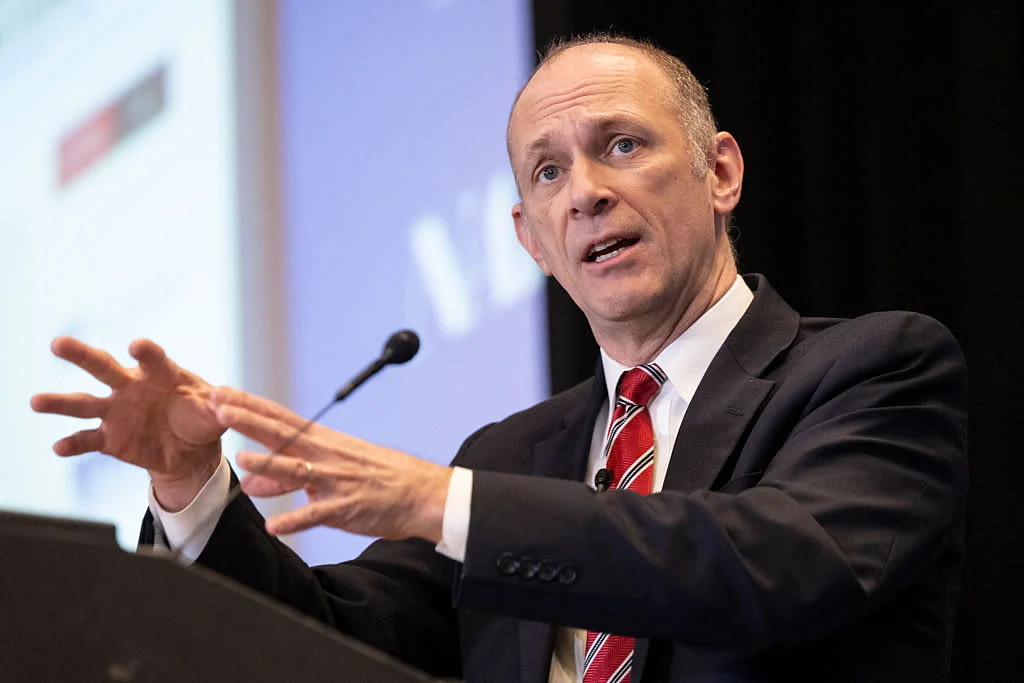
Chicago Federal Reserve President Austan Goolsbee declared on Monday that his primary economic concern has shifted unequivocally towards inflation, rather than unemployment, even as tentative progress appeared to emerge from high-stakes negotiations concerning the conflict in the Middle East. This statement, delivered during a candid interview with CNBC, underscored the intricate and often unpredictable challenges confronting central bankers in the current global economic and geopolitical environment. Goolsbee’s remarks arrived shortly after President Donald Trump announced that significant headway had been achieved in ongoing discussions with Iran, signaling a temporary five-day halt to attacks on critical energy infrastructure as talks continued, a development that immediately reverberated across global financial markets.
The Federal Reserve’s Dual Mandate and Goolsbee’s Stance
As a prominent voice within the Federal Reserve system, Austan Goolsbee’s observations carry considerable weight, offering insights into the evolving perspectives that shape monetary policy. The Federal Reserve operates under a dual mandate from Congress: to foster maximum employment and maintain price stability. Historically, periods of high unemployment often prompt the Fed to consider looser monetary policy, such as interest rate cuts, to stimulate economic activity. Conversely, elevated inflation typically necessitates tighter policy, like rate hikes, to cool an overheating economy. Goolsbee’s explicit prioritization of inflation signals a deep-seated worry that price pressures, exacerbated by external shocks, could derail the economy’s path back to stable growth.
Goolsbee has been a consistent voice of caution regarding premature easing of monetary policy. He notably dissented on a potential rate cut in December 2025, advocating for a more patient approach. His position remained aligned with the majority of the Federal Open Market Committee (FOMC) in their subsequent decisions to hold short-term interest rates steady at their January and March 2026 meetings. While Goolsbee is not a voting member of the FOMC this year, his influential perspective as a regional Fed president often foreshadows future policy debates and contributes significantly to the overall discourse within the central bank. He is slated to regain his voting status in the coming year, making his current views particularly relevant for discerning the future trajectory of monetary policy.
Inflation: The Enduring Challenge and the "Team Transitory" Lesson
The memory of the "team transitory" error looms large over current Fed deliberations. In 2021, many central bankers and economists, including some within the Fed, initially characterized the surge in inflation as a temporary phenomenon, largely attributable to supply chain disruptions and pent-up demand following the COVID-19 pandemic lockdowns. This assessment suggested that inflationary pressures would naturally subside as supply chains normalized. However, inflation proved far more persistent and widespread than anticipated, forcing the Fed to embark on an aggressive series of interest rate hikes starting in early 2022 to bring prices under control. This experience served as a stark lesson, imbuing policymakers with a heightened sense of vigilance against underestimating inflationary risks.
Goolsbee’s current concern stems from the potential for the Middle East conflict to reignite or exacerbate inflationary pressures, particularly through its impact on global energy markets. The global economy has only recently begun to see inflation recede from its multi-decade highs, with the Consumer Price Index (CPI) and Personal Consumption Expenditures (PCE) index – the Fed’s preferred inflation gauge – showing gradual moderation towards the central bank’s 2% target. Core inflation, which excludes volatile food and energy prices, has also shown signs of cooling, but remains above target. Any disruption to energy supplies could swiftly reverse this progress, pushing up transportation costs, manufacturing expenses, and ultimately, consumer prices across a wide range of goods and services. "I remain fairly optimistic that by the end of ’26 rates could go down," Goolsbee stated, "but I wanted to see proof that we’re back on an inflation headed to 2%. This [war] definitely throws a wrench into the plans. We do need to see progress." His emphasis on "proof" and "progress" highlights the data-dependent nature of the Fed’s approach and the significant hurdles posed by geopolitical instability.
The Geopolitical Undercurrent: Middle East Tensions and Energy Markets
The Middle East conflict, broadly defined, has been a persistent source of global instability for decades, with profound implications for energy markets. The specific "war with Iran" referenced in the original article appears to allude to a broader regional proxy conflict or heightened tensions that have intermittently threatened key energy infrastructure and shipping lanes. The region, particularly the Persian Gulf, is home to some of the world’s largest oil and natural gas reserves, and crucial chokepoints like the Strait of Hormuz, through which a significant portion of the world’s seaborne oil passes daily. Disruptions in this region, whether through direct attacks, threats to shipping, or political instability, can send immediate shockwaves through global energy prices.
President Trump’s announcement regarding "progress" in negotiations with Iran and the temporary halt to attacks on energy infrastructure, specifically for five days, was a critical development. While details of these negotiations remain scarce, the market’s immediate reaction underscored the perceived reduction in risk. A temporary cessation of hostilities targeting energy assets suggests a de-escalation, at least for the short term, which alleviates fears of immediate supply disruptions. However, the fragile nature of such agreements and the inherent volatility of the region mean that this relief could be fleeting. The outcome of these ongoing talks will be pivotal in determining the long-term impact on global energy prices and, by extension, the trajectory of inflation.

Market’s Immediate Verdict: Stocks, Oil, and Rate Expectations
The financial markets reacted with characteristic swiftness and volatility to the news of potential de-escalation. Following Trump’s announcement, stocks across major indices spiked higher. The Dow Jones Industrial Average, S&P 500, and Nasdaq Composite all registered significant gains, reflecting a broader sentiment of reduced geopolitical risk premium. Investors typically view geopolitical stability as conducive to economic growth and corporate earnings, leading to a surge in buying activity.
Conversely, oil prices experienced a sharp decline. West Texas Intermediate (WTI) crude futures, the U.S. benchmark, and Brent crude, the international benchmark, both saw substantial drops. This plunge was a direct consequence of diminished fears of immediate supply disruptions from the Middle East. When the risk of oil supply being cut off from a major producing region decreases, the "fear premium" embedded in oil prices evaporates, leading to downward pressure. Lower oil prices, if sustained, could offer a reprieve from inflationary pressures, easing costs for businesses and consumers.
In the bond market, the volatile action led traders to adjust their expectations for future Federal Reserve policy. Initially, the reduction in geopolitical risk and the drop in oil prices might suggest a clearer path for the Fed to consider rate cuts. However, the complexity of the situation led to nuanced adjustments. While the immediate market reaction saw some investors upping their bets on a potential rate hike by the end of 2026, signaling a belief that persistent inflation, potentially from other sources or a re-escalation, might still necessitate tighter policy, the broader consensus still leaned towards an eventual rate cut in 2027. This mixed signal highlights the deep uncertainty pervading market sentiment and the challenge for investors in fully pricing in all potential outcomes. The yield on benchmark 10-year U.S. Treasury notes, a key indicator of market expectations for long-term interest rates and economic growth, also saw fluctuations as traders digested the news, reflecting the ongoing debate about the Fed’s next move.
The Fed’s Path Forward: Navigating Uncertainty
The Federal Open Market Committee (FOMC) last week, following its March 2026 meeting, indicated through its "dot plot" projections that a majority of officials still anticipated at least one interest rate cut by the end of this year, followed by another in 2027. These projections, however, are highly conditional on economic data, particularly inflation and employment figures. Goolsbee’s cautious tone directly challenges the certainty of these projections, emphasizing the profound impact that external, non-economic factors like geopolitical conflicts can have on the economic outlook.
The central bank’s dilemma is multifaceted. On one hand, maintaining restrictive monetary policy for too long risks tipping the economy into a recession, hindering job growth. On the other hand, easing policy prematurely could allow inflation to re-accelerate, undoing the painful progress made over the past two years. The Middle East situation "definitely throws a wrench into the plans," as Goolsbee articulated, complicating the Fed’s ability to forecast inflation accurately and calibrate policy effectively. The five-day truce, while positive, provides only a brief window. If negotiations fail and tensions escalate, the inflationary risks would surge, potentially forcing the Fed to reconsider its entire timeline for policy normalization. Conversely, if a more durable peace or de-escalation takes hold, it could pave the way for the Fed to eventually ease policy, assuming inflation continues its downward trend.
Economic Implications and the Road Ahead
The broader implications of this evolving situation are significant for the global economy. A prolonged or escalating conflict in the Middle East would not only drive up energy prices but also disrupt global supply chains, increase shipping costs, and dampen consumer and business confidence. Such a scenario could lead to stagflationary pressures – a combination of stagnant economic growth and high inflation – which is one of the most challenging environments for central banks to navigate. Businesses might delay investment decisions, and consumers might curb spending in the face of higher prices and economic uncertainty.
Conversely, a sustained de-escalation and resolution of the conflict would remove a major source of global economic instability. Lower energy prices would act as a de-facto tax cut for consumers and businesses, potentially boosting discretionary spending and corporate profits. This would provide the Federal Reserve with greater flexibility, allowing it to focus more squarely on its employment mandate once price stability is firmly re-established.
The coming days and weeks will be critical. The outcome of the current negotiations with Iran, the subsequent geopolitical developments, and the reaction of global energy markets will all be closely watched by policymakers, investors, and businesses alike. Austan Goolsbee’s unequivocal statement serves as a powerful reminder that in an interconnected world, economic policy cannot be made in a vacuum, isolated from the complex and often unpredictable forces of geopolitics. The Federal Reserve, therefore, faces a complex balancing act, striving to steer the U.S. economy towards sustainable growth and price stability amidst a landscape fraught with both opportunity and significant risk.

0 Comments