
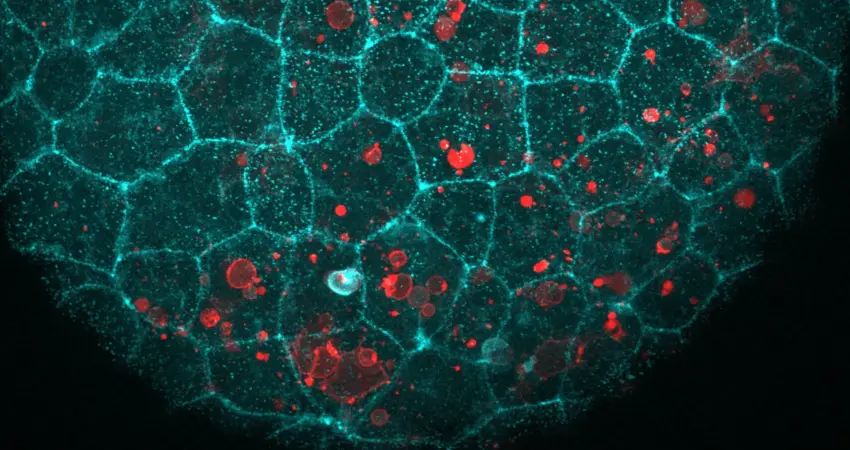
A protein complex long recognized for its fundamental role in maintaining the structural integrity of tissues by connecting cells has been found to possess a previously unknown, vital function: facilitating the engulfment of nearby dead cells by epithelial cells. This discovery, spearheaded by researchers at the Centre for Genomic Regulation (CRG) in Barcelona, sheds new light on the intricate processes of tissue maintenance and has significant implications for understanding and potentially treating chronic inflammatory diseases. The findings were published in the prestigious journal Nature Communications.
The Dual Nature of E-Cadherin: From Cellular Glue to Cleanup Crew
Epithelial cells form continuous, sealed layers that line many of the body’s surfaces, from the outer skin to the internal lining of the gut and respiratory system. Their primary function is to act as a barrier, preventing the uncontrolled passage of substances and maintaining tissue homeostasis. A key player in this barrier function is the E-cadherin complex, a molecular system composed of E-cadherin and three associated proteins. This complex acts as a potent "cellular glue," enabling adjacent epithelial cells to adhere firmly to one another, providing the essential structural strength required for tissues to remain intact and functional. Each epithelial cell establishes connections with its neighbors through these E-cadherin molecules situated on their respective cell membranes.
However, the recent study, led by ICREA Research Professor Verena Ruprecht, has unveiled a surprising secondary role for this familiar molecular machinery. Researchers observed in live zebrafish and mouse embryos that the E-cadherin complex not only mediates cell-to-cell adhesion but also congregates at the precise locations where a dying cell makes contact with the surrounding tissue. This observation prompted the investigation into whether this adhesion machinery was being repurposed for a cleanup operation.
Unraveling the Mechanism: Cellular Engulfment Without Compromising Barriers
The research team designed experiments to ascertain if the E-cadherin complex was involved in the process of engulfing dead cells in the same manner it connects living ones. Two critical experiments were conducted. Firstly, dying cells that had been experimentally stripped of their E-cadherin were introduced to the epithelial tissue. Remarkably, the epithelial cells proceeded to engulf these E-cadherin-deficient dead cells with the same efficiency as they did normal apoptotic cells. This indicated that the primary adhesion function of E-cadherin was not indispensable for the engulfment process itself.
In a subsequent experiment, the researchers introduced synthetic fat droplets containing no endogenous proteins but engineered to display a signal typically found on the surface of dying cells. The epithelial cells readily engulfed these protein-free droplets, provided they carried the correct "eat me" signal. This finding was pivotal, suggesting that the presence of the E-cadherin complex at the site of cellular debris might not be about direct attachment to the dying cell itself, but rather about orchestrating the cellular machinery necessary for engulfment.
"We were intrigued to find out that epithelial cells repurpose their molecular adhesion machinery – the ‘glue’ that normally holds them together – to engulf dying cells," stated Professor Ruprecht, the senior author of the study. This repurposing highlights the remarkable adaptability of cellular mechanisms.
The Mechanics of Engulfment: Maintaining Tissue Integrity During Cleanup
The process of engulfing a cell-sized entity presents a significant mechanical challenge for epithelial cells, which are typically packed tightly into sealed barriers. For these barriers to remain intact, individual cells must be able to deform and engulf debris without compromising the overall integrity of the tissue. Live imaging techniques provided crucial insights into how this delicate balance is achieved.
The study revealed a differential behavior between the upper and lower surfaces of the epithelial cells involved in engulfment. While the lower surface, which faces the dead cell, undergoes substantial stretching and bending to envelop the debris, the upper surface—facing either the external environment or an open space like a lumen—remains relatively stable. This differential deformation ensures that the tissue barrier’s integrity is maintained throughout the cleanup process. Quantitative measurements taken before, during, and after engulfment demonstrated minimal change in the area of the upper surface, while the lower surface underwent significant deformation.
Professor Ruprecht drew an analogy to a group of dancers linked arm-in-arm: "It’s the same dancer with a different choreography," she explained. "Their upper bodies remain steady, while their feet perform increasingly complicated movements when a dying cell appears." This vivid comparison underscores the sophisticated coordination required for cellular cleanup.
A Molecular Rope and Brake: The Intricate Machinery at Play
Further investigation delved into the specific molecular components within the E-cadherin complex that facilitate this cleanup process. The research identified two key roles for associated proteins. One protein acted as a "molecular rope," connecting the E-cadherin assembly to the cell’s internal cytoskeleton. This connection is crucial for transmitting the necessary forces across the surface of the material being engulfed. Cells lacking this tethering protein, or the specific region that anchors it to the cytoskeleton, were unable to effectively engulf dead cells. This suggests that the mechanical force required for engulfment is transmitted through this protein linkage.
Another component of the complex functioned more like a "brake" on the cell’s contractile machinery. Paradoxically, inhibiting this brake did not enhance the cleanup process. Instead, it rendered the cell too rigid, impairing its ability to deform and effectively remove dying cells. This finding suggests that a finely tuned balance of contractile forces, rather than unrestrained contraction, is essential for efficient engulfment.
Conservation Across Vertebrates: From Zebrafish to Mammals
The researchers then sought to determine if this E-cadherin-dependent mechanism of cellular debris clearance was conserved beyond zebrafish. Experiments conducted on early mouse embryos yielded striking results. When E-cadherin function was blocked in these embryos, dying cells accumulated, failing to be cleared. This outcome mirrored the observations in zebrafish, strongly indicating that this cellular cleanup mechanism is shared among vertebrates.
This new work builds upon Professor Ruprecht’s previous research, which demonstrated that embryos can employ epithelial tissues in a cooperative effort to remove dying cells, a behavior that represents an early form of innate immune defense. The use of transparent embryos, such as zebrafish, is particularly advantageous for such studies, allowing direct observation of living cells and tissues at a level of detail currently unattainable in opaque adult organisms.
Broader Implications: Chronic Inflammation and Adult Tissues
A critical outstanding question is whether this E-cadherin-mediated mechanism operates in adult tissues as well. While it is known that adult epithelial tissues in various locations—including the retina, colon, airways, and mammary glands—are involved in clearing dying cells, the precise molecular mechanisms are not always fully understood. The presence of E-cadherin throughout these adult epithelial tissues, and its remarkable evolutionary conservation across species, makes it a strong candidate for a more broadly utilized cleanup mechanism.
The potential medical significance of these findings is substantial, particularly in the context of chronic inflammation. When dying cells are not efficiently cleared from tissues, they can eventually rupture. This rupture releases intracellular contents, which can trigger and perpetuate inflammatory responses. Understanding the precise mechanisms by which tissues clear apoptotic debris could therefore reveal novel therapeutic targets for a range of inflammatory conditions, from inflammatory bowel disease to neurodegenerative disorders.
The study’s implications extend beyond identifying a new function for E-cadherin. It highlights that successful cellular cleanup is not solely dependent on receiving the appropriate chemical signals to engulf apoptotic material. Instead, it requires a complex interplay of physical capabilities, including the ability of cells to dynamically change shape, exert controlled force, and effectively wrap around dead material without compromising their own integrity or that of the surrounding tissue.
"Studying the mechanisms of how dying cells can be removed efficiently from tissues is of very high relevance to human health," concluded Professor Ruprecht. This research opens new avenues for investigating how impaired cellular clearance contributes to disease and how to potentially restore these vital cleanup processes.
The study was led by joint first authors Hanna-Maria Hämäläinen, Marta Batet Palau, and Laura F. Bianchi, under the supervision of Verena Ruprecht. Funding for this research was provided by the Spanish Ministry of Science and Innovation, the Human Frontier Science Program, the European Union’s Horizon Europe program, and the "la Caixa" Foundation, with additional support from the European Social Fund. The CRG Core Facilities for Advanced Light Microscopy, Tissue Engineering, and Protein Technologies were instrumental in supporting the experimental work.

0 Comments