
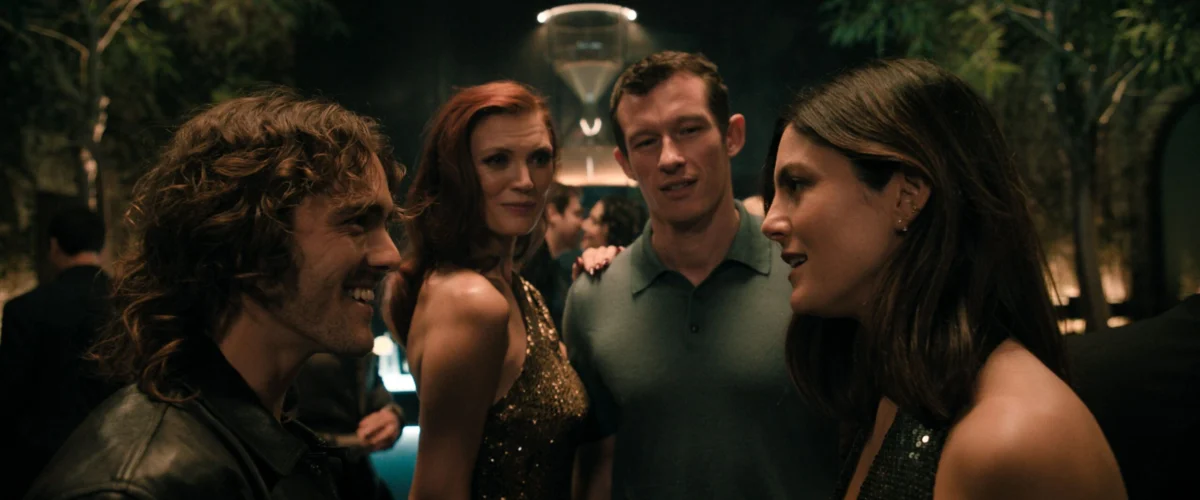
The landscape of the modern romantic comedy has frequently utilized New York City as a silent protagonist, yet few productions have attempted to map the five boroughs with the surgical precision found in director Will Gluck’s latest feature, One Night Only. Produced by Universal Pictures, the film introduces a high-concept satirical premise: a world where premarital intimacy is restricted by law to a single twenty-four-hour window per year, necessitating the mandatory use of protection. While the narrative premise leans into the absurd, the production’s commitment to physical location and transit logic represents a shift toward "geographic realism," a move intended to satisfy the scrutiny of lifelong New Yorkers and urban enthusiasts alike.
Starring Monica Barbaro as Allie, a struggling musician, and Callum Turner as Owen, a dejected pizza shop proprietor, the film follows the duo across at least three boroughs in a single night. Unlike many contemporary films that utilize tax-incentivized soundstages in Atlanta or Toronto to double for Manhattan, One Night Only was shot extensively on location. This decision, driven by Gluck—a "born-and-bred" New Yorker—aimed to capture the specific textures of neighborhoods ranging from the historic brownstones of Hamilton Heights to the industrial venues of Long Island City.
The Director’s Vision: Geographic Integrity as Narrative Foundation
Will Gluck, known for the commercial and critical successes of Easy A and Anyone But You, approached One Night Only with a mandate for spatial accuracy. In the production of urban-centric films, it is common for characters to exit a subway station in one neighborhood and miraculously appear in another miles away within the same scene. Gluck sought to eliminate these "teleportation" tropes.

"I was very concerned with geography," Gluck stated in a recent briefing. "I’m really a stickler that it has to make sense. I don’t want them going the wrong way to get to the right place." This philosophy extended to the casting of the city’s peripheral characters. By leveraging his local network, Gluck populated the film with New York-based comedic talent, including Mike Birbiglia as a satirical law enforcement officer and Ziwe as a formidable Greenpoint bouncer. This casting strategy serves to ground the film’s fantastical legal premise in a recognizable social reality.
A Chronology of Production: Mapping the Night
The filming schedule was designed to mirror the frantic, one-night timeline of the script. The production moved through several key sectors of the city, each chosen for its historical significance or its relative obscurity in mainstream cinema.
The Upper West Side and the Pizzeria Archetype
The story identifies Owen’s workplace as "Claremont’s Pizza." While the name is a tribute to Claremont Avenue near Columbia University where Gluck spent his childhood, the physical filming took place at The Original Ray’s Pizza on 82nd Street and Columbus Avenue. The choice of an "Original Ray’s" serves as a nod to the long-standing New York City culinary trope regarding the proliferation of identically named pizzerias. Though the fictional Claremont’s is implied to be further north, the use of a genuine Upper West Side institution provided the necessary visual shorthand for a neighborhood-focused small business.
Hamilton Heights and the Residential Aesthetic
The production moved further uptown to Hamilton Heights to establish the domestic life of Owen’s mother, Linda, portrayed by Molly Ringwald. The scenes were filmed in a historic brownstone near West 141st Street, a location notably close to the former home of Alexander Hamilton and the filming site of Wes Anderson’s The Royal Tenenbaums.

The logistics of finding the perfect brownstone involved location scouts knocking on doors across several blocks to find a residence that captured the "mama’s boy" dynamic central to Turner’s character. Furthermore, the production utilized a local pharmacy on Amsterdam Avenue—the same one frequented by Gluck’s parents—reinforcing the director’s "small-town" approach to the massive metropolis. In a notable instance of production ingenuity, an urgent care clinic featured in the film was actually a repurposed veterinarian’s office, a detail that has drawn praise for its sleek, modern aesthetic.
Lower Manhattan: The Nightlife Nexus
As the narrative shifts into the evening hours, the characters migrate to Lower Manhattan, the city’s primary theater for nightlife. Allie’s search for connection leads her to a high-end club, filmed at Chez Margaux in Chelsea. The venue, a red-toned members’ club situated near the Whitney Museum of American Art, provided the sophisticated, exclusive atmosphere required for the scene.
The production also secured the historic White Horse Tavern in the West Village. Established in 1880, the Tavern is famous for its literary history, having been a frequent haunt for figures like Dylan Thomas and Jack Kerouac. In the film, it serves as the backdrop for a pivotal encounter between Owen and a bartender played by Julia Fox. The use of the White Horse Tavern, rather than a constructed set, allowed the production to tap into the "old New York" charm that remains a draw for both locals and tourists.
The search for protection—a central plot point given the film’s mandatory condom law—takes the characters to a bodega in SoHo. This scene highlights the "no-nonsense" attitude often attributed to New York service workers, featuring veteran actress Roma Maffia as the shop owner.

Queens and Brooklyn: Industrial Repurposing
The film’s second act moves across the East River. In Long Island City, the production utilized The Foundry, a 19th-century industrial building that originally served as a metal foundry. Today, it is a prominent event space. In One Night Only, the venue doubles as both a luxury apartment and a performance space where Allie takes the stage. The 59th Street Bridge (Ed Koch Queensboro Bridge) is prominently visible in these sequences, providing a visual anchor that confirms the geographic location.
In Brooklyn, the production focused on Brooklyn Bridge Park and Greenpoint. A sequence involving a Citi Bike journey—a staple of modern New York transit—leads Owen to a comedic confrontation in the park. The production also transformed an active metal factory in Brooklyn into a makeshift police station, further emphasizing the "grizzled" industrial side of the city that Gluck intended to showcase.
The Little Red Lighthouse: A Historical Climax
The film concludes at the Little Red Lighthouse, officially known as the Jeffrey’s Hook Light, located in Fort Washington Park under the George Washington Bridge. This location is of significant cultural value, immortalized in the 1942 children’s book The Little Red Lighthouse and the Great Gray Bridge by Hildegarde Swift.
For Gluck, the lighthouse was a personal landmark. "I went there all the time as a kid. No one knows about it," he noted. By choosing this site for the film’s romantic climax, the production highlighted a part of Manhattan that is frequently overlooked by tourists and even some residents. The site’s isolation and its dramatic position beneath the towering bridge provided a cinematic scale that served as a counterpoint to the film’s earlier, more claustrophobic urban scenes.

Supporting Data: The Economic Impact of NYC Filming
The production of One Night Only is part of a broader economic trend within New York City’s media sector. According to reports from the Mayor’s Office of Media and Entertainment (MOME), the film and television industry contributes approximately $82 billion to the city’s economy annually and supports over 280,000 jobs.
By choosing to film on location rather than on a distant soundstage, productions like One Night Only provide direct economic benefits to local businesses. The use of The Original Ray’s Pizza, local pharmacies, and event spaces like The Foundry involves location fees, catering contracts, and local hiring. Furthermore, the "screen tourism" effect—where viewers visit locations seen in popular films—often provides a long-tail benefit to the neighborhoods featured.
Broader Implications: The Revival of the "Locational" Rom-Com
The release of One Night Only comes at a time when the romantic comedy genre is experiencing a resurgence. Following the success of Anyone But You, which utilized the scenic backdrop of Sydney, Australia, Gluck’s pivot to New York suggests a renewed interest in the "destination" rom-com.
Critics and industry analysts suggest that the emphasis on geographic accuracy serves to differentiate high-quality theatrical releases from the more generic, "any-city" aesthetic often found in streaming-exclusive content. By grounding a surreal premise—a legally mandated night of sex—in a meticulously mapped New York, the film achieves a level of "heightened reality." This allows the audience to accept the satirical elements because the environment feels tangibly real.

Moreover, the film’s transit-conscious writing addresses a common complaint among urban viewers. By ensuring that characters take the 145th Street station to get to Hamilton Heights or use Citi Bikes for cross-borough travel, Gluck respects the intelligence of the audience. This attention to detail suggests that for the modern viewer, the "romance" of the romantic comedy is as much about the setting as it is about the characters.
In conclusion, One Night Only functions as both a comedic exploration of social norms and a cinematic love letter to the lesser-seen corners of New York City. Through Will Gluck’s insistence on geographic integrity, the film avoids the pitfalls of generic urban representation, offering instead a detailed, borough-hopping journey that honors the complex layout of the United States’ largest city. As the film industry continues to navigate the balance between cost-effective production and creative authenticity, Gluck’s New York odyssey stands as a compelling argument for the latter.

0 Comments