
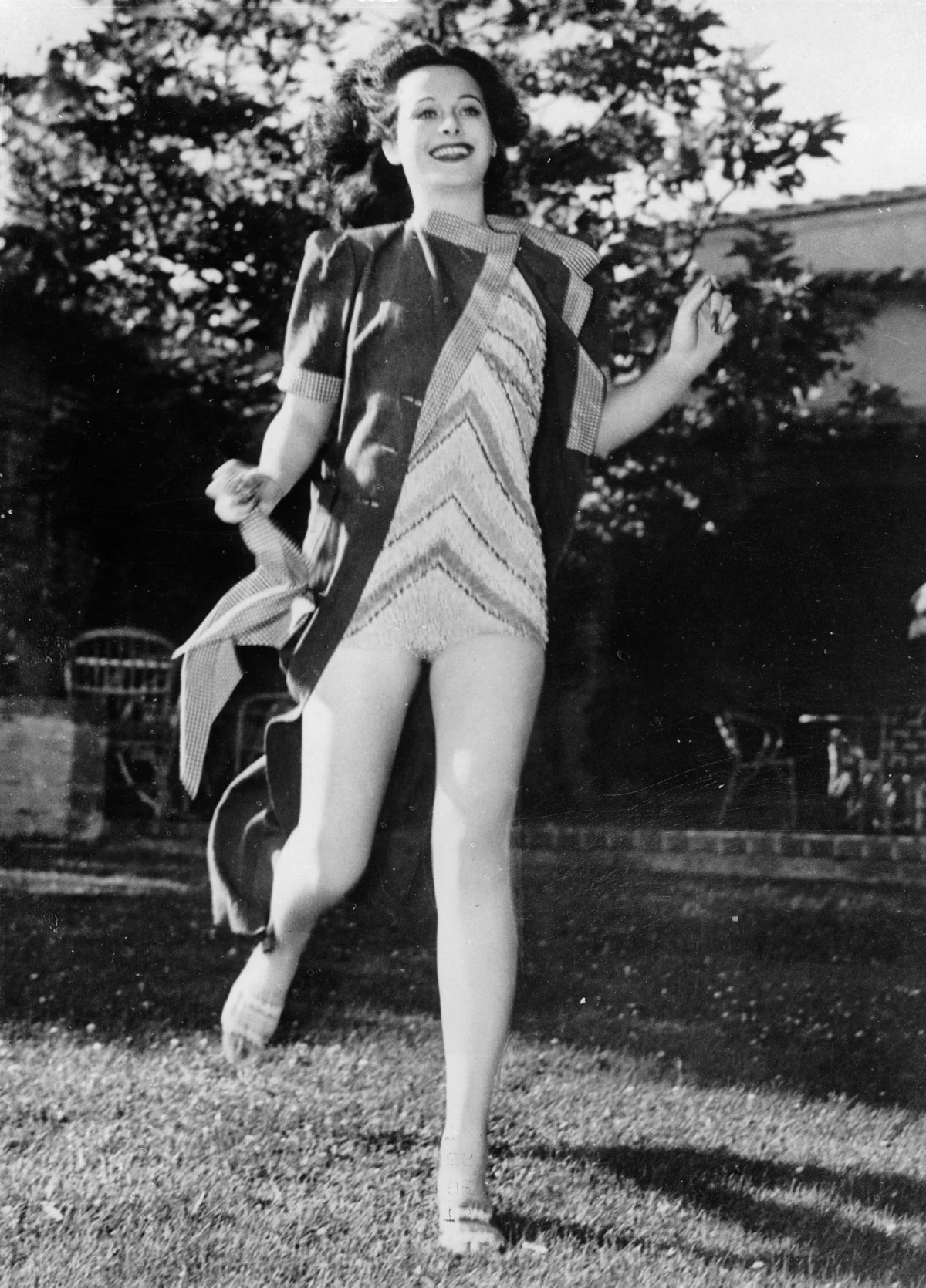
Hedy Lamarr understood the power of a beautiful home long before she was dubbed “the most beautiful woman in film.” Her appreciation for refined living, deeply influenced by her mother, was evident throughout her life, from her opulent Viennese childhood to her meticulously curated Hollywood residences. This innate understanding of aesthetics, coupled with a brilliant inventive mind, painted a portrait of a woman far more complex than her cinematic fame suggested. Lamarr’s early pronouncements reveal a soul attuned to sensory pleasure and the comfort of her surroundings: “Early on I learned the value of pretty things,” she once stated, as documented in Stephen Michael Shearer’s biography, Beautiful: The Life of Hedy Lamarr. “To love the feel of soft fabrics against me; delicate laces, lush velvets, and fine linens. I loved always to have my rooms dainty around me, with flowers in them, smelling sweet. People called me ‘a fastidious little thing.’”

Born Hedwig Eva Maria Kiesler in Vienna, Austria, on November 9, 1914, Lamarr’s formative years were steeped in an atmosphere of sophistication. Her family resided in a spacious nine-room apartment on Vienna’s prestigious Peter-Jordan-Strasse, a milieu that would serve as a lifelong touchstone for her sense of domestic elegance. This refined environment was not merely a backdrop; it was a foundational element that permeated her professional and personal life. Whether it was a charming Hollywood bungalow adorned with flowers and figurines or grand Beverly Hills estates where she raised her children and showcased her diverse art collection, Lamarr consistently infused her living spaces with her personal touch. Despite her celebrated status as one of Hollywood’s most glamorous stars, it was in the quieter rhythms of domestic life that she found profound contentment.
However, Lamarr’s narrative extends far beyond her captivating on-screen presence and her appreciation for interior design. She was also a remarkably skilled inventor. The compelling story of her wartime innovation highlights a fiercely patriotic spirit and a mind driven by problem-solving. Motivated to aid the Allied forces during World War II, Lamarr, alongside composer George Antheil, developed a groundbreaking secure communication system known as frequency hopping. This ingenious concept, designed to prevent enemy jamming of radio-controlled torpedoes, laid the critical groundwork for many of the wireless technologies we rely on today, including Wi-Fi, GPS, and Bluetooth. The dual nature of her brilliance—the dazzling star and the pioneering inventor—underscores a profound multifaceted talent that often transcended public perception. Even as she achieved monumental success in two vastly different fields, Lamarr remained characteristically modest, attributing her innovative drive to a natural inclination: “Improving things comes naturally to me.”

A Life of Refined Beginnings and Hollywood Glamour
Lamarr’s journey to Hollywood began in 1937 when she signed a contract with Metro-Goldwyn-Mayer. Initially, the studio arranged for her to stay at the iconic Chateau Marmont, a notorious haven for celebrities. Soon after, she was settled into a six-room bungalow at 1807 Benedict Canyon, a modest yet charming abode that quickly became her sanctuary. A photograph from this period captures Lamarr in the garden of her new home, a space she cultivated with potted petunias and whimsical Snow White and the Seven Dwarfs figurines, reflecting her playful side. The bungalow, costing $100 per month (deducted from her MGM salary), offered not just a dwelling but a small farm-like setting, complete with rabbits, chickens, and other small barnyard animals, providing a touch of pastoral tranquility amidst the Hollywood bustle.
This initial Hollywood residence was a precursor to her more established homes, each reflecting her evolving tastes and life circumstances. In 1939, after divorcing her first husband, Friedrich Mandl, Lamarr married screenwriter Gene Markey. The couple resided at 2727 Benedict Canyon Drive in Beverly Hills, a property known as Hedgerow Farm. Lamarr had acquired this sprawling estate years prior, describing it as “a little house on a hill.” The nine-room farmhouse, nestled on a sloping mountainside, boasted a swimming pool and a remarkable fireplace with an antique handcrafted mantel by the renowned Dutch woodcarver Grinling Gibbons. The dining room served as a showcase for her extensive collections of antique porcelain, copper, and pewter, illustrating her discerning eye for objets d’art.

The property itself offered a sense of grandeur and privacy, an essential element for a public figure navigating the intense scrutiny of Hollywood. Lamarr’s desire for a beautiful and comfortable home was not merely about aesthetics; it was about creating a personal haven, a space where she could retreat from the demands of her career and cultivate her passions. Her collection of fine linens, delicate laces, and plush velvets, mentioned in her early recollections, hinted at a deep appreciation for tactile comfort and luxurious textures, qualities she likely incorporated into the design of her homes.
The Intellectual Spark: Frequency Hopping and its Legacy
While Lamarr’s beauty captivated audiences, her intellect quietly revolutionized technology. Her collaboration with George Antheil during World War II on the frequency-hopping spread spectrum system was born out of a desire to contribute to the war effort. The concept involved rapidly changing radio frequencies to prevent enemy interception or jamming, a vital innovation for military communications. The patent for this system, granted in 1942, was initially overlooked by the Navy, but its principles would later prove foundational for numerous modern wireless technologies.

The implications of this invention are vast. The ability to transmit signals across multiple frequencies simultaneously is the bedrock of Wi-Fi, enabling seamless internet connectivity in homes, offices, and public spaces. Bluetooth technology, which allows devices to communicate wirelessly over short distances, also owes a significant debt to Lamarr’s pioneering work. GPS, the global positioning system that guides everything from navigation apps to precision agriculture, relies on sophisticated signal transmission techniques that trace their lineage back to Lamarr’s innovative concept.
The recognition of her scientific contributions came much later in her life, a stark contrast to the immediate acclaim she received for her acting. However, the enduring impact of her invention solidifies her legacy not just as a Hollywood icon but as a visionary inventor whose work continues to shape our interconnected world. The story serves as a powerful reminder that brilliance can manifest in unexpected forms and that contributions to science and technology can emerge from individuals from diverse backgrounds and professions.

A Glimpse into Domestic Life: Homes and Hobbies
Photographic archives offer a rare and intimate glimpse into Lamarr’s off-screen existence, revealing a woman who cherished the simple pleasures of home and family. Her Hollywood bungalow, though a rental, was imbued with her personality, decorated with an array of charming details. The presence of a Great Dane in photographs hints at her fondness for animals, a sentiment further evidenced by her keeping chickens at her Benedict Canyon property.
Her marriage to John Loder in 1943 marked another chapter in her domestic life. The couple resided at Hedgerow Farm, and their living arrangements reflected a unique approach to marital harmony. Biographer Shearer noted that they maintained separate bedrooms, each reflecting their distinct aesthetic sensibilities. Lamarr’s room featured elegant gray wood paneling and a carpet, complemented by a tufted headboard upholstered in a rose-patterned fabric. Loder’s, in contrast, was more ornate, with striking red plaid wallpaper and royal blue carpeting. This individuality in their private spaces speaks to a desire for personal expression within their shared life.

Lamarr’s hobbies further illustrate her multifaceted personality. She was an avid collector of art and antiques, adorning her homes with pieces from artists like Grandma Moses, Amedeo Modigliani, and Georges Rouault. Her passion for decorating and sourcing unique items was a consistent thread throughout her life. As noted in a 2000 Architectural Digest feature, she found joy in activities such as antique shopping, tending to her flower gardens, and caring for her chickens. These pursuits highlight a groundedness and a connection to tangible pleasures, a counterpoint to the ephemeral nature of the film industry.
Even in her leisure, Lamarr’s intellectual curiosity remained evident. A photograph from 1944 depicts her engrossed in a jigsaw puzzle, a pastime that demands focus and problem-solving skills. This image, like many others, portrays her in moments of quiet contemplation and personal engagement, away from the glare of the spotlight.

Family and a Later Life in Florida
The arrival of children brought a new dimension to Lamarr’s domestic life. In 1945, she and John Loder welcomed their daughter, Denise Hedwig Loder. Lamarr, having grown up as an only child, expressed a strong desire for her daughter to have a sibling, recalling the loneliness of her own childhood. “I loved Denise so much, and for her sake I didn’t want her to be an only child,” she stated in her memoir, Ecstasy and Me. “I remember the loneliness of my childhood. It’s difficult to be a child in an adult world, and that’s what happens to you when you’re an only child.”
The birth of their son, Anthony Loder, in 1947, further emphasized this desire for a larger family. By this time, however, Lamarr and Loder had separated, and they divorced that same year. Following the divorce, Lamarr sold Hedgerow Farm to the legendary Hollywood couple Humphrey Bogart and Lauren Bacall for $97,500. She then purchased a two-story Spanish-style mansion at 919 North Roxbury Drive for $75,000, continuing her pattern of creating beautiful and comfortable living spaces.

Later in life, Lamarr sought a change of scenery and relocated to Casselberry, Florida. In 1999, she purchased a house at 968 Wesson Drive for $130,000. It was in this Florida home that Hedy Lamarr passed away on January 19, 2000, at the age of 85. Her final residence, like her earlier homes, represented a place of personal retreat and comfort, a testament to her lifelong appreciation for the sanctuary of home.
Hedy Lamarr’s life was a remarkable tapestry woven with threads of cinematic allure, scientific innovation, and a profound appreciation for beauty and domesticity. She transcended the confines of her public persona to leave an indelible mark on both the entertainment industry and the technological landscape, proving that a star’s brilliance can illuminate more than just the silver screen. Her story continues to inspire, reminding us of the diverse capabilities and enduring legacies that can emerge from a single, extraordinary life.

0 Comments