
Lorenzo Castillo, a celebrated interior designer born in Madrid in 1968, stands at a pivotal moment in his illustrious career. While his work with an elite clientele continues to garner acclaim, Castillo has increasingly dedicated his focus to educating others on the rich history and fundamental principles of interior design. This commitment extends beyond his engaging appearances on the Spanish design competition show DecoMasters. His forthcoming book promises to delve into the core tenets of the discipline, solidifying his role as a cultural custodian. In an exclusive interview from his new residence in Oviedo, the capital of Asturias, Castillo shared insights into his professional journey, the evolution of Spanish interior design, and the cinematic inspiration that currently captivates him. His Oviedo home, a testament to his discerning eye, is a curated sanctuary filled with cherished objects and significant design pieces, reflecting a career dedicated to beauty and history.
A Symphony of Design: Castillo’s Oviedo Residence

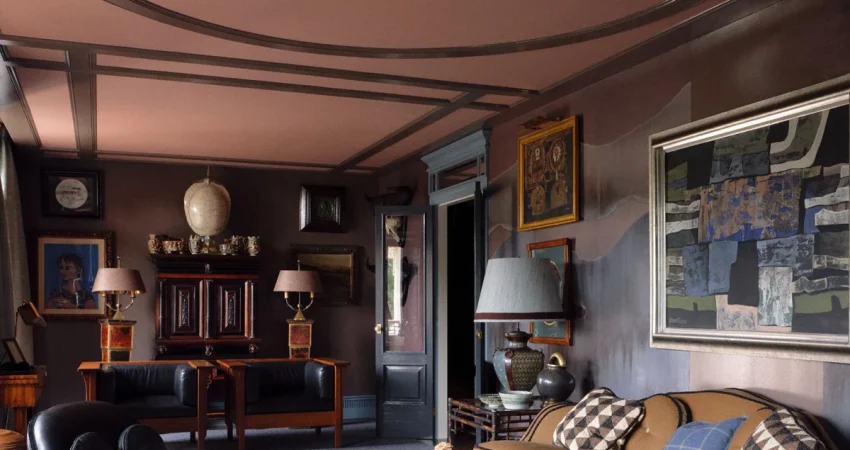
Castillo’s new home in Oviedo is a breathtaking showcase of his design philosophy, meticulously assembled from a harmonious blend of iconic furniture, esteemed artworks, and pieces by influential 20th-century designers. The apartment, a masterful combination of two previously separate units, presents an expansive and fluid living space. Every element, from the Jansen furniture to the captivating works by Gabriella Crespi and Anthony Redmile, has been thoughtfully placed within a layout that feels almost theatrical in its deliberate composition. The architectural challenge of merging two apartments into one grand residence was met with Castillo’s signature flair for creating expansive, interconnected rooms designed with the comfort of himself, his partner Alfonso, and their dog Tana in mind. The design is a sophisticated celebration of high-end interior design, subtly weaving in elements of Hollywood Regency style to imbue the space with a timeless glamour.
The Bedroom Lounge: A Sanctuary of Serenity
Within the primary bedroom suite, a Hollywood Regency-style sofa, upholstered in luxurious camel-colored mohair velvet from Castillo’s own collection, anchors the space. It is complemented by a distinguished rug from Alfombras Peña and walls adorned with lacquered panels featuring evocative Japanese wave motifs from Phillip Jeffries’ latest collection. A significant 17th-century Dutch piece of furniture adds a historical gravitas to the room, while a striking painting by artist Vaquero Turcio commands attention above the sofa. An elegant Napoleon III-style armchair, upholstered in opulent blue Rubelli silk, was a discerning acquisition from Isabel Martínez Antigüedades, further underscoring the room’s refined aesthetic.

"This is the most beautiful home I’ve ever designed," Castillo declared, reflecting on the significance of his Oviedo residence. When questioned about what sets this project apart, he quoted Karl Lagerfeld, stating, "The next house will be the best one." He then elaborated, "In this case, this home is the one," with a laugh. Castillo emphasized the importance of responding to the existing architecture. His new home is situated in a grand early 20th-century French-style building in a prime location in Oviedo, offering picturesque views of the Campo de San Francisco park. He aimed to capture the distinct northern Spanish character of the city through his color palette, acknowledging how the varying light conditions across different exposures influenced his choices.
Preserving History, Embracing Innovation
The renovation involved a significant reconfiguration, including the merging of two apartments. Castillo strategically placed the entire bedroom suite to face the Campo de San Francisco park, a deliberate choice to maximize the enjoyment of the scenic views from the master bedroom. This prime location, typically designated for living areas in buildings of this style, was reimagined to prioritize personal tranquility. The living room was consequently relocated to the rear of the apartment. Here, Castillo reintroduced a glass-enclosed gallery, an architectural element that was originally part of the apartment’s historical layout and is characteristic of Asturian design. This thoughtful integration of historical features with modern living requirements defines the residence’s unique charm.

The power of color is a fundamental element in Castillo’s design approach. He observed that the side of the apartment housing the bedroom receives less direct sunlight, especially during the afternoon. This informed his decision to employ darker, more tranquil hues in this area, creating a palpable sense of calm. In a deliberate contrast, the brighter side of the apartment, bathed in more light, features lighter color palettes. The sleeping quarters are a harmonious blend of pinks, blues, camel, and chocolate brown, all chosen for their ability to evoke a sense of peace. To soften the visual impact, the ceiling was painted a dusty pink, providing a subtle yet effective contrast. Castillo’s approach challenges the conventional notion that darker rooms require lighter colors, demonstrating that strategic use of deep tones can enhance a room’s serene atmosphere. Conversely, the brighter sections of the apartment are awash in butter, cream, ochre, and mustard tones, with generous accents of gold woven throughout.
A Passion for Gold and the Art of Balance
Castillo’s affinity for gold is not merely a stylistic preference; it is a deeply held passion. "I love it! Gold is light and warmth," he exclaimed, confessing his willingness to cover an entire room in the precious metal. He refutes the notion that gold is solely indicative of opulence or pretentiousness, emphasizing its inherent warmth. Castillo’s appreciation extends to the nuanced beauty of aged gold, particularly that which has developed a patina. He notes that even new gold, when brushed, can achieve a timeless appearance, as seen in the shower screens of his Oviedo home. While gold provides warmth and light, he also incorporates silver accents, believing that the interplay between warm and cool metals creates a dynamic and balanced aesthetic.

Redecorating and the Pursuit of Well-being
When asked about his approach to redecorating, Castillo revealed that while he doesn’t frequently alter the decor in spaces where he spends the most time, he does make changes in social areas. These adjustments, he explained, contribute to his overall sense of well-being. "Deep down, decor must always be linked to our quality of life and our search for happiness," he stated. This continuous evolution of his surroundings reflects his ongoing quest for happiness.
Castillo’s home is undeniably designed for entertaining, yet he humbly downplays any claims of being a socialite. "I’m no Truman Capote," he quipped. He identifies as a homebody, a characteristic he attributes to his Cancerian nature. This deep connection to his domestic space fuels his passion for decorating, which he describes as an integral part of his identity. "For me, there’s no greater pleasure in the world than coming home and being surrounded by my things," he confessed.

The Private Sanctum: An Apartment Within an Apartment
Within his expansive Madrid residence, Castillo has created a personal haven, a duplex apartment within the larger home that he shares with his partner, Alfonso. This intimate space, referred to as their "microcosm," is strictly off-limits to visitors, with their dog, Tana, acting as the vigilant guardian. "The first one of us who won’t let anyone in is Tana," Castillo remarked, noting her protective stance over this private sanctuary. This area, while decorated with the same aesthetic sensibility as the rest of his home, is characterized by a more relaxed, less curated feel. It is a space designed for ultimate comfort and personal expression, a departure from the more formal presentation of his public spaces. Here, a mix of cherished items, including paintings by José María Yturralde and a striking portrait of an elderly woman by the master portraitist Álvarez de Sotomayor, coexist. While artistically superb, Castillo admits that some pieces, like the Sotomayor portrait, are "a little difficult to live with" in a formal setting, but he finds immense joy in their constant presence.
A Cinematic Obsession: "Death in Venice"

Castillo’s current creative obsession is deeply intertwined with cinema, particularly the 1971 Luchino Visconti film, Death in Venice. He admits to watching the film "about 20 times" in recent months, finding new layers of inspiration with each viewing. His partner, Alfonso, has playfully questioned his sanity, to which Castillo responds, "No, Alfonso, it’s just that every time I watch it, I discover something new." He is captivated by the film’s intricate details, from the opulent drapes and exotic Indian fabrics to the Murano necklaces sold on the beach, which echo those from his grandmother’s collection. Visconti and Kubrick films, in general, serve as significant sources of inspiration for Castillo, highlighting the profound influence of cinematic storytelling on his design sensibilities.
A Legacy of Inspiration: Grandmother’s Influence and Early Aspirations
Castillo’s creative awakening was profoundly shaped by his maternal grandmother. A subscriber to the American edition of Architectural Digest during a time when it was the sole international publication, she would share the expensive magazines with a young Lorenzo. Her home, located on Madrid’s Calle Conde de Aranda, was a testament to forward-thinking design, featuring wallpaper imported from the United States, reflecting the influence of her American second husband. Her kitchen, a striking space with high-gloss turquoise walls and blue-and-white Portuguese tiles, was remarkably modern for its era and would be considered highly fashionable today. Castillo’s father, a maxillofacial surgeon, and his mother, who worked from home, instilled in him a passion for continuous redecoration. He recalls accompanying his mother on fabric shopping trips from a young age, gradually taking on more responsibility for the interior design of their home.

Navigating a Unique Path in 1970s Spain
Growing up in Spain during the 1970s, Castillo’s artistic inclinations set him apart. His father’s progressive stance, encouraging him to "Let the boy study whatever he wants," allowed him to pursue art history, despite the unconventional nature of this interest for a young boy at the time. His early educational experiences at Colegio Estudio and later at the Universidad Complutense were marked by a sense of not quite fitting in, with peers often viewing him as an anomaly. It was only after completing his university studies that Castillo realized his perceived differences were not a personal failing but rather a reflection of societal expectations. This realization marked a turning point, enabling him to embrace his unique perspective and forge his own path.
The Evolution of Spanish Interior Design: From Islamic Aesthetics to European Influence

Castillo attributes a significant contribution to Spanish interior design to Jaime Parladé, who he believes successfully cultivated an "international Spanish style," a distinct aesthetic that had previously been lacking. He also champions Rafael García, a largely overlooked pioneer of Spanish interior design. García, a Valencian entrepreneur, was instrumental in designing sets for numerous Spanish films in the 1960s and 70s. His impressive showroom in Madrid and his manufacturing facilities, with facades remodeled by Miguel Fisac, highlight his entrepreneurial vision and impact on the visual landscape of Spain.
Castillo observes a contemporary shift away from the post-World War II modernist trend of minimalism. He notes a resurgence of interest in textures, colors, patterns, and global influences, particularly from India, China, and Japan, within Spain, albeit with a different trajectory than in countries like England or France. He traces Spain’s historical aesthetic evolution back to the 15th century, when Queen Isabella I sought to modernize the country. The marriage of her daughter Joan of Castile to Philip of Burgundy initiated a move towards European interior design principles. Prior to this, Spanish aesthetics were heavily influenced by Islamic art, evident in textiles, cushions, draperies, layered rugs, and ivory-inlaid furniture—a richness and exuberance that, paradoxically, was later embraced and reinterpreted by Italian designers like Renzo Mongiardino, whose interiors often drew inspiration from the Spanish Renaissance.
The Decline of Spanish Influence and the Rise of the Bourgeoisie

Castillo posits that Spain’s diminished influence in interior design and decoration can be attributed to the late emergence of a robust bourgeoisie as a significant societal force. With a population largely comprised of peasants, a small nobility, and a centralized court, Spain lacked the burgeoning middle class that, in other European nations, drove aesthetic innovation and patronage during the 18th and 19th centuries, periods he identifies as marking Spain’s decline in this arena.
Fulfilling Dreams and the Art of Generosity
Looking ahead, Castillo expresses a continuous desire for new creative challenges. "I hope to always have the excitement of trying new things," he stated, believing that "the best is yet to come." Despite achieving considerable success with international clients over the past five years, he does not feel he has reached his ultimate aspirations. He inherited a passion for teaching from his scientist father and finds immense fulfillment in sharing his knowledge of interior design. "The joy of sharing knowledge, of teaching, of being generous with what I know, of passing on the torch, and of training the next generations of interior designers make me proud," he articulated. Castillo views interior design not as a frivolous pursuit but as a practical and creative endeavor that enhances well-being and contributes to happiness. He notes the increasing accessibility of interior design, emphasizing that curiosity and a desire to create beautiful spaces are more crucial than financial means.

The article was originally published by AD Spain and translated by John Newton.

0 Comments