
The onset of the back-to-school season has traditionally been defined by the acquisition of stationery, apparel, and electronics, yet a growing segment of the consumer market is now prioritizing the "home reset." As families transition from the fluid schedules of summer to the rigid structures of the academic calendar, the kitchen emerges as the central hub of logistical management. Recognizing this seasonal shift, premium cookware manufacturer Made In has introduced a comprehensive "Back to School" collection. This initiative aims to address the increased demand for durable, non-toxic, and professional-grade culinary tools capable of withstanding the rigors of daily meal preparation, from rapid morning breakfasts to high-volume evening dinners.
The Seasonal Transition and the Psychology of the Home Reset
The late summer period serves as a secondary "New Year" for many households. Sociological observations indicate that the return to school prompts a systematic reorganization of domestic spaces. This process typically involves a house-wide purge, the optimization of storage systems, and the replenishment of essential supplies. However, the kitchen—often the most heavily utilized room during the school year—is frequently the last to receive an upgrade.

Industry analysts note that the demands placed on kitchen equipment intensify significantly during the school months. The cycle of packing lunches, preparing nutritious breakfasts before the morning commute, and executing multi-component dinners after extracurricular activities necessitates equipment that offers both high performance and ease of maintenance. The Made In collection is positioned to meet these specific needs, offering a "clean cooking" system designed to replace worn, inefficient, or potentially hazardous older cookware.
The Evolution of Material Science in Domestic Cookware
At the core of the new collection is the CeramiClad 2.0 series, a significant technological advancement in the non-stick category. For decades, the non-stick market was dominated by coatings containing per- and polyfluoroalkyl substances (PFAS) and perfluorooctanoic acid (PFOA). While effective at preventing food adhesion, these "forever chemicals" have come under intense scrutiny from health organizations and environmental agencies due to their persistence in the human body and the environment.
Made In’s CeramiClad 2.0 utilizes a reimagined ceramic coating that is entirely free of PFAS and PFOA. Unlike traditional ceramic pans, which were often criticized for losing their non-stick properties after limited use, this 2.0 iteration is engineered for longevity. The material science involves a proprietary application process that ensures the coating releases food effectively over a longer lifecycle, even under the frequent use typical of a busy family kitchen.

Furthermore, the collection incorporates professional-grade 5-ply Stainless Clad construction. This engineering feat involves layering five different metals—typically an aluminum core for heat conductivity sandwiched between layers of stainless steel for durability and induction compatibility. This ensures even heat distribution, preventing the "hot spots" that lead to scorched food and uneven cooking, which is a critical factor for parents multitasking during meal prep.
Comprehensive Analysis of the Back-to-School Collection
The collection is structured to provide both comprehensive sets for those undergoing a total kitchen overhaul and individual pieces for strategic upgrades.
The 7-Piece CeramiClad 2.0 Set
This foundational set is designed to cover the essential spectrum of culinary tasks. It includes:

- 8-inch and 10-inch Frying Pans: Optimized for rapid tasks such as omelets or searing small proteins.
- 2-quart Saucepan with Lid: Ideal for grains, small batches of soup, or reheating leftovers.
- 3.5-quart Saucier with Lid: A versatile hybrid between a saucepan and a frying pan, featuring rounded sides that facilitate whisking and prevent ingredients from getting trapped in corners.
- 8-quart Stock Pot with Lid: A high-capacity vessel essential for boiling pasta, preparing large batches of stew, or meal-prepping for the week ahead.
Sustainable Prep Tools: The Paper Composite Innovation
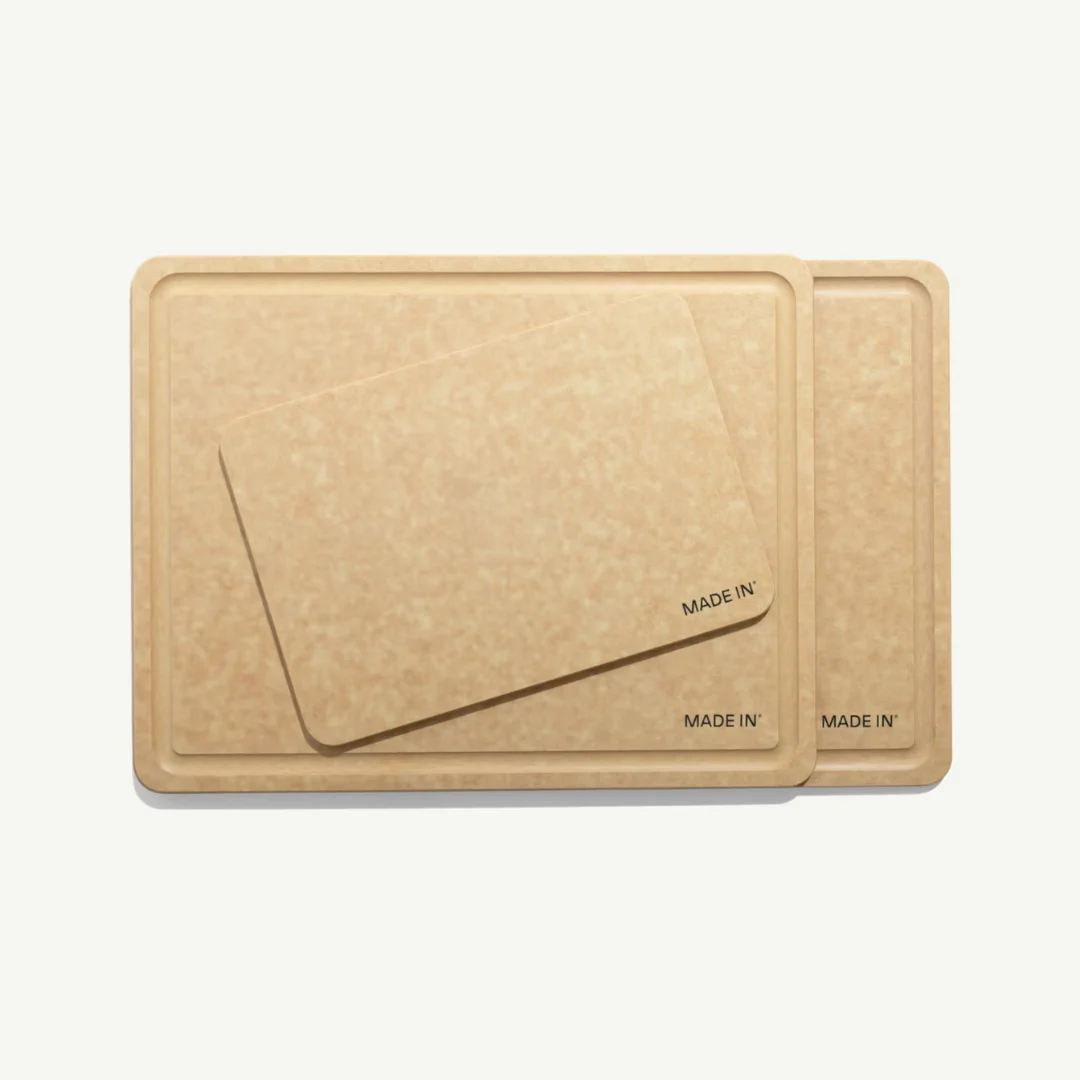
In a move toward greater sustainability and food safety, Made In has introduced a Paper Composite Cutting Board Set. Traditional plastic cutting boards are a primary source of microplastic contamination in food, while wood boards require intensive maintenance, including regular oiling and conditioning to prevent cracking and bacterial growth.
The new paper composite boards are crafted from resin-saturated paper that is compressed under high heat. The resulting material is non-porous, making it resistant to bacteria, odors, and moisture. Crucially, these boards are dishwasher-safe and microplastic-free. The three-piece set includes small (10” x 7”), medium (14” x 11”), and large (17” x 11”) variants. The medium and large sizes feature integrated juice grooves, a design element that contains liquids during the preparation of meats and fruits, thereby reducing cross-contamination risks and cleanup time.
Market Trends: The Rise of Professional-Grade Home Kitchens
The demand for high-end cookware like that offered by Made In reflects a broader shift in consumer behavior. Data from the National Retail Federation (NRF) and various market research firms suggest that back-to-school spending has expanded beyond traditional categories. In 2023 and 2024, there has been a documented uptick in "lifestyle and home" spending during the August-September window.

Consumers are increasingly viewing the home kitchen through a professional lens. This trend is driven by the "direct-to-consumer" (DTC) model, which allows brands like Made In to provide restaurant-quality tools—often used in Michelin-starred establishments—directly to home cooks at a lower price point than traditional luxury retailers. By eliminating the middleman, these brands have made professional-grade 5-ply stainless steel and carbon steel accessible to a wider demographic.
Health and Safety Implications of "Clean Cooking"
The emphasis on PFAS-free and PFOA-free products is not merely a marketing strategy but a response to evolving regulatory landscapes. In recent years, several U.S. states have moved to ban the sale of cookware containing added PFAS. The Environmental Protection Agency (EPA) has also issued stricter advisories regarding these chemicals.
For families, the kitchen serves as the primary site of health management. Upgrading to "clean" cookware is increasingly viewed as a preventative health measure. The CeramiClad 2.0 line addresses these concerns by providing a non-toxic interface for food preparation that does not off-gas toxic fumes at high temperatures, a known issue with older generations of PTFE-based (Teflon) non-stick pans.

Chronology of Innovation: Made In’s Path to the Domestic Hub
To understand the significance of this collection, one must look at the brand’s trajectory. Founded in 2017, Made In initially targeted professional chefs, partnering with renowned figures like Tom Colicchio and Grant Achatz.
- 2017-2019: Focus on Stainless Clad and Carbon Steel, establishing a reputation for durability in high-volume environments.
- 2020-2022: Expansion into the home market as the global pandemic increased the frequency of home cooking. The brand introduced enameled cast iron and initial ceramic lines.
- 2023-2024: Refinement of non-stick technology (CeramiClad 2.0) and a pivot toward sustainable prep tools (Paper Composite).
This timeline illustrates a move from specialized professional tools to a holistic "kitchen system" designed for the modern household.
Strategic Culinary Upgrades for the Academic Year
Experts in home economics suggest that a "one piece at a time" approach can be more financially sustainable for many families than purchasing entire sets. The Made In collection facilitates this by offering individual pieces that integrate seamlessly with existing kitchenware.

For instance, replacing a heavily scratched non-stick frying pan—often the most used and most damaged item in a kitchen—with a CeramiClad 2.0 pan can immediately improve meal quality and safety. Similarly, investing in a high-quality 8-quart stock pot can streamline "batch cooking," a strategy used by many parents to prepare multiple days’ worth of meals on Sundays to save time during the school week.
Broader Impact and Industry Outlook
The launch of this collection during the back-to-school season signals a permanent change in how seasonal retail is approached. It acknowledges that the "educational year" is a period of intense domestic operation that requires reliable infrastructure.
As the industry moves forward, the focus is expected to remain on material transparency and multi-functionality. Cookware that can transition from the stovetop to the oven (the CeramiClad 2.0 stock pot is oven-safe up to 550°F) and then to the dishwasher represents the pinnacle of modern convenience. By combining these functional requirements with a commitment to non-toxic materials, Made In is setting a new benchmark for the "back-to-school" market, transforming it from a season of temporary supplies into a season of long-term household investment.

0 Comments