
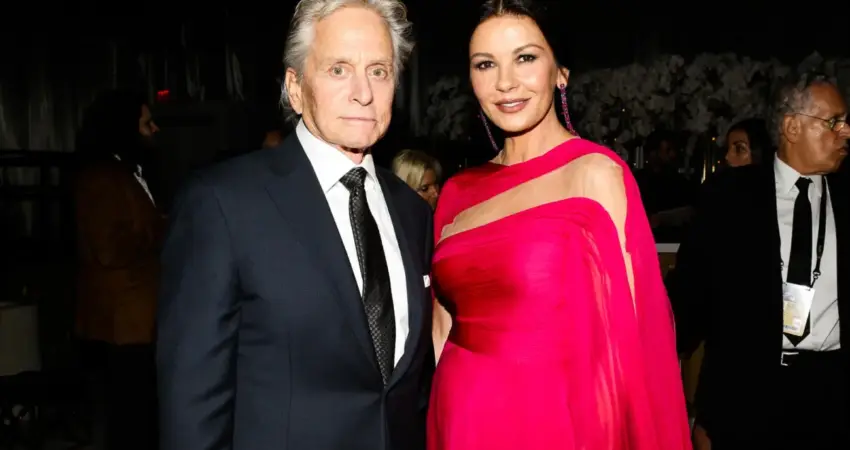
Michael Douglas, the 82-year-old Academy Award-winning actor and Hollywood icon, has recently released a candid and wide-ranging memoir titled One Helluva Ride, which offers an unvarnished look at his storied career and complex personal history. The book, which has quickly ascended to best-seller status, does not shy away from the more controversial aspects of Douglas’s life, including admissions of past infidelities and the challenges of navigating a high-profile marriage in the public eye. Central to the memoir’s narrative is Douglas’s reflection on his long-standing relationship with his wife, actress Catherine Zeta-Jones, and how his past actions—many of which occurred before they met—shape their current dynamic.
The publication of One Helluva Ride marks a significant moment in Douglas’s late-career trajectory. As a leading man who defined a specific era of American cinema through films like Wall Street, Fatal Attraction, and Basic Instinct, Douglas has often been associated with characters who grapple with moral ambiguity and sexual tension. In his memoir, he reveals that the lines between his professional roles and his personal life were occasionally blurred during the 1980s and 1990s. Specifically, Douglas admits to having affairs with his co-stars, including Kathleen Turner during the filming of Romancing the Stone and Jeanne Tripplehorn during the production of Basic Instinct. At the time of these indiscretions, Douglas was married to his first wife, Diandra Luker, with whom he shared a 23-year marriage before their high-profile divorce was finalized in 2000.
A Chronology of Hollywood Infidelity and the "B.C." Era
The timeline of Douglas’s romantic history provides essential context for the revelations found in his memoir. Douglas married Diandra Luker in 1977, a period during which his career was transitioning from television success in The Streets of San Francisco to major motion picture production and acting. By the mid-1980s, Douglas had become a global superstar. His chemistry with Kathleen Turner in the 1984 hit Romancing the Stone was palpable to audiences, and Douglas now confirms that the connection extended beyond the screen. Similarly, the 1992 thriller Basic Instinct, which became a cultural phenomenon for its provocative themes, served as the backdrop for a liaison with Jeanne Tripplehorn.
In addressing these past actions, Douglas has adopted a perspective he refers to as "B.C." or "Before Catherine." During an October 19 appearance on the Happy Sad Confused podcast, Douglas explained that he feels a sense of detachment from those events due to the significant passage of time and the chronological distance from his current life. He noted that the 25-year age difference between him and Zeta-Jones means that during his most turbulent years, she was often in an entirely different stage of life.
"I’ll be home to ask her because she just got the book two days ago… and this was all, as I say, B.C. before Catherine," Douglas remarked during the interview. He pointed out that when he was filming with Kathleen Turner in the early 80s, Zeta-Jones would have been a young child in Wales. This chronological buffer, Douglas suggests, allows for a level of transparency in his memoir that might otherwise be too painful for a spouse to encounter. He expressed confidence that his wife understands the person he was then is not the person he has been during their twenty-six years together.

Catherine Zeta-Jones: Professional Demands and a Pragmatic Response
Catherine Zeta-Jones, an accomplished actress in her own right and an Oscar winner for her role in Chicago, has responded to the memoir’s release with a blend of professional pragmatism and characteristic wit. Currently engaged in a rigorous filming schedule, Zeta-Jones has publicly stated that she has not yet prioritized reading the intimate details of her husband’s past.
Speaking to Willie Geist on the Today show on October 8, Zeta-Jones detailed her recent professional commitments, which included seven months of filming in Dublin for the third season of the hit Netflix series Wednesday, followed by work on the project Kill Jackie in London and Spain. "And as much as I love my husband, when I’m tired at night, I have no intention of reading about him. At all," she told Geist. Her comments highlight the reality of a "power couple" whose lives are often dictated by demanding schedules and international travel.
Despite her humorous dismissal of reading the book as bedtime material, Zeta-Jones has remained a staunch supporter of Douglas’s creative output. She encouraged audiences to purchase the memoir, describing it as "one helluva ride" and suggesting that Douglas’s life story is as cinematic as any of his films. This public show of solidarity serves to quiet any speculation regarding marital discord following the book’s revelations.
The Foundation of a Twenty-Six Year Partnership
The relationship between Michael Douglas and Catherine Zeta-Jones began in 1998 at the Deauville Film Festival in France. Douglas has famously recounted that after seeing Zeta-Jones in The Mask of Zorro, he told her, "I want to father your children." Despite the bold introduction and the initial skepticism from the public regarding their age gap, the couple married on November 18, 2000, at the Plaza Hotel in New York City.
The marriage has been one of the most enduring in Hollywood, though it has not been without significant challenges. The couple has navigated major health crises, including Douglas’s battle with stage IV tongue cancer in 2010 and Zeta-Jones’s public disclosure of her Bipolar II disorder. In 2013, they briefly separated to "evaluate and work on their marriage," but they reconciled shortly thereafter and have since remained a united front.
In One Helluva Ride, Douglas writes poignantly about the moment he first saw Zeta-Jones on screen, noting, "I had never fallen in love with a woman on a movie screen before… Until I saw Catherine." This sentiment underscores the narrative that while Douglas’s past was marked by the typical excesses and indiscretions of a 1980s Hollywood leading man, his meeting with Zeta-Jones represented a definitive shift in his personal values and stability.

Industry Context: The Rise of the Unfiltered Celebrity Memoir
The release of Douglas’s memoir occurs within a broader trend of high-profile celebrities choosing to reclaim their narratives through unfiltered autobiographies. In recent years, figures ranging from Prince Harry to Britney Spears and Matthew Perry have released memoirs that address addiction, infidelity, and the darker side of fame. These books often serve as a form of legacy-building, allowing veteran stars to address rumors and provide context to their public personas before they retire from the spotlight.
For Douglas, the memoir serves as a historical record of a specific era of Hollywood. His accounts of working with directors like Oliver Stone and Paul Verhoeven, and co-stars like Glenn Close and Sharon Stone, provide valuable insights into the production of films that defined the late 20th-century cinematic landscape. By including his personal failings alongside his professional triumphs, Douglas adheres to a modern standard of celebrity transparency that values authenticity over the carefully curated "star system" images of the past.
Analysis of Implications for Douglas’s Public Legacy
From a public relations and legacy perspective, Douglas’s decision to be candid about his past infidelities appears to be a calculated move toward total transparency. At 82, Douglas is in the "elder statesman" phase of his career. By addressing his "colorful" history directly, he effectively neutralizes the potential for future unauthorized biographies to use these facts as "gotcha" moments.
Furthermore, the involvement of Catherine Zeta-Jones in the promotional cycle of the book—even if through her witty refusal to read it—reinforces the image of a mature, resilient marriage. It suggests that the couple has processed these historical facts privately long before they were set to print. In an era where past behaviors are often scrutinized through a modern moral lens, Douglas’s defense of the "B.C." era seeks to contextualize his actions within the framework of a different time and a different marriage.
The success of One Helluva Ride indicates a continued public fascination with the "Old Hollywood" era of the 70s, 80s, and 90s. As Douglas and Zeta-Jones continue to balance their individual careers—with Douglas appearing in the Marvel Cinematic Universe and Zeta-Jones starring in prestige television—their ability to maintain a stable partnership while acknowledging a turbulent past remains a point of interest for both fans and industry observers.
In conclusion, Michael Douglas’s memoir is more than a collection of "naughty tales"; it is a document of survival and evolution in an industry known for its volatility. While the revelations of past affairs provide the headlines, the underlying story is one of a long-term partnership that has survived the pressures of fame, illness, and the eventual public airing of decades-old secrets. As the book continues to perform well in the marketplace, it solidifies Douglas’s position as one of the last remaining titans of a bygone Hollywood era who is willing to tell the whole truth about the ride he has taken.

0 Comments