
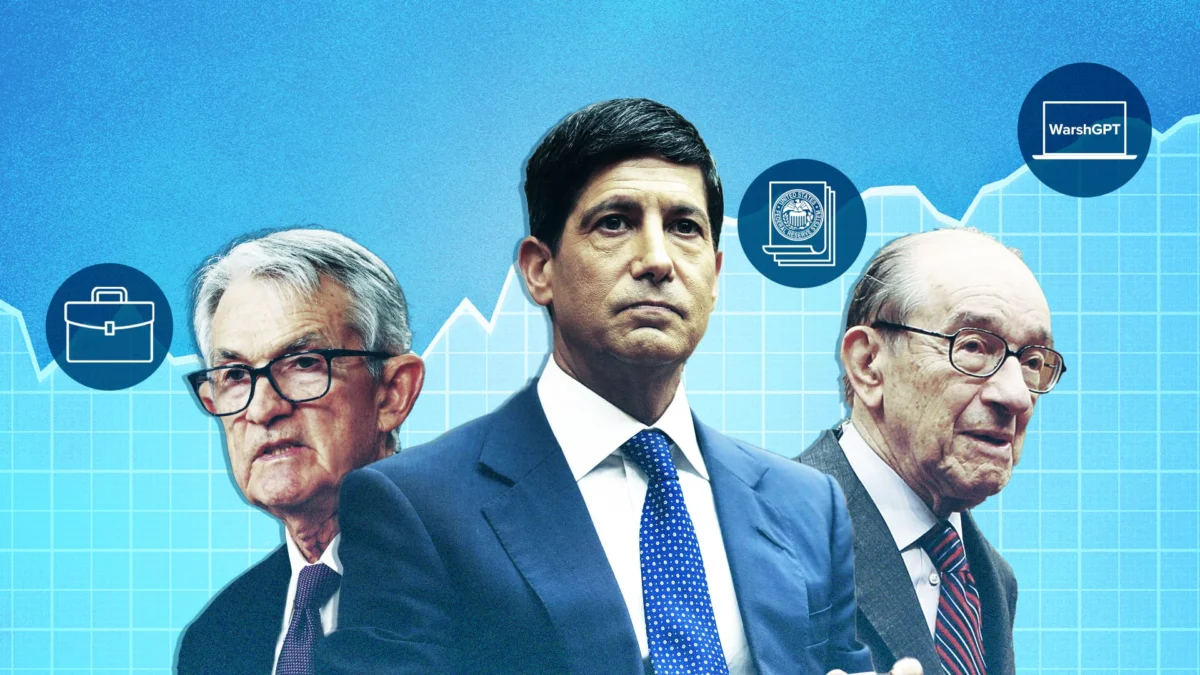
The financial world is recalibrating as Federal Reserve Chairman Kevin Warsh embarks on a significant overhaul of the central bank’s communication strategy, ushering in an era of reduced forward guidance and increased interpretive challenge for market participants. This pivot, initiated since Warsh took the helm in May, has profound implications for investment firms, economists, and even the everyday retail investor, compelling them to devise new tools and strategies to decode the Fed’s intentions.
The Genesis of a New Era: Chairman Warsh’s Vision for Central Bank Communication
Chairman Kevin Warsh’s appointment to lead the Federal Reserve marked a pivotal moment for the institution and global financial markets. Known for his tenure as a Fed Governor from 2006 to 2011, Warsh arrived with a reputation for intellectual rigor and a distinct perspective on monetary policy and central bank operations. His past experience included navigating the initial phases of the 2008 financial crisis, giving him unique insights into market dynamics and the efficacy of various Fed interventions. It was this background, many analysts suggest, that informed his decision to re-evaluate the Fed’s communication framework.
Upon assuming the chairmanship in May, Warsh swiftly signaled his intent to shift away from the expansive, often jargon-heavy "Fedspeak" that characterized previous administrations. His philosophy, as inferred by market watchers, appears rooted in a desire to reduce market over-reliance on explicit forward guidance. Proponents of such a shift argue that overly prescriptive communication can inadvertently constrain the Fed’s operational flexibility, leading markets to "front-run" policy decisions and potentially creating undue volatility if the Fed deviates from previously signaled paths. By "going quiet," Warsh may aim to foster more genuine price discovery, encourage markets to focus on fundamental economic data rather than central bank pronouncements, and reassert the Fed’s independence from daily market gyrations. This approach seeks to return a degree of mystery to central bank decision-making, compelling investors to analyze economic conditions and the Fed’s dual mandate (maximum employment and price stability) more holistically, rather than relying on explicit signals.
The immediate manifestations of this new philosophy were stark. The June Federal Open Market Committee (FOMC) meeting statement, the first under Warsh’s chairmanship, served as a potent indicator of the coming changes. CNBC analysis revealed the statement contained approximately 130 words, a dramatic reduction from the figures often exceeding 300 words seen in prior publications under his predecessor, Jerome Powell. Significantly, Warsh explicitly acknowledged the statement was "shorter" and "simpler," and, crucially, confirmed it purposefully excluded forward guidance. This omission alone sent ripples through markets accustomed to parsing every nuance of the Fed’s projections for future interest rate paths, economic outlooks, and balance sheet adjustments.
Further cementing this shift, Warsh’s inaugural post-decision press conference as chairman allocated a mere 5% of his sentences to policy-relevant topics, according to an analysis by UBS. This figure stands in stark contrast to the 27% average observed during press conferences under former Chairman Jerome Powell. The reduction in explicit policy discussion indicated a deliberate move to de-emphasize the chairman’s role as a direct market guide, instead focusing on broader economic principles and the Fed’s long-term objectives. This strategic reticence immediately presented a formidable challenge for financial institutions whose investment theses are intricately linked to predicting the Fed’s trajectory.
The Market’s Response: Decoding the Silence with AI and Advanced Analytics
For firms like F/m Investments, located just a short drive from the Federal Reserve’s Washington, D.C., headquarters, the shift felt like a vast increase in distance. Alexander Morris, CEO of F/m Investments, articulated the challenge: "We’ve made a pretty good business out of decoding Fedspeak," referring to the often-arcane language employed by central bank leaders. "And he just said he was going to go quiet on us." This sudden absence of explicit signals threatened to disrupt established investment strategies that thrived on anticipating the Fed’s next moves concerning interest rates, inflation, and U.S. Treasurys.
In response to this unprecedented communication landscape, F/m Investments rapidly innovated, releasing "WarshGPT." This artificial intelligence-powered tool is a testament to the urgency and creativity within the financial sector. Built using Anthropic’s Claude model – a sophisticated large language model – and despite its name being a playful nod to rival OpenAI’s ChatGPT, WarshGPT was developed with remarkable speed. It took approximately two weeks from inception to public release, and at a cost of less than $1,000, it represents an accessible yet powerful solution.
WarshGPT’s core functionality involves parsing nearly 1,800 documents and transcripts from Kevin Warsh’s public record. By analyzing this extensive corpus of speeches, testimonies, and interviews, the AI tool aims to help users understand how Warsh may analyze issues related to the economy or monetary policy, rather than predicting what he will do. It provides insights into his intellectual framework, his preferred economic indicators, and his philosophical leanings. To ensure contextual accuracy, the product also taps into a vast repository of economic and political history. However, F/m has set clear boundaries: WarshGPT is programmed not to speak as Warsh and will not offer forward statements or forecasts, thereby avoiding the very speculative pitfalls the Fed chairman himself is seeking to diminish. Its development included rigorous pre-rollout testing by a select group of experts, including Fed alumni and prominent financial newsletter writers, ensuring its robustness and relevance.
F/m Investments is not alone in this adaptive scramble. Across the financial industry, institutions are re-evaluating their analytical frameworks and investing in new technologies to gain an edge. UBS, the Swiss banking giant, has developed an interactive dashboard for its clients designed to track the Fed’s policy tone. Elena Amoruso, a strategist at UBS, explained that this tool offers an unbiased assessment of Warsh’s commentary during meetings, helping clients navigate the less explicit communication. Following Warsh’s debut policy meeting, Amoruso’s analysis highlighted an "overwhelmingly hawkish" tone in his policy-relevant comments, driven by his views on the labor market, economic growth, and the persistent state of inflation. She emphasized the high stakes involved, noting, "Arguably, this is the most high-value data set… in terms of how much one word can move dollars."
JPMorgan Asset Management, another major player, is also preparing for a more opaque future. David Kelly, the firm’s chief global strategist, has outlined contingency plans. Should the Fed discontinue the "dot plot" – the quarterly publication of individual FOMC members’ projections for future interest rates – Kelly’s team would intensify its scrutiny of speeches by members of the Federal Open Market Committee. The FOMC, comprised of the seven members of the Board of Governors and five of the twelve Federal Reserve Bank presidents, is the principal body responsible for setting interest rates. By meticulously analyzing individual members’ public statements, Kelly’s team hopes to reconstruct a consensus or identify divergent views that might foreshadow future policy actions. However, Kelly also noted that major changes to Fed communication would likely unfold over several months, allowing institutions time to adjust. "Just like the Federal Reserve says it can be patient in adjusting interest rates to the economy, we can be patient in adjusting our resources," he commented, suggesting a measured approach to adaptation.
Historical Precedents: Echoes of Greenspan’s Enigma

The current shift under Chairman Warsh evokes strong parallels with previous eras of Federal Reserve communication, particularly the tenure of Chairman Alan Greenspan. From 1987 to 2006, Greenspan became synonymous with a deliberately opaque communication style, often referred to as "Greenspan-speak." His public statements were legendary for their complexity, their liberal use of economic jargon, and their ability to convey very little concrete information despite appearing highly analytical. Market participants and Fed watchers often joked that Greenspan simply saying "good evening" could trigger a market decline, such was the intensity of their search for hidden signals.
A famous, albeit anecdotal, example of market obsession with Greenspan’s signals was the "briefcase indicator." This theory posited that if Greenspan arrived at a congressional hearing or public event with a noticeably bulkier briefcase, it suggested he had accumulated more evidence or data that might warrant an alteration in borrowing costs. While humorous, this anecdote perfectly illustrates the desperate lengths to which markets would go to glean insights from a central bank leader who preferred ambiguity.
Greenspan’s approach had its defenders, who argued that it preserved the Fed’s flexibility, preventing markets from locking into specific expectations and allowing the central bank to respond dynamically to evolving economic conditions without being constrained by past pronouncements. However, critics argued that such opacity could increase market uncertainty, making it harder for businesses and consumers to plan, and potentially leading to misallocations of capital.
The post-Greenspan era saw a general movement towards greater transparency within the Federal Reserve, particularly under Chairmen Ben Bernanke, Janet Yellen, and Jerome Powell. This shift was driven by a belief that clear communication, including explicit forward guidance, could better anchor market expectations, reduce volatility, and enhance the Fed’s accountability. Concepts like the "dot plot" and detailed summaries of economic projections became standard tools. Warsh’s current recalibration, therefore, represents a significant departure from this recent trend, suggesting a re-evaluation of the benefits and drawbacks of heightened central bank transparency.
Implications for Economic Stability and Market Dynamics
The transition to a less transparent Federal Reserve carries significant implications for both economic stability and market dynamics. Steve Friedman, a former New York Fed alum and now a senior macroeconomist at MacKay Shields, captured this duality: "If there’s less communication about the reaction function, I actually think that’s a negative for the economy." This perspective stems from the idea that uncertainty can breed caution, potentially dampening investment, hiring, and overall economic activity. Businesses might delay expansion plans if they are unsure about future borrowing costs or the Fed’s commitment to specific economic goals.
However, Friedman also pointed out that "less clarity about what the Fed may do can actually be a source of alpha for investors if you have a robust framework for thinking about the economy and monetary policy." "Alpha" refers to the excess return of an investment relative to the return of a benchmark index. In an environment where easily digestible central bank signals are scarce, investors who can accurately interpret complex economic data and anticipate policy shifts through their own sophisticated models and analyses stand to gain a significant advantage. This creates a potential divergence: while the broader economy might face headwinds from uncertainty, highly skilled and well-resourced institutional investors could find new opportunities for outperformance.
For retail traders and ordinary investors, the landscape is becoming considerably more challenging. Gary Richardson, a former historian at the central bank and now an economics professor at the University of California, Irvine, succinctly stated, "For ordinary investors, it’s already really hard for them to figure out what’s going on. It’s going to become much harder." He advises retail traders to further diversify their portfolios to account for added policy uncertainty. Without clear signals, individual investors relying on traditional news and public statements may struggle to accurately assess risk and make informed decisions, potentially increasing their vulnerability to market swings.
Investment firms, meanwhile, are expected to significantly increase their spending on expertise. Richardson predicts a hiring boom for Fed alumni and economists with deep institutional knowledge, as their insights become invaluable in a lower-transparency environment. These experts can provide nuanced interpretations of the sparse official communications, analyze the historical context of policy decisions, and offer informed conjectures on the likely motivations and leanings of key FOMC members.
The immediate impact of this communication shift is already evident in divergent market expectations. According to CME’s FedWatch tool, fed funds futures traders are pricing in an almost 59% likelihood that the central bank will increase interest rates in September. This indicates a significant portion of the market anticipates a hawkish move. Conversely, traders on the Kalshi prediction market platform believe it is most likely that the Fed will keep rates unchanged at that same meeting. Such discrepancies underscore the heightened difficulty in forming a consensus view on monetary policy without explicit forward guidance, illustrating how different data interpretations and analytical models can lead to contrasting outlooks in the absence of clear central bank signals.
Christopher Waller, a prominent Fed Governor, has already emerged as a key figure to watch in this new environment. Steve Friedman described Waller as a "bellwether" for the broader committee. Waller recently stated that the Fed should not be focused on "fighting the last war" with inflation, suggesting a forward-looking approach, but also cautioned that interest rate hikes could still be on the table. Such nuanced statements from individual governors will gain amplified importance as the chairman himself recedes from providing direct guidance.
The Path Forward: Navigating an Evolving Landscape
As the Federal Reserve embarks on this new chapter under Chairman Warsh, the financial ecosystem is being forced to adapt at an unprecedented pace. The shift towards reduced transparency represents a philosophical realignment, challenging market participants to develop more sophisticated analytical capabilities. The rise of AI-powered tools like WarshGPT, alongside enhanced human expertise and refined quantitative models, will be crucial for navigating this evolving landscape.
While the immediate future may bring increased market volatility and interpretive challenges, particularly for less sophisticated investors, the long-term implications remain to be fully understood. The Fed’s objective may be to foster a more resilient market that relies less on central bank hand-holding and more on fundamental economic analysis. As David Kelly of JPMorgan Asset Management wisely observed, patience will be key for both the Fed in implementing its changes and for market participants in adjusting their strategies. The financial world is unequivocally entering a new era of central bank communication, demanding innovation, adaptability, and a deeper understanding of the subtle signals that will now define monetary policy.

0 Comments