
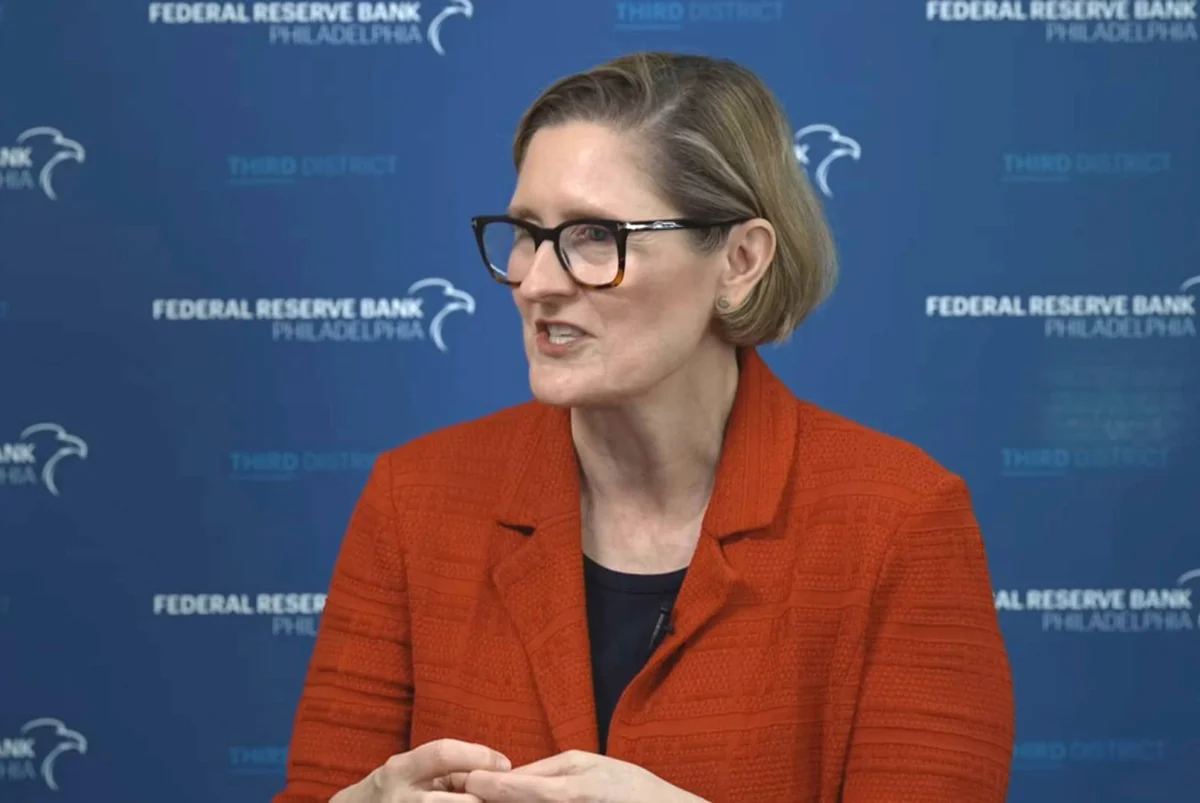
Philadelphia Federal Reserve President Anna Paulson stated emphatically on Tuesday that she believes the current level of interest rates is sufficient to guide inflation back towards the central bank’s long-term target of 2%. Speaking in her inaugural interview with CNBC, Paulson underscored her commitment to an open-minded approach regarding the future trajectory of monetary policy but expressed unwavering confidence in her recent vote to maintain the benchmark federal funds rate at its prevailing target range of 3.5%-3.75%. Her remarks provide critical insight into the ongoing internal deliberations within the Federal Open Market Committee (FOMC), highlighting a nuanced yet firm stance amidst persistent inflationary pressures.
Paulson’s Stance on Monetary Policy
"I think we need… policy that’s mildly restrictive, and I think policy has been mildly restrictive to get underlying inflation back down to 2% in an acceptable time period," Paulson conveyed to CNBC’s Steve Liesman during a "Squawk Box" interview. She emphasized the necessity of observing tangible progress from this point forward, indicating a data-dependent approach to future policy adjustments. This perspective positions Paulson firmly within the majority faction of the FOMC, which opted to hold rates steady at its most recent meeting. Her definition of "mildly restrictive" is crucial, suggesting that the current rate level, while not aggressively tightening, is adequately curbing demand to bring inflation under control without severely stifling economic growth. This delicate balance is at the core of the Fed’s strategy to achieve a "soft landing," avoiding a recession while reining in price increases.
The Federal Reserve’s Dual Mandate and Inflation Target
The Federal Reserve operates under a dual mandate from Congress: to achieve maximum employment and maintain price stability. The 2% inflation target, specifically for the Personal Consumption Expenditures (PCE) price index, is the quantitative representation of its price stability goal. This target, formally adopted in 2012, provides a clear benchmark for policymakers and market participants. For years leading up to the COVID-19 pandemic, the Fed struggled to consistently reach this 2% target, with inflation often running below it. However, the economic landscape dramatically shifted in 2021 and 2022, as unprecedented fiscal stimulus, supply chain disruptions, robust consumer demand, and geopolitical events, particularly the war in Ukraine and its impact on energy prices, propelled inflation to multi-decade highs.
The current challenge for the Fed is to bring inflation back down to this 2% target without triggering a sharp economic downturn. This involves carefully calibrating the federal funds rate, which influences borrowing costs across the economy, impacting everything from mortgage rates to business investment. The debate within the FOMC often centers on the precise level of restrictiveness required and the appropriate pace of policy adjustments to navigate these complex economic currents.
Understanding "Mildly Restrictive" Policy
The concept of a "mildly restrictive" policy is central to Paulson’s argument. In economic terms, a monetary policy is considered restrictive when the real federal funds rate (the nominal rate minus inflation) is above the "neutral rate of interest" (often denoted as R-star). The neutral rate is the theoretical interest rate that neither stimulates nor restricts economic growth, allowing the economy to operate at its full potential with stable inflation. Estimating the neutral rate is notoriously difficult, with various models suggesting it could be anywhere from 0% to 1% in real terms, implying a nominal neutral rate of 3-4% if long-run inflation expectations are around 2%.
Paulson’s confidence in the 3.5%-3.75% range implies her belief that this level is indeed above the neutral rate, thus exerting sufficient downward pressure on aggregate demand. She specifically noted that her assessment of underlying inflation, excluding volatile components like energy supply shocks and tariffs, sits in the range of 2.4%-2.8%. This internal estimate is considerably lower than the 3.3% core PCE inflation rate reported by the Commerce Department for June, which the Fed uses as its primary forecasting tool. This discrepancy suggests Paulson views a significant portion of current inflation as transient or non-core, which might naturally abate, requiring less aggressive monetary intervention.
The Recent FOMC Decision and Dissenting Voices
The Federal Open Market Committee’s decision last week to keep rates steady was not unanimous. The 9-3 tally reflected a significant internal debate, with three voting members dissenting in favor of a rate hike. These dissenting policymakers, whose identities are typically revealed in meeting minutes, have consistently argued that the current rate level is not sufficiently restrictive to decisively bring inflation down to the 2% target in a timely manner. Their concerns often stem from the persistence of elevated inflation metrics, strong labor market data, and the potential for inflation expectations to become unanchored if the Fed appears hesitant.
For Paulson, however, the decision was straightforward. "For me, it was not a close call," she stated, reiterating her conviction in the current policy stance. This clear divergence of opinion underscores the challenges inherent in formulating monetary policy in an uncertain economic environment. While the majority, including Paulson, believes the cumulative effect of past rate hikes is still working its way through the economy, the dissenters advocate for pre-emptive action to guard against the risk of entrenched inflation. This debate reflects the perennial tension between the risks of overtightening and triggering a recession versus undertightening and allowing inflation to become a more persistent problem.
The Inflation Landscape: A Detailed Look
Understanding the current inflation landscape is crucial to appreciating the Fed’s policy choices. Following the initial surge in 2021-2022, driven by supply chain bottlenecks, robust consumer spending fueled by stimulus, and energy price spikes, inflation peaked at 9.1% year-over-year in June 2022, as measured by the Consumer Price Index (CPI). Since then, a combination of easing supply pressures, the Fed’s aggressive rate hikes, and some normalization of demand has led to a deceleration.
The PCE price index, the Fed’s preferred measure, also showed significant increases, peaking at 7.0% year-over-year in June 2022. The core PCE, which excludes volatile food and energy components, peaked at 5.4% in February 2022. While these headline figures have come down, they remain stubbornly above the 2% target. The 3.3% core PCE reported for June, for instance, still indicates a significant gap that needs to be closed. Paulson’s internal estimate of 2.4%-2.8% for underlying inflation suggests a more optimistic view on the trajectory of price pressures, possibly focusing on lagging indicators or specific components that are showing more rapid deceleration. This distinction between headline, core, and underlying inflation metrics often forms the basis of different policy views within the FOMC.

Economic Indicators Informing Policy
Monetary policy decisions are inherently data-dependent, with the FOMC closely monitoring a broad array of economic indicators.
- GDP Growth: The U.S. economy slowed to a 1.5% growth rate in the second quarter, as reported by the Commerce Department. This moderation in growth, while still positive, suggests that the Fed’s tighter monetary policy is having the intended effect of cooling economic activity without plunging it into recession. Paulson’s "mildly restrictive" assessment aligns with this moderate growth, indicating a desired slowdown.
- Labor Market: The labor market has remained remarkably resilient, with unemployment rates near historic lows. While wage growth has moderated slightly, it remains elevated, raising concerns for some policymakers about a potential wage-price spiral. A strong labor market, however, also provides a buffer against a severe downturn.
- Consumer Spending: Consumer spending, a major driver of economic growth, has shown resilience but also signs of slowing in certain sectors, influenced by higher interest rates and persistent inflation eating into purchasing power.
- Business Investment: Higher borrowing costs typically deter business investment, which can slow future growth and hiring. The Fed monitors these trends to gauge the broader impact of its policy.
Paulson’s focus on "progress" suggests she will be keenly observing these and other indicators in the coming months, particularly those that shed light on underlying inflationary pressures and the balance between demand and supply in the economy.
The Debate Over Monetary Policy Efficacy
The internal debate within the FOMC reflects a broader discussion among economists and market participants about the efficacy of current monetary policy. Some argue that historical evidence suggests that once inflation becomes entrenched, it requires more aggressive and sustained monetary tightening to dislodge it. They point to the risk of the Fed pausing too early, leading to a resurgence of inflationary pressures and necessitating even more painful measures later. This group often advocates for higher rates for longer, even if it entails a greater risk of recession.
Conversely, others, like Paulson, believe that the cumulative effect of past rate hikes has not yet fully materialized due to typical lags in monetary policy transmission. They contend that continuing to hold rates steady allows these previous actions to work their way through the economy, bringing inflation down without unnecessarily triggering a deep recession. They emphasize the risks of overtightening, which could lead to widespread job losses, business failures, and prolonged economic stagnation. The "mildly restrictive" stance seeks to achieve disinflation through a gradual reduction in demand rather than an abrupt shock.
Paulson’s willingness to "recalibrate monetary policy" if progress is not observed indicates a conditional commitment to the current stance, dependent on incoming data. This flexibility is a hallmark of modern central banking, acknowledging the inherent uncertainties in economic forecasting and policy effectiveness.
Market Reactions and Investor Sentiment
Financial markets closely scrutinize every statement from Fed officials, seeking clues about future policy moves. Paulson’s remarks, particularly her confidence in the current "mildly restrictive" policy and her dismissal of the need for immediate rate adjustments, likely reinforce market expectations for a prolonged pause in rate hikes. Bond yields, particularly for shorter-term Treasuries, tend to react to such statements, reflecting altered perceptions of future interest rates. Equity markets, while initially welcoming a pause in hikes, also weigh the implications of persistent inflation and the potential for a slower economic growth trajectory.
The market’s interpretation of "mildly restrictive" often involves assessing the duration for which rates are expected to remain at their current elevated levels. If the Fed signals a longer period of maintaining higher rates, even without further increases, this can still have a restrictive effect on financial conditions, influencing investment decisions and consumer borrowing. Paulson’s comments suggest that while the Fed might be done raising rates for now, it is not contemplating cutting them anytime soon, a sentiment that aligns with the "higher for longer" narrative prevalent in some market segments.
Broader Economic Implications and Future Outlook
The implications of the Fed’s current policy stance are far-reaching. For consumers, stable interest rates mean that borrowing costs for mortgages, auto loans, and credit cards may not rise further, but they will remain elevated compared to recent history. This continues to weigh on demand for interest-sensitive goods and services, particularly housing. For businesses, higher borrowing costs affect investment decisions, potentially slowing expansion and hiring.
The path forward for the Fed, as articulated by Paulson, is clearly data-dependent. "If we don’t see that progress, then we have to be open to recalibrating monetary policy. You know, we need to get to 2%," she affirmed. This suggests that upcoming inflation reports, labor market data, and consumer spending figures will be critical in shaping future FOMC decisions. The central bank’s credibility hinges on its ability to return inflation to its target, and Paulson’s statement underscores this unwavering commitment.
Beyond immediate rate decisions, Paulson also touched upon broader operational discussions within the Federal Reserve, acknowledging Chairman Kevin Warsh’s initiatives, including the potential to reduce the frequency of FOMC meetings from the current eight per year. "It’s healthy to have a discussion about that," she remarked. Such discussions, while not directly related to monetary policy calibration, reflect an ongoing assessment of the Fed’s governance and operational efficiency in a rapidly evolving economic and technological landscape. These administrative considerations, alongside the critical task of inflation management, paint a comprehensive picture of the complex responsibilities shouldered by the Federal Reserve and its leadership.

0 Comments