
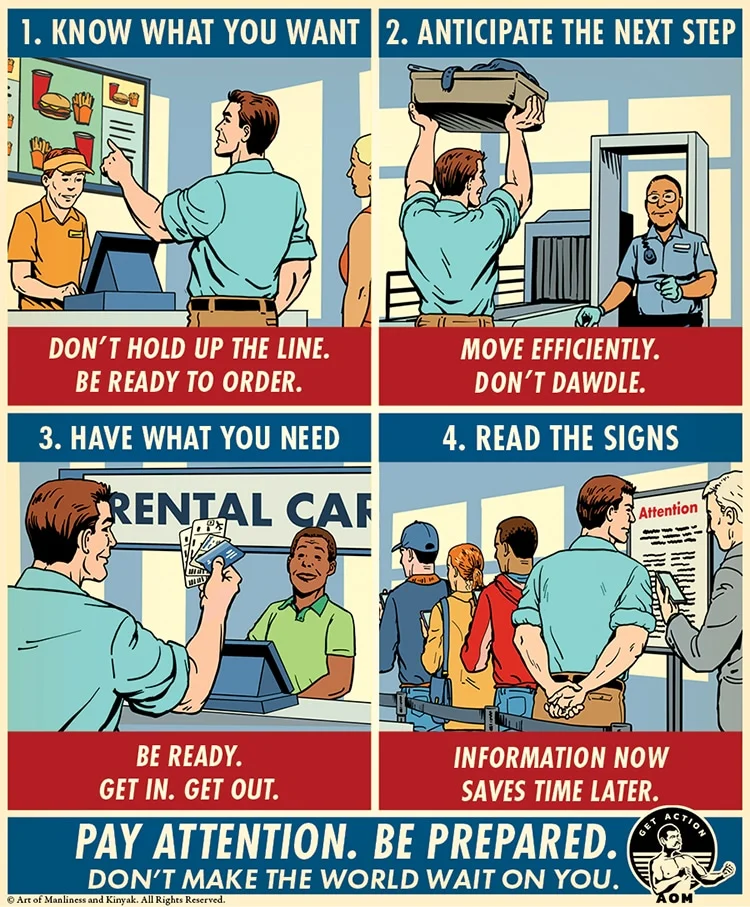
The erosion of social situational awareness in public spaces has emerged as a significant contributor to systemic inefficiency in service-oriented environments. From fast-food establishments and car rental agencies to government offices and airport security checkpoints, a growing trend of unpreparedness among consumers is creating measurable bottlenecks. This phenomenon, often characterized by a lack of attention to posted instructions and a failure to anticipate the requirements of a transaction, represents more than a minor social annoyance; it reflects a broader shift in how individuals interact with their physical and social surroundings in an increasingly digitized world.
The Landscape of Modern Public Interaction
The modern consumer landscape is designed for efficiency, yet the human element often serves as the primary point of failure. Comedian Sinbad famously critiqued this behavior in a routine regarding McDonald’s, noting that despite the menu remaining largely static for decades, customers frequently reach the front of the line without having decided on their order. This observation serves as a microcosm for a wider societal trend where individuals appear "caught flat-footed" by routine interactions.
In high-stakes environments, such as car rental counters, the consequences of this lack of preparation are more pronounced. Despite signs clearly indicating the necessity of a driver’s license, credit card, and confirmation details, agents frequently report that customers only begin searching for these items once they have reached the service desk. Similarly, at United States Postal Service (USPS) locations, the requirement for passport appointments—clearly stated on websites and physical signage—is frequently ignored, leading to service delays and interpersonal conflict between staff and the public.
A Chronology of Declining Situational Awareness
The decline in social situational awareness can be traced through several technological and cultural shifts over the last two decades.
- The Pre-Digital Era (Pre-2000s): Before the ubiquity of smartphones, individuals waiting in line were forced to engage with their surroundings. This often involved reading posted menus, observing the transactions ahead of them, and preparing physical currency or documents in advance.
- The Rise of Mobile Distraction (2007–2015): With the introduction of the smartphone, the "dead time" of waiting in line was filled with digital engagement. This period marked the beginning of "inattentional blindness," where individuals became less aware of environmental cues and signage.
- The Automation Pivot (2016–Present): As human-to-human interactions became increasingly inefficient due to customer distraction, industries pivoted toward kiosks and mobile ordering. However, this has created a secondary issue: when individuals are forced to interact with a human agent, they have lost the "muscle memory" of social preparedness.
- Post-Pandemic Friction (2021–Present): Following the COVID-19 pandemic, service industries reported a sharp increase in "customer incivility." Behavioral analysts suggest this is partly due to the frustration that arises when unprepared customers encounter the friction they themselves helped create.
Supporting Data: The Economic and Psychological Cost of Delays
The impact of unpreparedness is quantifiable. According to research in operations management, even a 30-second delay per customer in a high-volume queue can lead to a 20% increase in total wait time for those at the back of the line. This cumulative effect, known as "queue friction," has direct economic implications.
In the fast-food industry, drive-thru efficiency is a primary Key Performance Indicator (KPI). Data from 2023 industry reports suggests that the average drive-thru time has increased significantly since 2019, partly due to more complex orders but also due to slower customer response times at the speaker box.
Psychologically, the "Psychology of Waiting Lines," a landmark study by David Maister, posits that "unoccupied time feels longer than occupied time." When a customer at the front of the line is unprepared, they are essentially forcing everyone behind them into a state of "unproductive waiting," which heightens stress and decreases customer satisfaction across the board. Furthermore, the "Social Situational Awareness" deficit contributes to what sociologists call "collective friction"—the small, unnecessary hurdles that make daily life in a high-density society more taxing.
Industry and Official Responses
In response to the growing trend of customer obliviousness, various sectors have implemented strategies to force awareness or bypass the human element entirely.
- Transportation Security Administration (TSA): The TSA has increasingly utilized "Queue Comms"—agents whose sole job is to walk the line and verbally repeat instructions regarding laptops, liquids, and footwear. This is a direct response to the fact that static signage is no longer sufficient to capture the attention of the modern traveler.
- Car Rental Agencies: Companies like Hertz and Avis have heavily invested in "skip the counter" programs. By allowing prepared customers to bypass the human interface entirely, they mitigate the delays caused by unprepared customers at the desk.
- Retail and Food Service: The implementation of digital kiosks is not merely a labor-saving measure; it is a way to standardize the "order time" and reduce the pressure on staff to manage customers who have not yet read the menu.
While these technological solutions help, they do not address the underlying issue of human agency. Industry experts suggest that the most "high-agency" individuals—those who navigate the world with efficiency and purpose—are becoming a distinct minority in a sea of "passive consumers."
The Concept of High Agency and the "Listo" Mindset
A key factor in navigating the world effectively is what some cultures refer to as being listo. In Spanish, the term translates to "ready" or "sharp." It describes a person who is perpetually prepared for the next step of a process. This mindset is the antithesis of the "sleepwalking" behavior observed in modern queues.
High-agency individuals exhibit specific behaviors that reduce social friction:
- Environmental Scanning: They read all signage upon entering a facility to understand the protocol.
- Predictive Preparation: They identify the "critical path" of a transaction (e.g., needing a ID or a specific app) and have those items ready before they are requested.
- Observation of Friction Points: They watch previous transactions to identify where others are struggling and adjust their own behavior to avoid the same pitfalls.
- Clarification Seeking: If a protocol is unclear, they ask for clarification immediately upon reaching the agent, rather than waiting for the agent to discover the confusion.
Broader Impact and Societal Implications
The lack of situational awareness has implications that extend beyond the checkout counter. It is a symptom of a broader withdrawal from the public sphere. When individuals are tethered to their devices, they stop practicing the "small-scale diplomacy" required to keep a society running smoothly.
The "bottleneck effect" created by unpreparedness contributes to a general sense of societal malaise. When every interaction—from getting a coffee to boarding a plane—takes longer than necessary, it reduces the overall "velocity" of a city or organization. This leads to increased irritability, lower productivity, and a breakdown in social cohesion.
Moreover, there is a pedagogical concern. As younger generations grow up in an environment where technology "pre-thinks" for them, the cognitive skill of situational awareness may continue to atrophy. Educators and behavioral scientists have noted that the ability to "read a room" or understand a complex physical process is a skill that must be practiced.
Conclusion: The Call for Social Vigilance
The "PSA: Know What You’re Doing" is more than a plea for faster service; it is a call for a return to social vigilance and personal responsibility. By committing to being present and prepared, individuals can significantly reduce the collective friction of modern life.
The win-win-win scenario is clear: the service representative experiences a more efficient and less stressful interaction; the individual customer saves time and avoids the stress of a "scramble"; and the public at large benefits from a more fluid and functional environment. In a world increasingly defined by digital distraction, the act of paying attention has become a form of social currency—one that costs nothing but provides immense value to the community.
To be a "high-agency" participant in society is to recognize that one’s own preparedness is a contribution to the common good. The directive is simple: pay attention, be prepared, and do not make the world wait.

0 Comments