
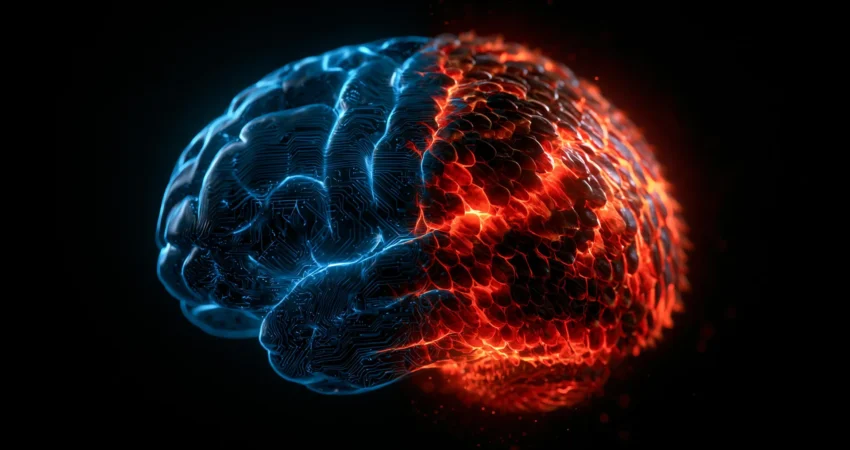
The seemingly perennial conflict between reasoned decision-making and gut instinct, often portrayed in popular culture as a battle between a sophisticated human brain and an ancient "lizard brain," is a dramatic oversimplification of complex neurobiology. A groundbreaking study, published in the esteemed journal Science Advances, challenges this long-held, layered view of brain evolution, proposing instead that the intricate development of neural architecture is dictated by a fundamental competition between distinct wiring strategies, rather than the simple accretion of new regions atop older ones. This research, spearheaded by Nabil Imam, an assistant professor at Georgia Tech’s School of Computational Science and Engineering and a key member of the Institute for Neuroscience, Neurotechnology, and Society (INNS), offers a compelling new paradigm for understanding how brains – both biological and artificial – are constructed and evolve.
Challenging the "Lizard Brain" Orthodoxy
For decades, a prevalent theory in neuroscience posited that the brain evolved sequentially, with more primitive functions localized in older, deeper structures, and complex cognitive abilities emerging in newer, superficial layers. This "reptilian brain" versus "mammalian brain" versus "neocortex" model, popularized in the mid-20th century, suggested a hierarchical stacking of evolutionary advancements. However, as Imam explains, this linear progression fails to resonate with the nuanced perspective of evolutionary biologists. "There was a theory proposed in the ’50s that the brain evolved in layers starting with basic bodily functions, to emotions in the reptilian brain, leading up to sophisticated reasoning in humans," Imam stated in an interview. "This is not how an evolutionary biologist would think about the problem."
The new research shifts the focus from the age of brain regions to the fundamental organizational principles of neural connections. By analyzing the structural blueprints of both biological brains across a diverse range of species and the architecture of artificial neural networks, Imam and his collaborators have uncovered evidence suggesting that evolution operates more like a strategic allocation of finite brain resources. The brain, they propose, engages in a computational tug-of-war between two fundamentally different wiring methodologies, both of which are established early in development, even before birth. This intricate interplay has profound implications, potentially demystifying long-standing evolutionary puzzles and paving the way for more efficient and sophisticated artificial intelligence systems.
Deconstructing the "Lizard Brain" Myth
The popular dichotomy of "logical brain" versus "lizard brain" is a convenient, albeit imprecise, metaphor. The neocortex, the outermost layer of the human brain, is indeed the seat of higher cognitive functions such as reasoning, language, and consciousness. Its intricate folding and vast surface area are associated with complex perception, problem-solving, and abstract thought.
The "lizard brain," however, is a far more nebulous concept. Often conflated with the limbic system, this collection of brain structures plays a crucial role in emotions, memory, motivation, and survival instincts. Imam clarifies the anatomical and functional diversity within this system: "The limbic system, sometimes called the ‘reptilian brain,’ controls emotion broadly speaking — but it also has other components with distinct functions." This system encompasses regions vital for processing olfactory information, forming memories, navigating the environment, and regulating emotional responses. The persistent grouping of these disparate functions into a single, undifferentiated "reptilian brain" has long been a point of contention, lacking a unifying theoretical explanation for their shared evolutionary trajectory.
To address this, the research team embarked on a comparative evolutionary analysis, examining not individual brain structures in isolation, but how the limbic system and the neocortex varied in tandem across numerous species. A striking pattern emerged: when certain parts of the limbic system were relatively enlarged, other limbic regions tended to follow suit, while the neocortex, conversely, often exhibited a diminished size. This observed co-variation strongly suggests that these systems are not evolving independently but rather undergo coordinated expansion and contraction as a unified network. "Rather," Imam emphasized, "it’s a coordinated expansion of these regions across species." This finding reframes the limbic system as an integrated network whose components evolve in concert, rather than a disparate collection of ancient relics.
The Fundamental Architectures: Spatial Mapping vs. Barcode Encoding
The critical question then became what drives this coordinated evolutionary shift. Imam’s hypothesis centers on the pre-natal wiring strategies that establish the fundamental organization of neural circuits. The neocortex, for instance, is characterized by a spatial mapping organization. In this architecture, functionally related neural regions are physically proximate. For example, brain areas processing sensory input from the thumb and index finger are located near each other, mirroring the spatial arrangement of the body parts they represent. Similar spatial organization is observed in systems dedicated to processing visual and auditory information.
In stark contrast, the limbic system employs a different organizational principle, which the researchers liken to a "barcode" encoding. Instead of spatial proximity, information is represented through distributed patterns of neural activity. Complex memories or specific olfactory cues are not localized to a single area but are encoded across a network of interconnected neurons, much like a barcode’s pattern of bars and spaces encodes information.
To empirically test whether these distinct wiring strategies were innate architectural biases or primarily learned through experience, the researchers employed artificial neural networks. They constructed AI models designed with either localized, spatial connections or distributed, "barcode-style" networks. The results were illuminating: networks built with spatial connectivity excelled at tasks mirroring sensory processing, such as image recognition and auditory discrimination. Conversely, the distributed, "barcode-style" networks demonstrated superior performance in tasks requiring smell recognition and memory recall. This strongly indicates that these wiring strategies are fundamental architectural predispositions that confer specific functional advantages.
An Evolutionary Arms Race for Brain Space
The consistent variation in the relative sizes of these brain systems across species led the researchers to investigate the underlying evolutionary pressures. The core principle at play is the concept of limited resources. Brains, like all biological systems, operate within constraints of space and energy. Natural selection, therefore, favors the wiring strategy that provides the greatest survival advantage in a given ecological niche.
To simulate this evolutionary competition, the team developed a multimodal artificial network capable of integrating both spatial and distributed systems, allowing them to compete for computational "real estate." In their simulations, environments that heavily rewarded olfactory processing led to the expansion of the distributed system at the expense of the spatial neocortical regions. Conversely, environments prioritizing visual processing resulted in the opposite pattern, with the neocortex growing and the distributed system shrinking.
This dynamic trade-off offers a compelling explanation for the striking anatomical differences observed in real-world animals. The nine-banded armadillo, for example, with its highly developed sense of smell and reliance on subterranean foraging, possesses a disproportionately large limbic system. In contrast, the squirrel monkey, which thrives in arboreal environments and relies heavily on its keen eyesight for navigation and foraging, exhibits a brain dominated by a larger neocortex. Across the 182 species meticulously analyzed in the study, the findings collectively suggest that brain evolution is not a linear accumulation of new, more sophisticated layers, but rather a dynamic reallocation of neural resources between competing wiring systems, driven by the adaptive demands of survival.
Lessons from Brain Evolution for the Future of AI
The implications of this research extend far beyond the realm of evolutionary biology, offering profound insights for the development of artificial intelligence. By understanding and potentially replicating the inherent architectural biases that shape biological brains, engineers may be able to create AI systems that learn more efficiently and operate with significantly less computational power and data.
Imam draws a clear distinction between current AI training methodologies and biological learning processes. "Today’s artificial neural networks are trained by vast amounts [of] data — it’s about nurture," he observes. "But the brain is not a blank slate that gets trained by experience. It is a mix of nature and nurture, and the nature is that pre-wired architecture." This "nature" component, the intrinsic wiring strategy, provides a powerful foundation upon which experience can build.
The potential to translate these biological architectural principles into AI systems could lead to more "brain-like" intelligence, capable of learning and functioning with the remarkable efficiency that characterizes biological brains. This could usher in an era of AI that requires substantially less energy consumption and fewer training data sets, addressing some of the most significant challenges facing the field today.
This pioneering research was a collaborative effort involving scientists from Cornell University and received vital support from the National Science Foundation, underscoring the importance of interdisciplinary research in unraveling complex scientific questions. The findings represent a significant leap forward in our understanding of brain evolution and hold the promise of revolutionizing artificial intelligence.

0 Comments