
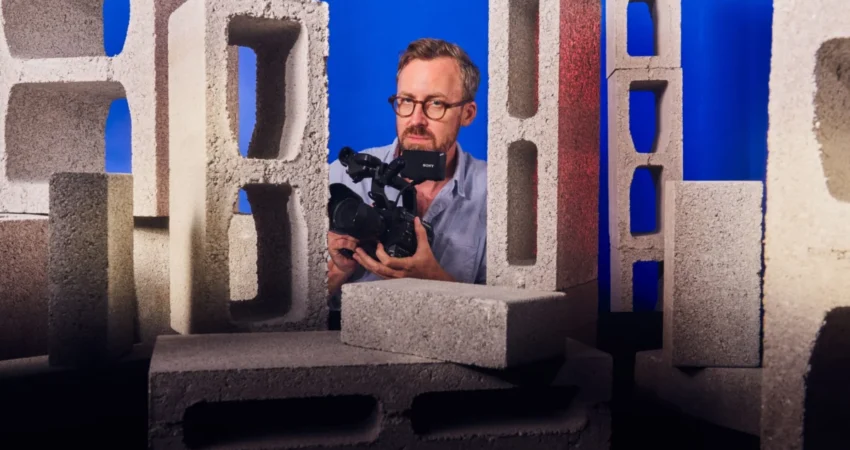
Filmmaker John Wilson’s latest cinematic offering, The History of Concrete, is not merely a documentary about the ubiquitous building material that forms the backbone of our modern world. It is a profound, often poignant, and occasionally darkly humorous exploration of urban infrastructure, societal neglect, and the enduring human desire to build for eternity. The film, which premiered on September 18th, uses concrete as a starting point to delve into the complexities of our built environment, challenging viewers to confront the impermanence of their surroundings and the forces that shape them.
A Foundation in Question: From Queens to the World Trade Center
The genesis of Wilson’s fascination with concrete can be traced back to a personal struggle with his own home in Ridgewood, Queens. A cracked foundation, allowing stormwater to seep into his living space, prompted a deeper investigation than a typical homeowner might undertake. "Most people just hire a contractor," Wilson shared during an interview from a kitchen on the 35th floor of One World Trade Center, a towering testament to concrete’s capabilities. "But I got a bunch of books and wanted to understand concrete on a more molecular level, to figure out what my house is even made of, and whether or not repairing it now is going to save me a headache in the future." This drive to understand the fundamental nature of the materials that define our lives led him on a global journey, tracing concrete’s ancient origins to Italy, where Roman structures built nearly two millennia ago still stand. The stark contrast between these enduring relics and the disrepair evident in his own home, and indeed in much of contemporary urban infrastructure, became a central question driving the film: if concrete can last for thousands of years, why does so much of our modern built world seem to be crumbling?

The "Million Things at Once" Documentary
Clocking in at an hour and 40 minutes, The History of Concrete defies easy categorization. Wilson, known for his Emmy-nominated HBO series How to With John Wilson, employs his signature documentary style, blending observational footage with a disembodied voiceover that acts as a guide through the film’s intricate tapestry of ideas. His camera lingers on the often-overlooked details of urban life – the peculiar rituals of street vendors, the fleeting interactions of pedestrians, and the silent narratives etched into the city’s fabric. This approach, which he describes as capturing "outrageous and ordinary moments that people might briefly register in passing, but never stop to engage with," allows the audience to experience the city in a more profound and reflective way.
While the film ostensibly explores the material itself – its composition, its history, and its global prevalence as the second-most-used substance on Earth after water – it quickly expands its scope. Wilson uses concrete as an entry point to examine the systemic issues plaguing urban environments. He investigates the failing infrastructure of New York City, highlighting the precarious state of public pools, sidewalks marred by years of chewing gum, and critical arteries like the Brooklyn-Queens Expressway.
Examining Crumbling Infrastructure: A City on the Brink?

The film features a notable segment with Sam Schwartz, the former New York City Traffic Commissioner, renowned for coining the term "gridlock." Standing beneath the triple-cantilever of the Brooklyn-Queens Expressway, a vital route for an estimated 130,000 vehicles daily, Schwartz points to exposed rebar, warning of the potential for catastrophic failure without immediate intervention. This dire prediction underscores the film’s broader concern about the deferred maintenance of essential urban systems.
The implications of such infrastructure decay are far-reaching. Beyond the immediate safety risks, the deterioration of transportation networks can lead to significant economic disruptions, increased commute times, and a diminished quality of life for residents. While the film notes that New York City subsequently announced a $4 billion, 10-year rehabilitation plan for this section of the expressway, a move intended to extend its lifespan by another 40 years, Wilson’s point about the recurring cycle of neglect and urgent, costly repair remains a powerful indictment of current urban planning and investment strategies.
The Paradox of Luxury and Decay: 432 Park Avenue
Wilson’s critique extends to the city’s most exclusive enclaves. The film casts a critical eye on 432 Park Avenue, a supertall skyscraper on Manhattan’s "Billionaire’s Row." Despite units selling for upwards of $80 million, the building’s concrete structure is reportedly riddled with cracks, and its facade has been observed shedding material. This paradox highlights the film’s central argument: that even the most opulent structures are not immune to the material failures that plague the rest of the city. It suggests that the problems are not confined to a lack of funding for public works but may also stem from issues in design, construction, or the very materials used, even in high-end projects.

The Politics of "Not in My Backyard": Stalled Progress and Civic Discord
Beyond what is built poorly, Wilson is equally concerned with what isn’t built at all, particularly in the realm of affordable housing and community amenities. He provocatively labels The History of Concrete "one of the most NIMBY movies I’ve ever seen," as his camera immerses the audience in the contentious world of civic hearings and protests. NIMBYism, or "Not In My Backyard," emerges as a significant obstacle to urban progress, where well-intentioned projects, such as affordable housing complexes and skate parks, become focal points of neighborhood resistance.
This aspect of the film delves into the complex interplay between individual property rights, community desires, and the pressing need for urban development. While there may be broad agreement on the desirability of these projects, the willingness of residents to cede space or accept the perceived disruptions associated with them often proves to be a significant hurdle. The film implicitly asks whether this resistance, driven by a desire to preserve the status quo, ultimately contributes to the very decay Wilson documents, by preventing necessary upgrades and new developments.
A Call for a "Thousand-Year City"

At its core, The History of Concrete is a plea for more deliberate and long-term thinking about urban development. Wilson advocates for the concept of a "thousand-year city," a vision that contrasts sharply with what he perceives as the prevailing "50-year" approach to urban planning and construction. This forward-looking perspective challenges the current economic models that often prioritize short-term gains over sustainable, enduring urban environments.
The film draws inspiration from urban theorists like Jane Jacobs, author of The Death and Life of Great American Cities, who "lit a fire" for Wilson in 2008. He also cites James Howard Kunstler’s Geography of Nowhere and William H. Whyte’s The Social Life of Small Urban Spaces as formative texts. Whyte’s observational work, which meticulously documented how people interact with their urban surroundings, particularly the social life of small urban spaces, resonated with Wilson. "Whyte’s work proves a point that wasn’t really proven up until then—that there are certain needs we have as people, and as social creatures," Wilson explained. "Being able to identify the ways that the city tries to suppress that is important."
The Architect of Observation: Wilson’s Cinematic Approach
While not an architect himself, Wilson’s decade-plus immersion in urban theory and his keen observational skills allow him to dissect complex urban issues with accessible language and relatable examples. His filmmaking style, often described as a "dérive" in the spirit of Guy Debord, guides viewers through the city’s unplanned pockets of interest, revealing the subtle yet significant ways in which design and engineering failures impact everyday life. This humble presentation, he suggests, belies a deep engagement with the subject matter.

The film doesn’t shy away from the emotional toll of grappling with such issues. Wilson admits that the research and filming process was emotionally taxing, leaving him "living with the full dosage of a lot of really depressing trivia about concrete." He likens his approach to that of a "Mr. Bean" type, seemingly bumbling through complex subjects, yet arriving at profound insights.
A Cycle of Building, Decay, and Rebuilding
The film concludes with a thought-provoking encounter with actor Michael Imperioli, who, when asked for advice for aspiring filmmakers, simply states: "To make it as inexpensively as they can, and to get it done." This seemingly pragmatic response, Wilson suggests, mirrors the broader approach to building and development in contemporary society – a cycle of construction, decay, failure, and rebuilding that he labels "our collective architectural samsara." Whether this is an inherent condition of human civilization or a symptom of our current economic and societal priorities, Wilson leaves for the audience to ponder.
The History of Concrete is more than just a film; it is an extended meditation on the foundations of our society, both literal and metaphorical. It challenges us to look beyond the surface of our cities and consider the materials that bind them, the systems that support them, and the future we are collectively building, or failing to build, for generations to come. The film’s release, and the dialogue it is sure to spark, comes at a critical juncture, as cities worldwide grapple with aging infrastructure, housing crises, and the escalating impacts of climate change, making Wilson’s unflinching gaze on the very substance of our urban existence more relevant than ever.

0 Comments