
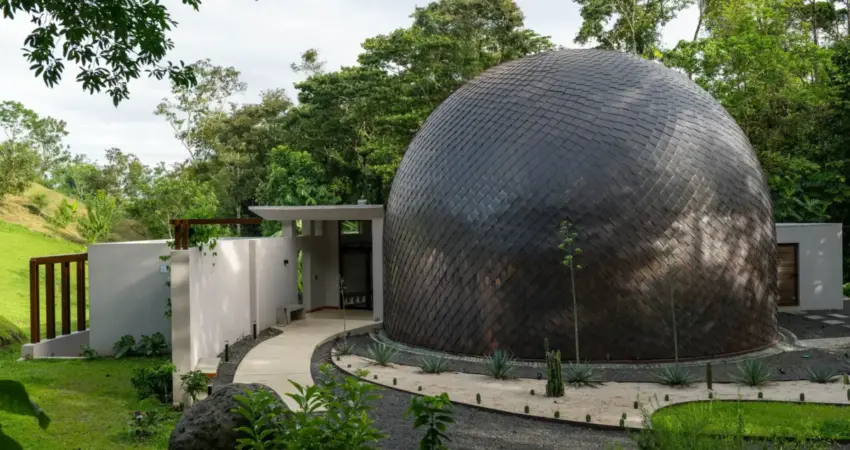
The global wellness industry has reached a new intersection of technology and natural immersion with the opening of The Vessyl, a specialized resort in the northern highlands of La Fortuna, Costa Rica, which identifies as the world’s first 4D sound resort. Situated on 118 acres of rainforest beneath the Arenal Volcano, the facility represents a significant departure from traditional wellness models that emphasize physical detoxification or basic spa services. Instead, The Vessyl focuses on "internal engineering" and nervous system regulation through high-fidelity acoustic technology, bio-imaging, and artificial intelligence. This development comes as Costa Rica experiences a rapid expansion in its wellness sector, which has seen a 58% market increase since 2019, according to data from the Global Wellness Institute.
The Frequency Dome: A Convergence of Architecture and Acoustics
The centerpiece of the resort is the Frequency Dome, a copper-scaled structure designed to facilitate immersive sound experiences that guests can physically feel rather than just hear. The facility was developed over an 11.5-year period in collaboration with George Augspurger, a Grammy Award-winning acoustician known for his work in studio design. The technical architecture of the Dome features a custom floating floor embedded with 24 transducers—devices similar to those used in advanced theme park attractions—to transmit frequencies directly through the ground.

According to Chad Wittman, Chief Operating Officer of The Vessyl, the integration of spatial audio and haptic feedback is designed to trigger a "nervous system reset." The space serves multiple functions, ranging from vibrational yoga and fractal visual projections to live performances and scientific research. An adjacent recording studio provides a venue for artists and scientists to experiment with the therapeutic applications of specific frequencies, suggesting a broader ambition for the resort to serve as a laboratory for acoustic wellness.
Quantifiable Wellness: Bio-Well Scans and Energetic Mapping
A core component of the guest experience at The Vessyl is the use of Gas Discharge Visualization (GDV) technology. Upon arrival, guests undergo a "Bio-Well" scan, a diagnostic tool developed by Russian physicist Konstantin Korotkov. The device captures electro-photonic images of a person’s fingertips to generate data on stress levels, energy distribution, and organ-specific regulation.
This data-driven approach allows the facility to provide guests with a "biorhythm" chart, mapping physical, emotional, and intellectual cycles. By quantifying the physiological impact of external stressors—such as grief, professional anxiety, or physical ailment—the resort aims to provide a baseline for personal optimization. This shift toward "biohacking" and biometric monitoring reflects a growing trend in the luxury travel sector, where consumers increasingly demand measurable outcomes and scientific validation for wellness interventions.

The Integration of Human Design and Artificial Intelligence
The Vessyl utilizes a complex personal mapping system known as "Human Design" to tailor guest experiences. This system, established in 1987 by Alan Robert Krakower, synthesizes elements of the Kabbalah, the I Ching, numerology, the chakra system, and quantum physics to create a "bodygraph" based on an individual’s birth data.
In a novel application of modern technology, The Vessyl leverages artificial intelligence to process these bodygraphs and generate personalized audio narratives. During sessions in the Frequency Dome, guests receive messages allegedly crafted by AI to resonate with their specific psychological and energetic profiles. While some critics argue that such highly intellectualized frameworks may lead to "over-optimization," proponents suggest that these tools provide a necessary roadmap for navigating the complexities of modern life. Svetlana Parmar, lead facilitator at the resort, noted that the goal is to help guests recognize their inherent traits and reduce the friction caused by societal expectations.
Physiological Mechanisms of Somatic Breathwork
Beyond the high-tech acoustic sessions, the resort employs somatic breathwork to induce altered states of consciousness. These sessions involve controlled, rhythmic breathing patterns—typically three seconds in and three seconds out—for extended periods. Dr. Diva Nagula, Co-Founder and Chief Medical Officer at The Vessyl, explained the medical foundation behind the practice.

"During active, connected breathing, carbon dioxide levels fall, which temporarily raises blood pH and reduces cerebral blood flow," Dr. Nagula stated. This process activates the sympathetic nervous system, often resulting in physical sensations such as tingling, muscle tightening, or "energy moving through the body." As the brain’s regions for emotion and memory—the amygdala and hippocampus—are affected, participants frequently report emotional releases or visual hallucinations. The integration period following the breathwork allows the parasympathetic nervous system to take over, leading to profound states of relaxation and mental clarity.
Strategic Location and Regional Economic Context
The selection of La Fortuna as the site for The Vessyl is strategically aligned with Costa Rica’s "Pura Vida" branding and its status as a premier destination for eco-tourism. The resort limits its capacity to 32 guests at a time, ensuring a high ratio of staff to visitors and maintaining the tranquility of the 118-acre rainforest setting. Accommodations, such as the "Sky Tree House" built on stilts, are designed to minimize environmental impact while maximizing the sensory connection to the rainforest.
Costa Rica’s wellness industry is a vital component of its national economy. The Global Wellness Institute’s recent data highlights that the country has successfully pivoted from traditional nature tourism to a more sophisticated "wellness-plus" model. By combining natural assets—like the geothermal activity of the Arenal Volcano—with high-tech facilities, the region is attracting a demographic of high-net-worth individuals looking for sophisticated mental health and longevity treatments.
.png)
Founders and the Philosophy of Wellness Innovation
The Vessyl was founded by Josh Stanley, a prominent figure in the cannabis and CBD industry. Stanley and his brothers gained international recognition in 2013 for developing "Charlotte’s Web," a high-CBD hemp strain used to treat pediatric epilepsy. Stanley’s transition from plant-based medicine to frequency-based wellness reflects a consistent theme in his career: the mainstreaming of formerly niche or taboo therapeutic modalities.
During an inaugural dinner at the resort, Stanley emphasized the importance of pioneering new categories of health. Just as CBD sparked a global conversation about the medicinal properties of hemp, Stanley views 4D sound and vibrational therapy as the next frontier in holistic health. The resort’s philosophy posits that as the world becomes increasingly digital and disconnected, humans require more sophisticated "vessels" for reconnection—both with themselves and with the natural environment.
The Intersection of Technology and Animal-Assisted Therapy
Despite the heavy emphasis on 4D sound and AI, The Vessyl maintains a connection to traditional therapeutic practices, specifically equine-assisted therapy. Guests participate in sessions with a "horse whisperer," such as Enrique Molina, who uses Criollo horses to mirror human emotions. Horses, known for their sensitivity to human temperament, provide immediate feedback on a guest’s state of confidence, fear, or hesitation.
.jpg)
This combination of ancient animal-human bonds and futuristic technology highlights the resort’s multifaceted approach. While the Frequency Dome offers a controlled, engineered environment for introspection, the rainforest and its inhabitants provide an unpredictable, organic counterpoint. This duality is central to the resort’s mission: using technology to sharpen human awareness of the natural world.
Broader Implications for the Future of Wellness
The launch of The Vessyl signals a shift in the global wellness narrative. The industry is moving away from passive experiences—such as standard massages or facials—toward active, tech-enhanced transformations. The use of spatial audio, biometric scanning, and AI-driven personalization suggests a future where wellness is not just a luxury, but a precisely calibrated medical and psychological intervention.
However, the rise of such "high-interference" wellness also raises questions about the role of simplicity in mental health. As guests use Oura rings, Bio-Well scans, and AI bodygraphs to monitor their every metric, the challenge for facilities like The Vessyl remains ensuring that the technology serves to enhance, rather than replace, the fundamental human experience. The success of this model will likely depend on its ability to balance the "New-New Age" tech with the timeless restorative power of the environment in which it is situated.

As the resort continues its operations, it plans to launch a dedicated mobile application, allowing guests to continue their "human design" journey and acoustic therapy sessions after returning home. This extension of the resort experience into the daily lives of guests represents a new frontier in the hospitality industry, where the relationship between the brand and the consumer is sustained through ongoing digital and wellness support.

0 Comments