
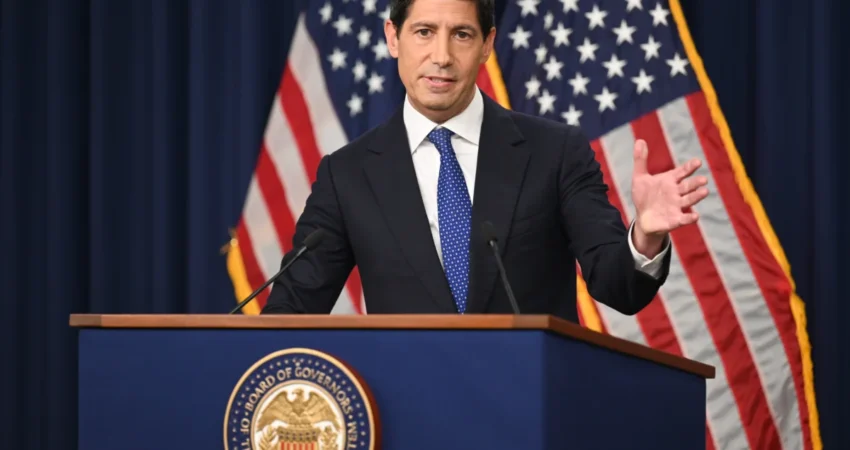
Federal Reserve Chair Kevin Warsh, addressing a news conference at Federal Reserve headquarters in Washington on September 16, 2026, confirmed the central bank’s decision to raise interest rates by a quarter percentage point, marking the first such increase since 2023. This move, which brings the benchmark federal funds rate to a target range of 3.75%-4%, has not only reasserted the Fed’s commitment to price stability but has also ignited a fervent debate among economists and investors regarding the future trajectory of monetary policy. Warsh’s carefully chosen words, notably describing the action not as a "tightening" but as merely removing "a dose of accommodation," have left markets pondering the extent and duration of the current tightening cycle, particularly given his apparent disavowal of traditional frameworks like the neutral rate.
A Pivotal Policy Shift: The September 2026 Rate Hike
The Federal Open Market Committee (FOMC), under Chair Warsh’s leadership, voted to lift the benchmark rate following its latest policy meeting. This decision was presented against a backdrop of a U.S. economy that Warsh characterized as having "strengthened," accompanied by financial conditions that have become "less restrictive." The language employed by Warsh immediately drew scrutiny, as it deviates from the more conventional lexicon of previous Fed chairs who often framed rate hikes as a tightening of monetary policy designed to cool an overheating economy or combat inflation. By opting for "removing a dose of accommodation," Warsh suggested that despite the recent hike, monetary policy might still be considered supportive of economic growth, implying that further adjustments could be necessary to achieve a truly neutral or restrictive stance.
The significance of this semantic choice was not lost on market participants. Krishna Guha, head of economics and central bank strategy at Evercore ISI, highlighted the phrase as "the one stand-out hawkish element" of Warsh’s post-meeting commentary. Guha further emphasized that this was not an accidental slip but a "deliberate choice to frame policy in this way," repeated several times by the Chair. Such framing, according to Guha, is "substantively different to that used by the Fed in recent years, and raises the possibility of a more open-ended approach to the number of hikes that might be required." This distinct communication strategy has injected an element of uncertainty into market expectations, replacing the more explicit forward guidance that characterized previous eras of Fed leadership.
The Economic Backdrop: Navigating Persistent Inflation and Robust Growth
To fully appreciate the context of the September 2026 hike, one must recall the economic landscape that preceded it. The period following the 2023 rate increase saw the U.S. economy grappling with a complex mix of persistent inflationary pressures and resilient growth. After an aggressive series of rate hikes between 2022 and 2023, which saw the federal funds rate rise from near-zero to a peak of 3.50%-3.75% to tame inflation that had soared past 9% (CPI, mid-2022), the economy experienced a period of stabilization. Inflation, as measured by the Personal Consumption Expenditures (PCE) price index, had gradually receded from its peaks, briefly dipping below 2.5% in early 2025. This moderation, coupled with signs of a potential slowdown in global growth, prompted the previous Fed Chair, Jerome Powell, to implement what were widely dubbed "insurance cuts" in late 2025, lowering the benchmark rate by 50 basis points to a range of 3.00%-3.25%. These cuts were intended to provide a buffer against a potential recession and support a "soft landing."
However, the economic narrative shifted once more in early to mid-2026. Data revealed a reacceleration of inflationary pressures, with the core PCE index creeping back towards 3% by August 2026. The labor market remained remarkably robust, with the unemployment rate consistently hovering around a tight 3.6%, and wage growth, while moderating slightly, still showing upward momentum. Gross Domestic Product (GDP) growth for the second quarter of 2026 registered an annualized rate of 2.8%, indicating a strong and expanding economy. Consumer spending, buoyed by solid employment and rising incomes, continued to be a significant driver of economic activity. This confluence of resilient demand, persistent inflation, and a tight labor market created a clear imperative for the Federal Reserve to reconsider its accommodative stance. Kevin Warsh, who assumed the Chairmanship in early 2026, inherited an economy that, despite the earlier "insurance cuts," was showing signs of overheating. His first rate hike, therefore, was a direct response to these evolving conditions, aimed at aligning monetary policy with the Fed’s dual mandate of achieving maximum employment and maintaining price stability, specifically targeting a 2% inflation rate over the longer run.

The Neutral Rate Conundrum: A Departure from Traditional Benchmarks
A central point of contention and a source of market mystification emerged from Warsh’s direct challenge to the operational relevance of the "neutral rate." The neutral rate, often referred to as r-star (r*), is a theoretical interest rate that neither stimulates nor constrains economic growth. For over a decade, central bankers and market analysts have extensively used this concept to gauge the stance of monetary policy. Benchmark rates significantly above the neutral rate are considered restrictive, while those closer to or below neutral are deemed accommodative. When CNBC’s Steve Liesman directly questioned Warsh about where he saw the current rate of 3.75%-4% sitting relative to neutral, the Chair offered a definitive, and for many, surprising, response.
Warsh stated that measuring the benchmark rate against neutral is "useful academically. It’s a discussion to help us think about policy. Do I think it has any operational effect of decisions that we make today? No, I don’t." This rejection of a long-standing analytical framework for current policy decisions marks a significant departure from the communication strategies of his predecessors. Past Fed chairs, while acknowledging the inherent uncertainties in estimating r*, typically framed policy discussions within this conceptual framework. Warsh’s dismissal suggests a shift towards a more pragmatic, perhaps less explicitly guided, approach to monetary policy, where decisions are made based on real-time economic data and an assessment of "financial conditions" rather than adherence to theoretical constructs. This contributes to the perception of Warsh as a chairman who is developing a reputation for being cryptic regarding the inner workings of his policy tuning.
Market Reactions and Future Expectations: An Open-Ended Path
The immediate aftermath of Warsh’s press conference saw a flurry of activity and speculation across financial markets. The bond market reacted swiftly, with Treasury yields rising as investors priced in a higher probability of future rate hikes. The yield on the 2-year Treasury note, highly sensitive to Fed policy, saw a noticeable uptick, reflecting increased expectations for short-term rates. In the equity markets, the reaction was mixed, with some sectors sensitive to higher interest rates experiencing declines, while others, buoyed by the perceived strength of the underlying economy, showed resilience.
The most tangible shift in expectations was reflected in the probabilities derived from the CME Group’s FedWatch Tool. By Friday morning, just two days after the FOMC meeting, the market-implied odds of another rate increase at the Fed’s next meeting in October had surged to nearly 58%, up significantly from 42% a week prior. This pronounced shift underscored how Warsh’s commentary, particularly the "dose of accommodation" remark and the dismissal of the neutral rate, had been interpreted as unequivocally hawkish.
Major financial institutions quickly revised their forecasts. Goldman Sachs, for instance, added an October hike to its projections, anticipating a continued path of monetary tightening. Bank of America similarly adjusted its outlook, expecting not only an October increase but also another move in December, signaling a more aggressive end to 2026 than previously envisioned. James Egelhof, chief U.S. economist at BNP Paribas Securities, articulated the market’s interpretation clearly: "The word ‘accommodation’ means ‘stimulus’ at the Fed; this comment implies that the current monetary policy stance is meaningfully stimulative." He further elaborated, "With policy starting at a stimulative stance, a strong cyclical impulse, and persistent inflation, we think significant rate increases, perhaps more than the three we expect, may be necessary to stabilize the unemployment rate from below and prevent overheating next year." This sentiment suggests a growing consensus that the Fed is embarking on a sustained period of removing stimulus.
Looking further ahead, futures markets began pricing in a fed funds rate of approximately 4.635% near the end of 2027. This implies an expectation of three to four additional quarter-percentage point hikes beyond the September 2026 move, pushing the terminal rate significantly higher than prior estimates. Such a trajectory would effectively unwind many of the "insurance cuts" implemented by Warsh’s predecessor, Jerome Powell, who now serves on the committee as a governor, providing a fascinating dynamic within the FOMC.

Broader Economic Implications: Ripples Across Sectors
The implications of Warsh’s policy shift extend far beyond financial market speculation, potentially impacting various sectors of the U.S. and global economies.
- Consumers and Housing: Higher interest rates directly translate to increased borrowing costs for consumers. Mortgage rates, already influenced by long-term Treasury yields, are likely to climb further, potentially cooling a housing market that has shown resilience. Credit card interest rates and auto loan costs will also rise, which could dampen consumer spending, a crucial component of GDP. For those with variable-rate debt, the impact will be immediate.
- Businesses and Investment: Corporations will face higher costs for financing investments and operations. This could lead to a slowdown in capital expenditures, particularly for smaller businesses more reliant on debt financing. Sectors that are highly sensitive to interest rates, such as manufacturing and construction, might experience headwinds. However, a stronger dollar, a common consequence of higher U.S. rates, could make imports cheaper but make U.S. exports more expensive, affecting trade balances and multinational corporations.
- Global Economy: The Fed’s tightening cycle often has significant spillover effects globally. A stronger U.S. dollar can put pressure on emerging market economies, particularly those with dollar-denominated debt, as it becomes more expensive to service their obligations. Other central banks might feel compelled to raise their own rates to prevent capital outflows and stabilize their currencies, potentially triggering a synchronized global tightening cycle that could risk a broader economic slowdown.
- Inflation Control: Ultimately, the Fed’s primary goal is to bring inflation back to its 2% target. By removing accommodation, the central bank aims to temper aggregate demand, thereby easing price pressures. The success of this "open-ended" approach will be closely watched, as an overly aggressive stance could tip the economy into a recession, while insufficient action could allow inflation to become entrenched.
Jack Janasiewicz, portfolio manager and lead portfolio strategist at Natixis Investment Managers Solutions, offered a slightly more tempered view, suggesting that the "dose of accommodation" remarks "seemingly helped to underscore this hawkish tone, implying that [the] committee no longer views policy as modestly restrictive." However, he added, "We remain unconvinced that this is the start of an aggressive new tightening cycle. Rather, we see this as a removal of the insurance cuts the Fed delivered in the fall of 2025." This perspective suggests that while the Fed is indeed moving to a less accommodative stance, the extent of future hikes might not be as steep as some market participants currently anticipate, possibly aiming for a truly neutral rate without necessarily moving into deeply restrictive territory.
The Road Ahead: Navigating a New Era of Fed Communication
Chair Warsh’s initial rate hike and his accompanying remarks signal a potentially new chapter in Federal Reserve policymaking and communication. His disinclination to anchor policy discussions around the neutral rate, combined with the deliberate ambiguity of "removing a dose of accommodation," suggests a pivot towards a more data-dependent, perhaps less prescriptive, approach. While this could afford the Fed greater flexibility in responding to evolving economic conditions, it also introduces a higher degree of uncertainty for markets accustomed to clearer forward guidance.
The coming months will be crucial in understanding the true implications of this shift. Market participants will be scrutinizing every economic data release – from inflation reports to employment figures and GDP growth – for clues about the Fed’s next moves. They will also be looking for any further insights into Warsh’s policy philosophy, particularly how the committee defines "financial conditions" and what metrics will guide their decisions on when policy is no longer "accommodative." The presence of former Chair Jerome Powell on the FOMC as a governor adds another layer of intrigue, as his insights and potential influence on the committee’s deliberations could be significant.
In essence, the September 2026 rate hike under Kevin Warsh is more than just a numerical adjustment; it represents a philosophical recalibration of the Federal Reserve’s approach to monetary policy. As the U.S. economy continues its post-pandemic recovery amidst persistent inflationary challenges, the world will be watching closely to see how this new framework unfolds and what it ultimately means for the stability and growth of the global financial system.

0 Comments