
The global timepiece market is currently witnessing a paradoxical shift as consumers increasingly supplement their high-tech wearables with traditional analog watches. While the Apple Watch has dominated the wrist-wear industry for the past decade, capturing a significant portion of the market share since its 2015 debut, a growing segment of the population is returning to classic horology for reasons ranging from aesthetic versatility to "digital detox" initiatives. This trend has highlighted a specific niche in the market: the sub-$100 traditional watch. These entry-level timepieces, such as the Timex Expedition Scout, the Relic Rylan, and the Skagen Signatur, serve as critical entry points for consumers who are either transitioning away from smartwatches or seeking a secondary accessory for formal and social occasions where digital notifications are deemed intrusive.
The Evolution of Wrist-Wear: From Quartz to Silicon and Back
The history of the modern wristwatch is defined by three major eras: the mechanical era, the quartz revolution of the 1970s, and the contemporary smartwatch boom. When Apple entered the market in 2015, industry analysts predicted the potential demise of the entry-level traditional watch. However, data from the Federation of the Swiss Watch Industry and market research firms like IDC suggest that while mid-tier fashion watches suffered, the high-end luxury market and the ultra-affordable utility market have remained resilient.
In the last three years, the concept of "digital fatigue" has become a measurable consumer sentiment. A 2023 survey on consumer electronics indicated that approximately 22% of smartwatch users felt "overwhelmed" by constant wrist-based notifications. This has led to a documented rise in "hybrid" users—individuals who wear a smartwatch for fitness and productivity during work hours but switch to an analog timepiece for evening events, weekends, or periods of intentional disconnection.
Market Analysis: The Strategic Importance of the Under-$100 Segment
The sub-$100 price bracket represents a strategic "testing ground" for the horological industry. For the consumer, it offers a low-risk investment to determine if the ergonomics and utility of a traditional watch align with their lifestyle. For manufacturers like Timex, Fossil Group (which owns Relic and Skagen), and Casio, this segment drives volume and brand loyalty.
Market data indicates that the entry-level segment relies heavily on quartz movement technology. Unlike mechanical movements, which require intricate gears and springs, quartz movements utilize a battery and a vibrating quartz crystal to maintain high accuracy at a fraction of the production cost. This technological efficiency allows brands to focus their budget on exterior materials, such as stainless steel, genuine leather, and specialized dial treatments, providing the "look and feel" of a luxury item without the associated price tag.
Case Study 1: The Utility of the Field Watch – Timex Expedition Scout
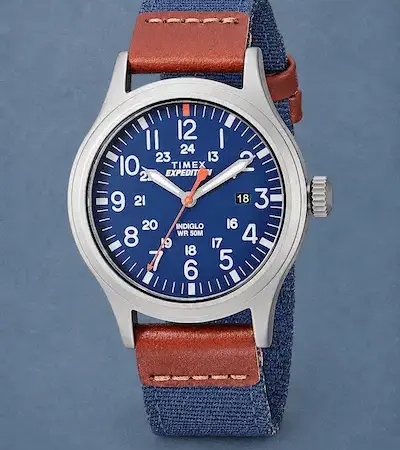
The Timex Expedition Scout represents the "field watch" category, a design lineage that dates back to the "trench watches" of World War I. The primary objective of a field watch is legibility and durability. The Expedition Scout features a high-contrast dial with Arabic numerals and a rugged aesthetic that appeals to consumers seeking a utilitarian alternative to the sleek, glass-heavy design of a smartwatch.
Technically, the Scout is noted for its inclusion of Timex’s proprietary Indiglo night-light technology. Patented in 1992, Indiglo uses an electroluminescent panel as a backlight, a feature that remains a significant selling point for budget-conscious buyers. Analysts note that the Scout’s popularity stems from its "unpretentious" branding; it is frequently cited in style forums as a "staple" accessory that outperforms its price point in both reliability and social acceptability.
Case Study 2: The Fashion-Forward Bridge – Relic by Fossil Rylan
Relic by Fossil serves as the accessible entry point for the Fossil Group, a conglomerate that reported over $1.4 billion in net sales in recent fiscal years. The Relic Rylan model targets a different consumer demographic: the professional seeking a "dress watch" aesthetic. Utilizing stainless steel cases and bracelets, the Rylan mimics the visual language of high-end luxury sports watches.
The Rylan’s design philosophy incorporates "complications"—features beyond simple timekeeping—such as day and date windows. While these are standard in many watches, the execution at the sub-$100 level requires a balance of mass-production efficiency and quality control. The Rylan is often marketed toward younger professionals or those entering the workforce who require a "smart" appearance for networking events where a rubber-strapped smartwatch might be perceived as too casual.
Case Study 3: Scandinavian Minimalism – The Skagen Signatur
Acquired by the Fossil Group in 2012, Skagen Denmark has maintained a distinct identity centered on "Hygge"—the Danish concept of cozy contentment and functional simplicity. The Skagen Signatur exemplifies the minimalist movement that has gained traction in response to the cluttered interfaces of modern operating systems.
The Signatur’s slim profile—often less than 8mm thick—offers a physical contrast to the "clunky" nature of smartwatches, which must house batteries, sensors, and processors. This slimness allows the watch to slide easily under a shirt cuff, making it a preferred choice for formal wear. From a manufacturing standpoint, the Signatur utilizes sandblasted dials and linear indexes, reflecting a design-led approach that prioritizes "negative space" over data density.
Chronology of the Analog Resurgence
To understand the current market, one must look at the timeline of the last decade:
- 2014-2015: Launch of the Apple Watch. Initial reports suggest a "death knell" for traditional watches under $500.
- 2017-2019: The "Instagram Watch" boom. Micro-brands (e.g., MVMT, Daniel Wellington) use social media to revive interest in minimalist analog designs among Gen Z and Millennials.
- 2020-2022: The COVID-19 pandemic leads to a surge in "hobbyist" horology. Consumers, stuck at home, begin researching watch movements and history, leading to a renewed appreciation for heritage brands like Timex and Seiko.
- 2023-Present: The "Digital Detox" movement goes mainstream. High-profile tech figures and influencers begin publicly advocating for periods of "unplugging," driving sales of "dumb" watches and "dumb" phones.
Expert Perspectives and Industry Reactions
Industry analysts suggest that the traditional watch is no longer competing with the smartwatch on functionality; instead, it is competing on "emotional resonance."
"A smartwatch is a tool that expires in three to five years due to battery degradation and software obsolescence," says James Wu, a market analyst specializing in wearable tech. "A $50 Timex, however, can theoretically last decades with simple battery changes. There is a perceived ‘permanence’ to analog that silicon cannot replicate."
Furthermore, horological experts point out that budget watches act as a "gateway drug" to the wider world of watch collecting. A consumer who spends $60 on a Skagen and enjoys the experience is statistically more likely to eventually invest in a $500 Seiko or a $5,000 Omega. This "ladder effect" is why luxury conglomerates continue to support and invest in their entry-level brands.
Broader Impact and Social Implications
The shift toward traditional watches also carries social and psychological implications. In professional settings, looking at a smartwatch is often interpreted as a sign of distraction or boredom, as the observer does not know if the wearer is checking the time or reading an urgent email. An analog watch, by contrast, has a single, transparent function. This clarity of purpose is becoming a valued commodity in the "attention economy."
Environmental concerns also play a role in the analog resurgence. The consumer electronics industry is a major contributor to e-waste. Smartwatches, with their lithium-ion batteries and complex circuitry, are difficult to recycle and have a short lifecycle. Traditional quartz watches, while still requiring batteries, have significantly fewer components and longer operational lifespans, aligning with a growing consumer interest in "slow fashion" and sustainable consumption.
Future Outlook: The Coexistence of Tech and Tradition
As we move toward the mid-2020s, the "watch versus smartwatch" debate is evolving into a "watch and smartwatch" reality. Major retailers are reporting that consumers are increasingly building "watch wardrobes"—a collection of timepieces for different activities.
The sub-$100 market is expected to remain robust as long as brands continue to innovate within the constraints of the price point. Future developments may include the integration of more sustainable materials, such as solar-powered movements (eliminating the need for battery changes) and straps made from recycled ocean plastics or vegan leathers.
Ultimately, the enduring appeal of the inexpensive traditional watch lies in its simplicity. In an era defined by complexity and constant connectivity, the ability to glance at one’s wrist and see nothing but the time remains a powerful, if subtle, form of personal autonomy. Whether it is the rugged reliability of a Timex, the polished presence of a Relic, or the refined minimalism of a Skagen, these timepieces prove that style and utility do not require a high-resolution screen or a four-figure price tag.

0 Comments