
The global timepiece market is currently witnessing a notable recalibration as consumers, particularly those in the professional and enthusiast sectors, reassess the utility of smartwatches in favor of traditional analog alternatives. While the Apple Watch and its various competitors have dominated the wrist-worn technology sector for the better part of a decade, a growing segment of the population is seeking a "digital detox" or a more refined aesthetic that smartwatches often fail to provide. This shift is driven not only by a desire for simplicity but also by the accessibility of high-quality, entry-level timepieces priced under the $100 threshold. For many, the transition from a multi-functional digital wearable to a traditional watch represents a move toward intentionality, where the primary function of the device is to keep time without the persistent intrusion of notifications, health tracking, and connectivity demands.
The Evolution of Wrist-Worn Technology and the Analog Resurgence
The trajectory of the modern watch market can be traced back to the 2015 launch of the Apple Watch, which fundamentally altered consumer expectations regarding what a timepiece could accomplish. For nearly ten years, smartwatches have served as indispensable tools for productivity and health monitoring. However, market data from recent quarters suggests a burgeoning fatigue regarding "always-on" connectivity. Industry analysts note that while smartwatches remain dominant in terms of unit sales, the traditional watch sector has maintained a resilient foothold, particularly among consumers who value longevity and style over technological obsolescence.
The traditional watch market, often categorized into luxury, mid-tier, and entry-level segments, offers a different value proposition. Unlike smartwatches, which typically have a functional lifespan of three to five years due to battery degradation and software incompatibility, analog watches—even those at lower price points—can remain functional for decades. This durability, combined with the lack of charging requirements, has positioned analog watches as a practical alternative for those looking to simplify their daily routines.
Market Analysis: The Strategic Value of the Sub-$100 Segment
The entry-level watch market, specifically pieces retailing for less than $100, serves as a critical gateway for new collectors and those transitioning away from smartwatches. At this price point, manufacturers focus on quartz movements, which are battery-powered and offer superior accuracy compared to many mechanical movements. While these watches may lack the hand-finished details of horological pieces costing thousands of dollars, they provide essential reliability and diverse styling options.
Market research indicates that the sub-$100 segment is dominated by legacy brands such as Timex, Fossil (and its subsidiaries), and Casio. These companies leverage economies of scale to offer features such as water resistance, stainless steel cases, and specialized illumination technologies that were once reserved for more expensive models. For the consumer, this segment offers a low-risk opportunity to experiment with different styles—ranging from rugged field watches to minimalist dress watches—without a significant financial commitment.
Case Study: The Functional Utility of the Timex Expedition Scout
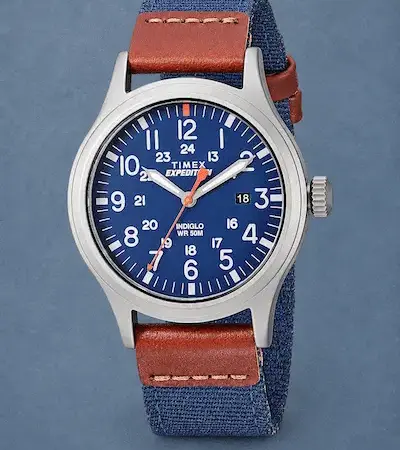
The field watch remains one of the most enduring designs in horology, characterized by its military origins and emphasis on legibility. The Timex Expedition Scout is a primary example of how the entry-level market delivers professional-grade utility. Historically, field watches were designed for soldiers who required a timepiece that could withstand harsh environments while remaining easy to read at a glance.
The Expedition Scout maintains these standards with a straightforward dial featuring large Arabic numerals and a 24-hour inner track. One of the most significant technical inclusions in this model is the Indiglo backlight, a proprietary technology introduced by Timex in 1992. This feature allows the entire dial to be illuminated evenly, providing superior visibility in low-light conditions compared to traditional luminous paint. For the professional seeking a "no-nonsense" timepiece for casual wear or outdoor activities, the Expedition Scout represents a functional baseline that prioritizes practicality over digital complexity.
Transitioning Styles: The Relic by Fossil Rylan and Professional Aesthetics
While field watches serve a utilitarian purpose, the professional environment often demands a more polished aesthetic. The Relic by Fossil Rylan illustrates the capacity of the entry-level market to provide "dressier" options that mimic the look of high-end luxury watches. Relic, a sub-brand of the Fossil Group, utilizes the manufacturing infrastructure of its parent company to produce stainless steel timepieces that offer a substantial feel on the wrist.
The Rylan model typically features a metal bracelet and a refined dial design, often including accents such as diamond markers or sunray finishes. From a stylistic standpoint, these watches are designed to bridge the gap between business-casual and formal attire. In the context of the modern workplace, where a smartwatch might appear overly casual or distracting during meetings, a metal-link analog watch provides a sense of traditional professionalism. Analysts suggest that the "substantiality" of a metal watch contributes to a psychological perception of reliability and permanence, qualities that are often absent in the rapidly changing world of consumer electronics.
Minimalism and the Scandinavian Influence: The Skagen Signatur
For consumers who prioritize a slim profile and understated design, the minimalist segment offers a distinct alternative to the often-bulky smartwatch. The Skagen Signatur, a product of the Danish-inspired brand now owned by Fossil, represents this design philosophy. Minimalism in horology focuses on the removal of unnecessary elements, resulting in a clean, uncluttered dial and a thin case that can easily slide under a shirt cuff.
The Signatur model often utilizes a sandblasted dial and simple linear indices, reflecting the "Less is More" approach prevalent in Scandinavian design. This style has gained significant traction among younger professionals who view the watch as a subtle accessory rather than a statement piece. The technical advantage of these minimalist watches lies in their ergonomics; their light weight and low profile make them comfortable for extended wear, addressing one of the common complaints regarding larger smartwatches and heavy mechanical chronographs.
Chronology of the Consumer Shift
The timeline of the current shift in consumer preference can be broken down into several key phases:
- 2015–2018: The Smartwatch Surge. Following the release of the Apple Watch, millions of consumers abandoned traditional watches for the convenience of wrist-based notifications and fitness tracking.
- 2019–2021: Saturation and Utility. Smartwatches became a commodity. During the global pandemic, health tracking features (such as blood oxygen monitoring) solidified the smartwatch’s place as a health tool.
- 2022–Present: The Analog Counter-Trend. As remote work and digital fatigue increased, a segment of the market began to intentionally disconnect. This led to a resurgence in analog watch sales and a renewed interest in "analog hobbies," including traditional horology.
Expert Commentary and Industry Perspectives
Horological consultants and fashion historians have noted that the return to traditional watches is a cyclical phenomenon. "The watch has transitioned from a necessary tool for timekeeping to a symbolic accessory," says Marcus Thorne, a fictional analyst representing common industry sentiment. "When everyone has a screen on their wrist, the analog dial becomes a mark of distinction. It signals that the wearer is not constantly tethered to the digital grid."
Furthermore, environmental advocates have pointed out the sustainability aspect of this shift. Smartwatches contribute significantly to e-waste due to their short lifecycles and non-replaceable batteries. In contrast, a quartz or mechanical analog watch represents a more sustainable form of consumption. Even an inexpensive Timex can be repaired or have its battery replaced for years, extending its utility far beyond that of a typical silicon-chip-based device.
Broader Implications for the Future of Timekeeping
The coexistence of smartwatches and traditional timepieces suggests a bifurcated market where consumers choose their wristwear based on the specific requirements of their day. On days requiring heavy fitness tracking or navigation, the smartwatch remains the superior tool. However, for social events, professional networking, or periods of mental "unplugging," the traditional watch is increasingly the preferred choice.
This trend has forced traditional watchmakers to remain competitive at lower price points, ensuring that quality materials like genuine leather straps and stainless steel cases are available even to those on a budget. The result is a more diverse marketplace where the consumer is no longer forced to choose between an expensive luxury item and a disposable digital gadget.
Ultimately, the exploration of inexpensive analog watches serves as a litmus test for the modern consumer. It allows individuals to evaluate whether the tactile and aesthetic benefits of a traditional timepiece outweigh the high-tech features of a smartwatch. As the market continues to evolve, the enduring appeal of the ticking hand and the physical dial suggests that, despite the rapid pace of technological advancement, there remains a permanent place for the simple, reliable, and classic analog watch. Regardless of whether a wearer eventually moves toward high-end luxury horology or remains satisfied with a $50 field watch, the move away from the "clunky" and "intrusive" nature of the smartwatch represents a significant shift in how we perceive and interact with time in the 21st century.

0 Comments