
The Catskill Mountains, a physiographic province of the larger Appalachian Mountains located in southeastern New York, have served as a primary recreational destination for residents of the New York metropolitan area for over two centuries. Spanning four primary counties—Sullivan, Ulster, Greene, and Delaware—the region encompasses the 700,000-acre Catskill Park, a protected forest preserve that provides a critical ecological and economic anchor for the state. In recent years, the hospitality landscape of this region has undergone a significant transformation, shifting from the grand, centralized resorts of the mid-20th century to a decentralized model dominated by high-end, design-focused short-term rentals and boutique "farm-to-table" experiences.
Historical Context: From the Romantic Era to the Borscht Belt
The trajectory of Catskills tourism began in the early 19th century, driven by the Hudson River School of painters, such as Thomas Cole and Frederic Edwin Church, who romanticized the rugged landscape. This period saw the construction of "Mountain Houses," massive timber-frame hotels designed to provide the urban elite with fresh air and panoramic views. By the late 1800s, the expansion of the Ulster and Delaware Railroad made the region accessible to a broader demographic, setting the stage for the Catskills’ most famous era.
The mid-20th century marked the height of the "Borscht Belt," a nickname for the collection of summer resorts, hotels, and bungalow colonies that primarily served Jewish families from New York City. At its peak, the region hosted upwards of 500 hotels and thousands of smaller stays. This era was characterized by all-inclusive hospitality and a thriving entertainment circuit that launched the careers of many American comedians and musicians. However, by the 1970s, the rise of affordable air travel and the decline of segregationist practices at other American resorts led to a steady decrease in the traditional Catskills resort model.
The Modern Revival and the Short-Term Rental Surge
Following decades of economic stagnation, the Catskills began a notable resurgence in the early 21st century. This revival was accelerated by the 2008 financial crisis and further intensified by the COVID-19 pandemic, which saw a mass exodus of urban professionals seeking low-density environments. According to data from the New York State Department of Labor, the hospitality and leisure sector in the Hudson Valley and Catskills regions has seen a compound annual growth rate that exceeds many other rural districts in the Northeast.
The modern visitor is less likely to seek an all-inclusive hotel and more likely to book a private residence that offers a curated, aesthetic experience. Platforms like Airbnb have facilitated this shift, with the Catskills becoming one of the most competitive markets for short-term rentals (STRs) in the United States. Data from AirDNA, a short-term rental analytics firm, indicates that "Superhost" listings in towns like Woodstock and Phoenicia often maintain occupancy rates exceeding 70%, even during the traditional "shoulder seasons" of spring and late autumn.
Regional Geography and Economic Drivers
The Catskills region is not a monolith; each of its four counties offers a distinct economic and cultural profile that influences the rental market:
- Ulster County: Known as the cultural heart of the region, Ulster is home to Woodstock and Kingston. It focuses heavily on the arts, boutique retail, and culinary tourism.
- Greene County: Dominated by the Great Northern Catskills, this area is a hub for outdoor recreation, featuring major ski resorts like Hunter Mountain and Windham Mountain.
- Sullivan County: The historic center of the Borscht Belt, Sullivan has seen a recent influx of investment following the opening of the Resorts World Catskills casino and the development of high-end wellness retreats.
- Delaware County: Often referred to as the "Western Catskills," this remains the most rural and agricultural sector, appealing to travelers seeking seclusion and traditional farmhouse experiences.
Tourism remains the lifeblood of these local economies. According to a 2022 report by Oxford Economics, tourism in the Catskills region generated an estimated $2.1 billion in direct visitor spending. This spending supports over 30,000 jobs, representing a significant portion of the total workforce in counties like Greene and Sullivan.
Architectural Trends: The Rise of the Design-Minded Hideaway
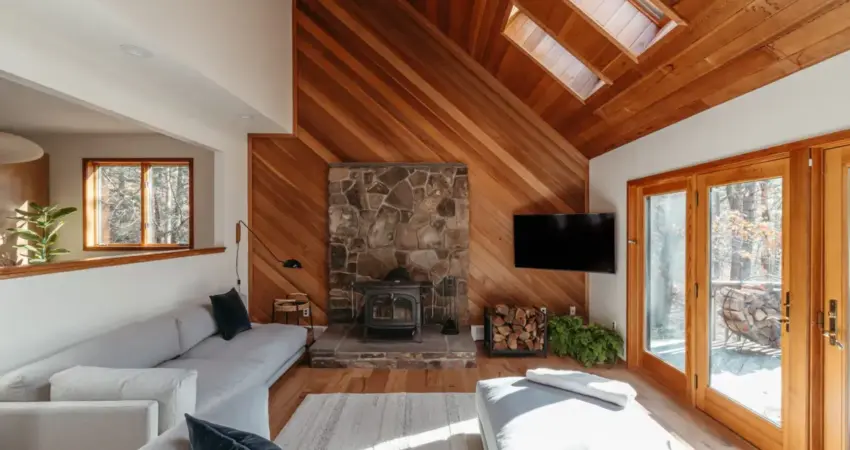
The contemporary Catskills Airbnb market is defined by a specific architectural and interior design aesthetic often referred to as "Upstate Modern" or "Cottagecore." Professional investors and homeowners have increasingly turned toward renovating historic structures or building minimalist, eco-friendly cabins to meet the demands of a design-conscious clientele.
Top-rated properties in the region generally fall into three categories:
- A-Frame Cabins: Originally popularized in the 1950s, these triangular structures have seen a massive revival. Their geometric simplicity and large glass facades are designed to integrate the indoor living space with the surrounding forest.
- Renovated Farmhouses: Many 19th-century agricultural homes have been retrofitted with modern amenities—such as radiant floor heating, chef’s kitchens, and Scandinavian-inspired furniture—while preserving original details like hand-hewn beams and wide-plank floors.
- Modernist Glass Pavilions: Newer constructions often feature floor-to-ceiling glass walls, emphasizing the region’s natural topography and providing "immersive" nature experiences that command premium nightly rates.
The inclusion of specific amenities has also become a standard for high-performing rentals. Wood-burning stoves, cedar hot tubs, and proximity to "swimming holes" or private hiking trails are frequently cited in guest reviews as primary motivators for booking.
Community Impact and Regulatory Responses
The rapid growth of the short-term rental market has not been without controversy. Local governments in the Catskills are currently grappling with the "Amazon effect" on local real estate. As properties are purchased by out-of-town investors for use as full-time rentals, the inventory of affordable long-term housing for local residents has dwindled.
In response, several towns have implemented or are considering strict STR regulations. For instance, Woodstock and Gardiner have introduced permit caps and residency requirements to ensure that the character of the community remains intact. "We are seeing a delicate balancing act," says a representative from a regional planning board. "Tourism provides the tax revenue needed to maintain our infrastructure, but if our workforce cannot afford to live here, the service-based economy will eventually collapse."
Furthermore, environmental organizations like the Catskill Center for Conservation and Development have raised concerns regarding the impact of increased foot traffic on fragile ecosystems. The "Leave No Trace" initiative has become a central part of tourism marketing as the region tries to mitigate the impact of thousands of new hikers on trails like Overlook Mountain and Kaaterskill Falls.
Timeline of Catskills Tourism Development
- 1823: The opening of the Catskill Mountain House marks the beginning of the "Grand Hotel" era.
- 1920s–1960s: The Borscht Belt flourishes, providing a cultural touchstone for the Jewish-American experience.
- 1969: The Woodstock Music & Art Fair (held in Bethel, Sullivan County) cements the region’s reputation as a counter-culture hub.
- 1980s–1990s: A period of economic transition as many large resorts close their doors.
- 2010: The "Brooklynization" of the Catskills begins, with a new wave of entrepreneurs opening boutique hotels and restaurants.
- 2020: The COVID-19 pandemic triggers a record-breaking surge in short-term rental demand and upstate relocation.
- 2024: The market matures, with a focus on sustainable tourism and the regulation of the short-term rental industry.
Future Outlook and Implications
The future of the Catskills hospitality industry appears to be moving toward a "hybrid" model. While Airbnbs remain dominant, there is a growing trend of "micro-resorts"—collections of individual cabins that offer the privacy of a short-term rental with the amenities of a hotel, such as on-site dining and concierge services.
Economists suggest that the region’s proximity to New York City—roughly a two-to-three-hour drive—ensures a permanent baseline of demand. As remote work remains a fixture for many industries, the distinction between "vacationer" and "part-time resident" continues to blur. This demographic shift is likely to drive further investment in high-speed internet infrastructure and local services, potentially stabilizing the year-round economy of these mountain towns.
In conclusion, the Catskills have successfully transitioned from a niche resort destination to a diverse, year-round tourism powerhouse. The rise of curated Airbnbs has played a pivotal role in this evolution, offering a new generation of travelers a way to engage with the landscape that is both private and deeply rooted in the region’s storied past. As the market continues to professionalize, the challenge for the Catskills will be maintaining the rugged, authentic charm that made it a destination in the first place, while managing the logistical and social pressures of its own success.

0 Comments