
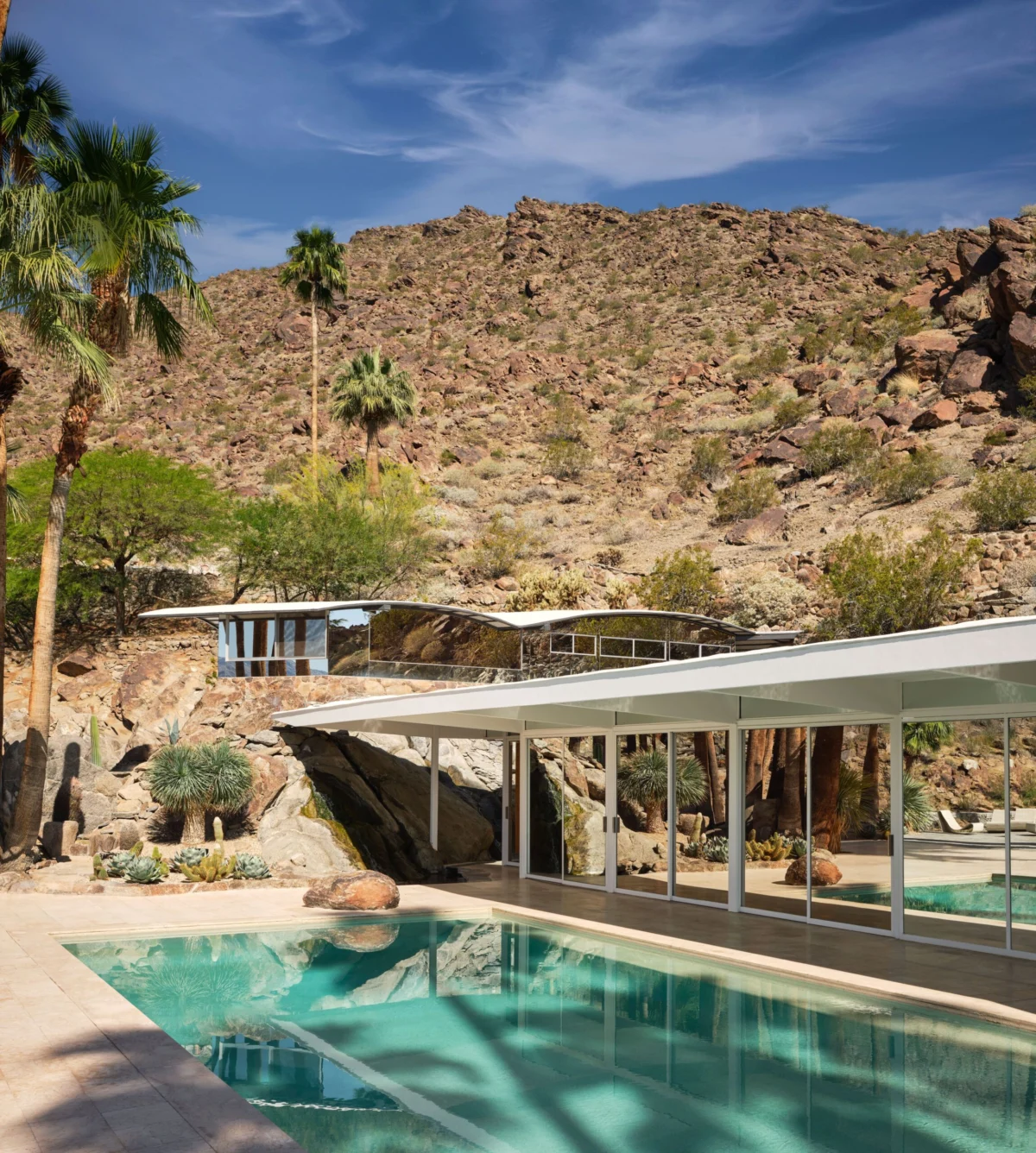
The Burgess House, a significant yet often overlooked structure in the pantheon of Palm Springs midcentury modernism, is finally receiving its due recognition following a meticulous restoration spearheaded by its current custodians, Ronnie Sassoon and James Crump. While its architectural lineage shares proximity with iconic residences such as Richard Neutra’s Kaufmann House, E. Stewart Williams’ Twin Palms estate for Frank Sinatra, and Albert Frey’s own Frey House II, the Burgess House has historically resided in a shadow cast by decades of convoluted renovations, obscured attribution, and a previous owner’s reluctance to acknowledge the contributions of its architects, Hugh Kaptur and Albert Frey. The dense, verdant embrace of bougainvillea that once shrouded the home’s archetypal modernist forms has now given way to a clear appreciation of its sophisticated design, a transformation orchestrated by Sassoon and Crump, whose deep understanding and passion for modern design have brought the Burgess House back into the architectural spotlight.

A Legacy of Midcentury Design and Passionate Stewardship
Ronnie Sassoon, an art historian, collector, and accomplished designer, brings a wealth of experience to the restoration. Her previous stewardship of Richard Neutra’s Singleton House in Los Angeles, a project undertaken with her late husband, the legendary Vidal Sassoon, attests to her commitment to preserving and revitalizing significant architectural works. James Crump, a distinguished documentary filmmaker and curator, complements Sassoon’s expertise with his own profound immersion in the history of modern design. His filmmaking career has focused on influential artists and architects, including Marcel Breuer, Robert Mapplethorpe, and Sam Wagstaff, further underscoring the couple’s dedication to the modernist canon. Their personal residences have also reflected this dedication, having previously lived in Neutra’s Levit House in Los Angeles and later acquiring Marcel Breuer’s 1966 Stillman House II in Connecticut, demonstrating a consistent engagement with seminal works of 20th-century architecture.
The Burgess House, with its complex history, could not have found more sympathetic or capable guardians. Sassoon and Crump’s acquisition of the property signifies not just a residential choice, but a commitment to uncovering and celebrating architectural narratives that may have been historically marginalized. Their approach emphasizes a deep respect for the original design intent while integrating contemporary living needs seamlessly.

Unearthing the Architectural Narrative: Kaptur and Frey’s Collaboration
The story of the Burgess House begins in 1957 with Hugh Kaptur, who, prior to obtaining his architectural license, designed the initial structure. This modest, 1,200-square-foot post-and-beam cottage was characterized by a flat roof, expansive glass curtain walls, and deep, cantilevered eaves—hallmarks of the burgeoning midcentury modernist aesthetic. Roughly a decade later, the renowned architect Albert Frey, a pivotal figure in Palm Springs architecture, took on the task of expanding the residence. Frey masterfully integrated his additions, ensuring they spoke the same architectural language as Kaptur’s original design.
Frey’s involvement was not a singular event; he continued to evolve the Burgess House over several decades. His interventions were crucial in shaping the property into its current form. Notable among these were the addition of an iconic arched balustrade atop the rugged stone embankment that anchors the house, creating a dramatic visual counterpoint to the natural landscape. This arched motif, a signature element of Frey’s later work, reappeared in the vaulted shade structures of stretched canvas he introduced in 1980, and most dramatically, in the design of a separate guest pavilion completed in 1989. The guest pavilion, perched on an escarpment above the main residence, features a striking barrel-vaulted roof and a façade of mirrored glass. This innovative use of reflective surfaces serves to dematerialize the structure, allowing it to merge with its surroundings, mirroring the vast desert sky, the rugged mountains, and the swaying palm trees.

Frey’s genius for integrating the built environment with the natural landscape is perhaps most powerfully expressed in his incorporation of massive, naturally occurring boulders into the interior spaces of the guest pavilion, echoing his approach in Frey House II. This deliberate insertion of geological elements reinforces the profound connection between the indoor and outdoor realms, a defining characteristic of desert modernism. As Sassoon observes, these boulders "channel the energy of the mountain directly into the home," creating a palpable sense of place and grounding the modern structure within its ancient context.
A Vision for Restoration: Distillation and Refinement
Sassoon’s extensive renovation of the Burgess House can be characterized as a process of distillation. Her vision was to clarify the architectural details, remove extraneous elements that had accumulated over time, and reveal the structure as an embodiment of Palm Springs modernism. Working in close collaboration with the design-build firm Studio Veren, Sassoon meticulously executed her plan. This involved liberating the structures from the overgrown bougainvillea that had obscured their forms, replacing ornamental urns with architectonic cacti that better complement the desert environment, and relocating unsightly mechanical equipment from the roof of the primary residence.

While the original floor plans were largely preserved to honor the architects’ intentions, Sassoon’s personal touch is evident in the design of a sleek, custom-tailored stainless-steel kitchen in the main house. This space, executed with precision by Marmol Radziner, caters to Sassoon’s passion for cooking, seamlessly blending functionality with high design. The kitchen’s camouflaged door, designed to appear as a continuous appliance wall, exemplifies the thoughtful integration of practical elements into the architectural fabric.
The interior design scheme is a testament to Sassoon’s refined aesthetic and her deep appreciation for significant works of art and design. Her approach embraces a minimalist sensibility, allowing the architecture and the breathtaking vistas to take center stage. The home is adorned with carefully selected objets d’art from her personal collection, featuring iconic pieces by masters such as Charlotte Perriand, Jean Prouvé, and Alexandre Noll. Sassoon’s interest in the Zero group and the Arte Povera movement is also reflected in the curated selection of artworks, which resonate with the raw, elemental qualities of the desert landscape and the architecture itself.

“With an open plan, you’re looking at everything all at once, so it has to work together,” Sassoon explains. “The boulders require you to use furniture of a certain scale and weight—nothing dainty.” This philosophy ensures that every piece contributes to the overall harmony of the space, enhancing rather than competing with the architectural statement.
The Allure of the Desert Landscape: Cinematic Views and Enduring Beauty
The Burgess House’s setting is as integral to its appeal as its architecture. Perched on a dynamited shelf carved from the rock face, the house offers an unparalleled sense of being suspended between the earth and the sky. Crump eloquently describes the home’s allure in cinematic terms: "You have uninterrupted sight lines across the Coachella Valley framed in a wide-screen ratio." During daylight hours, the landscape is bathed in a "clean, crystalline desert light," with colors and shadows constantly shifting, creating a dynamic and ever-changing tableau. As night falls, the view transforms into a "carpet of sparkling city lights," offering a breathtaking panorama.

The restoration has not only revitalized the house but also enhanced the viewer’s experience of the surrounding environment. The strategic removal of overgrowth and the careful curation of the landscape now allow the architecture and the natural beauty to coexist in perfect balance. The stone rampart, enhanced by Frey’s arched balustrade, now provides a dramatic framing for the property’s generous patios and exterior walkways, inviting residents and guests to immerse themselves in the desert’s serene grandeur.
The guest pavilion, with its mirrored glass exterior, further dissolves the boundaries between interior and exterior. As palm trees and clouds drift across its surfaces, the pavilion becomes an ephemeral element, a shimmering mirage that seems to grow organically from the mountainside. The inclusion of water features, such as a koi pond that receives cascading water from the rock face, adds another sensory layer, harmonizing the visual spectacle with the soothing sounds of nature.

Enduring Impact and the Future of Desert Modernism
The careful restoration of the Burgess House by Ronnie Sassoon and James Crump serves as a powerful reminder of the enduring legacy of midcentury modernism in Palm Springs. It highlights the importance of recognizing and celebrating the contributions of all architects involved in shaping these iconic structures, moving beyond singular attributions to embrace collaborative histories. This project underscores the value of passionate stewardship in preserving architectural heritage for future generations.
The Burgess House, once obscured by its own history and vegetation, now stands as a beacon of design, a testament to the vision of its original architects and the dedication of its current owners. It is a prime example of how thoughtful restoration can not only preserve but also elevate a significant piece of architectural history, allowing it to resonate with renewed relevance in the contemporary world. The ongoing appreciation for such properties also contributes to the broader understanding and preservation of Palm Springs as a vital cultural and architectural landscape. The success of this restoration is likely to inspire further interest in and advocacy for similar architectural treasures facing the challenges of time and evolving landscapes.

0 Comments