
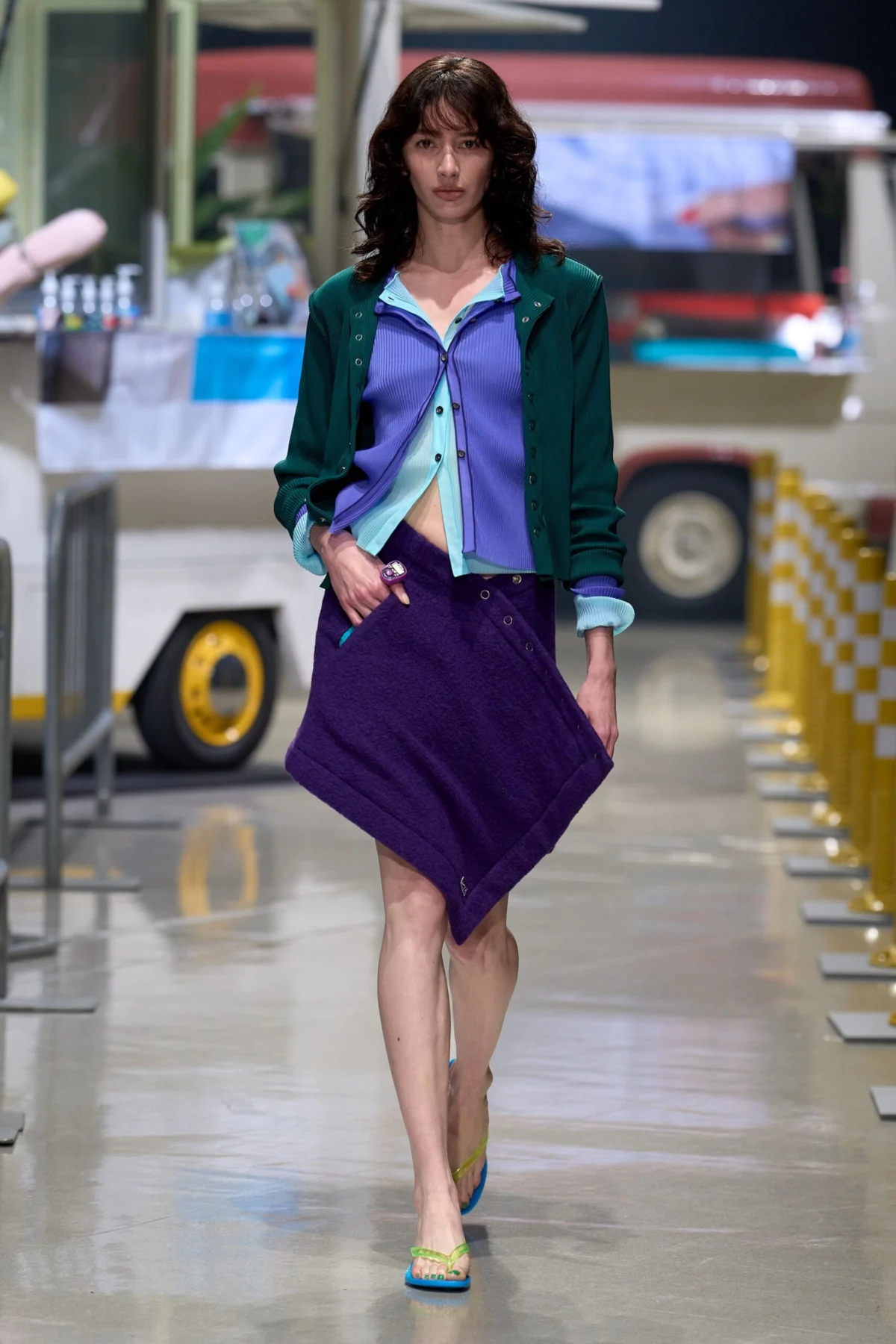
The Tokyo fashion circuit witnessed a significant milestone this season as Kotoha Yokozawa, the 34-year-old designer known for her technical precision and unconventional urban aesthetics, staged her first runway presentation in four years. Held on the ninth floor of the Shibuya Hikarie building, the Fall 2026 collection marked a definitive evolution for the designer, who previously honed her craft within the design department of the global retail giant Uniqlo. Yokozawa’s latest work serves as a sociological study of Nishi-Shinjuku, one of Tokyo’s most complex and bustling districts, translating the chaotic energy of the neighborhood into a cohesive, high-energy wardrobe. The collection effectively bridges the gap between high-concept runway art and the functional realities of contemporary Japanese city life, utilizing a palette of fuchsia, tangerine, mint, and lemon to contrast against the grey concrete of the metropolitan landscape.
The Aesthetic Evolution of Kotohayokozawa
Since the brand’s inception, Kotoha Yokozawa has been recognized for a "thrifty" yet sophisticated approach to construction. This season’s return to the runway highlighted her signature stretch pleat tops, which have become a commercial cornerstone for the brand. However, the Fall 2026 collection pushed these established elements into new territory by pairing them with sheer skirts and tightly cropped cardigans, creating a silhouette that is both delicate and utilitarian.
A central feature of Yokozawa’s design language is the use of fabric cutouts and the reincorporation of "leftover" materials. Backstage, the designer reflected on the origins of this technique, noting that it was born out of financial necessity during the brand’s early years. At the time, lacking the capital to commission large-scale factory production or the technical expertise in complex pattern-making, Yokozawa began manually cutting fabrics and reattaching remnants to create textured, layered garments. What began as a resourceful workaround has since matured into a deliberate aesthetic choice, representing a unique form of sustainable design that prioritizes the creative reuse of textiles.
The collection also introduced futuristic menswear pieces, a departure from the brand’s traditionally female-centric focus. These garments were styled with popper-lined jeans, suggesting a modular approach to dressing that aligns with the "gorpcore" and "techwear" trends currently dominating the Tokyo street style scene. While the collection was largely praised for its energy, some critics noted that certain elements, such as a heavy fluffy jacket and standard yoga pants, felt less integrated into the overarching visionary narrative of the show.
Inspiration from the Nishi-Shinjuku Landscape
The thematic core of the Fall 2026 show was rooted in Yokozawa’s daily observations of Nishi-Shinjuku, a district characterized by its juxtaposition of corporate skyscrapers, luxury hotels, and the gritty reality of late-night entertainment. The designer cited the visual "mismatch" of the area as her primary inspiration—specifically the sight of tourists, partygoers consuming canned chuhai (shochu highballs), and the increasing prevalence of LUUP electric scooters.
"I really like that slightly mismatched look of colors that runners wear, like they’ve bought different things and have to make it work," Yokozawa remarked in a post-show interview. This observation translated into a collection that celebrates the accidental harmony of functional athletic wear. The neon-clad joggers preparing for the Tokyo Marathon provided a specific color reference, leading to a palette that felt intentionally jarring yet optimistic. By focusing on the "spirit-lifting" power of color, Yokozawa aimed to provide a visual antidote to the often-drab aesthetic associated with urban winter wardrobes.
Scenography and the Immersive Runway Experience
The presentation at Shibuya Hikarie was notable not only for the clothing but for its elaborate set design, which many industry observers ranked among the best of the season. To recreate the atmosphere of a Tokyo street, the production team transported two full-sized food trucks and a tuk-tuk onto the 9th-floor venue. The runway was further defined by traffic bollards and oversized foliage, blurring the lines between an indoor fashion event and an outdoor public square.
The styling further reinforced this urban realism through the use of Y2K-inspired accessories. Models were equipped with plastic pedometers and Tamagotchi digital pets clipped to their waistbands, a nostalgic nod to Japanese tech culture of the late 1990s and early 2000s. Yokozawa emphasized that these props are not merely decorative but essential to her creative process. "I really enjoy creating spaces, props, and even small souvenirs just as much as I enjoy making clothes," she explained. "Simply showing clothes isn’t what I like about fashion; it’s something that exists within a landscape."
Chronology of the Brand and the Four-Year Hiatus
The Fall 2026 show serves as a "comeback" of sorts for Yokozawa, who had shifted her focus away from large-scale runway presentations during the global pandemic and the subsequent period of economic restructuring.
- 2015-2017: Initial brand launch and the development of the "thrifty" cutout technique.
- 2018-2019: Expansion into the domestic Japanese market, gaining a cult following for the "todo" line of pleated wear.
- 2020-2023: A pivot toward digital presentations and smaller-scale installations during the COVID-19 pandemic. This period allowed the designer to refine the brand’s business model and supply chain.
- 2024-2025: Preparation for the return to the physical runway, focusing on a broader lifestyle-based aesthetic.
- March 2026: The Fall 2026 runway show at Rakuten Fashion Week Tokyo, marking her first major live event in four years.
This timeline reflects a broader trend in the Japanese fashion industry, where independent designers are increasingly taking multi-year breaks from the traditional fashion calendar to focus on sustainable growth, direct-to-consumer sales, and creative rejuvenation.
Supporting Data: The Economic Context of Tokyo Fashion
The success of Kotoha Yokozawa’s return comes at a time when the Tokyo fashion market is experiencing a shift in consumer behavior. According to recent retail data from the Japan Department Stores Association, there has been a 12% increase in demand for "versatile luxury"—garments that combine high-fashion design with everyday functionality. Yokozawa’s use of stretch fabrics and athletic silhouettes positions her brand perfectly within this growing market segment.
Furthermore, the "Nishi-Shinjuku" theme taps into the resurgence of domestic and international tourism in Japan. With Tokyo seeing record-breaking visitor numbers in early 2026, the cultural "mismatch" that Yokozawa describes has become a defining characteristic of the city’s visual identity. The brand’s ability to monetize this local "vibe" into a globally recognizable aesthetic is a key factor in its continued business viability.
Industry Reactions and Critical Analysis
Industry analysts have noted that Yokozawa’s background at Uniqlo provides her with a unique competitive advantage. While many independent designers struggle with the technicalities of mass production and garment durability, Yokozawa’s experience at a global retail giant ensures that even her most experimental pieces maintain a level of wearability and manufacturing quality.
"Yokozawa understands the ‘grammar’ of clothing in a way that many of her peers do not," stated a senior fashion editor following the show. "She takes the mundane—the joggers, the scooters, the convenience store culture—and elevates it through a rigorous design lens. The return to the runway proves that she is ready to move beyond ‘cult’ status and into the mainstream of Japanese contemporary fashion."
The inclusion of Y2K accessories like Tamagotchis was also praised as a savvy marketing move, appealing to the "Gen Z" demographic that currently drives much of the luxury resale and vintage-inspired markets. By grounding these trends in a specific Tokyo landscape, Yokozawa avoids the pitfall of generic nostalgia, offering instead a localized and authentic interpretation of the era.
Broader Impact and Implications for the Future
The Fall 2026 collection by Kotohayokozawa signals a broader movement within the Japanese fashion industry toward "narrative-driven" streetwear. As the market becomes increasingly saturated with minimalist designs, Yokozawa’s "confident palette" and high-energy scenography offer a blueprint for how brands can differentiate themselves through storytelling and environmental context.
Moreover, the designer’s commitment to using leftover fabrics and manual cutting techniques suggests a path forward for "slow fashion" within a fast-paced urban environment. As environmental regulations in the textile industry tighten globally, Yokozawa’s early adoption of these "thrifty" methods provides her brand with a foundational philosophy that aligns with modern sustainability goals without sacrificing aesthetic boldness.
In the context of Rakuten Fashion Week Tokyo, Yokozawa’s show was a reminder of the city’s role as a laboratory for urban style. By looking at the street not as a source of "trends" to be copied, but as a "landscape" to be interpreted, Kotoha Yokozawa has solidified her position as one of the most observant and technically capable designers of her generation. As the brand looks toward international expansion, the Fall 2026 collection will likely be remembered as the moment the label transitioned from a niche favorite to a significant voice in the global fashion dialogue.

0 Comments