
The culinary world often presents unexpected pairings, and the latest offering from Bon Appétit’s Bake Club, a sweet corn butter mochi cake, was initially met with a mixture of anticipation and trepidation. Senior Test Kitchen editors Shilpa Uskokovic and Jesse Szewczyk admitted to considerable behind-the-scenes anxiety leading up to the July recipe reveal. The prospect of incorporating sweet corn into a dessert, particularly a distinctly textured butter mochi made with glutinous rice flour, raised concerns about its potential reception.
"We were not slightly worried. I was like, ‘This is gonna flop.’ This is it for us," recalled Szewczyk on the BA Bake Club Podcast, highlighting the high stakes they felt were attached to the unconventional recipe. However, the Bake Club community, known for its adventurous palates and willingness to explore new culinary frontiers, once again demonstrated its characteristic enthusiasm. The Sweet Corn Butter Mochi With Coconut Crunch recipe, as detailed on bonappetit.com, has emerged as a resounding success, far exceeding the editors’ initial fears.
"I hope you guys know how much it means to us," expressed Uskokovic, visibly touched by the community’s embrace of the recipe. "I’m very touched every month when you guys bake our recipes, and we see you in the Substack chat and you post these pictures. So, this is very heartwarming for me." This sentiment underscores the unique connection fostered by the Bake Club, where home bakers and culinary professionals engage in a shared journey of discovery.
The enthusiastic response has also led to the recognition of a Bake Club member as the "Baker of the Month," lauded for a particularly adventurous pairing of the Sweet Corn Butter Mochi with a savory dinner, rather than a traditional dessert. This choice further exemplifies the community’s willingness to push the boundaries of conventional culinary applications.
In a segment dedicated to expanding the horizons of Bake Club enthusiasts, the podcast also featured an insightful conversation with Katherine Yang, the executive pastry chef at Mille Fête in Honolulu’s Chinatown. Yang, formerly the proprietor of the highly successful by-order cake bakery Gigi Blue, shared her expertise on Hawaiian dessert culture and offered valuable tips for crafting the perfect butter mochi cake. Her insights provide a deeper context for the recipe’s origins and its place within a broader culinary tradition.
The Unexpected Journey of Sweet Corn Butter Mochi
The genesis of the Sweet Corn Butter Mochi recipe was rooted in a long-standing desire within the Bon Appétit test kitchen to feature a corn-based dessert. Uskokovic and Szewczyk had been exploring various corn dessert concepts for some time, initially contemplating ideas like a caramel corn flan. This initial concept, while intriguing, proved to be a known entity, with a similar Mexican dessert, flan de elote, already existing. This realization prompted a pivot, with Uskokovic determined to integrate corn into a dessert in a novel way.
The inspiration eventually landed on butter mochi, a confection celebrated for its uniquely chewy and bouncy texture. "Butter mochi, as a cake, it has a very unique texture that is completely unlike any cake that we see," explained Uskokovic. She described it as a "chewy cake," akin to "squishing down on very soft toasted milk bread," or even the "gummy bear of cakes." This distinctive mouthfeel, a departure from the crumbly nature of conventional cakes, presented an ideal canvas for infusing a new flavor profile.
The challenge then became how to seamlessly incorporate the sweet corn without compromising the characteristic chewiness of the mochi. Uskokovic’s solution was to puree fresh summer corn, creating a "corn milk" or "corn soup" that could be integrated into the batter without introducing disruptive solid components. This approach ensured that the corn flavor was deeply infused while preserving the desired textural integrity. The recipe’s simplicity was also a deliberate choice, aiming to introduce members to a different taste and texture profile rather than focusing on complex techniques.
Unpacking the Recipe: From Ingredients to Technique
The Sweet Corn Butter Mochi With Coconut Crunch recipe, as detailed in the podcast and on the Bon Appétit website, is presented as one of the Bake Club’s more accessible creations. The core ingredients include fresh summer corn, eggs, melted butter, sweetened condensed milk, regular milk, salt, vanilla, glutinous rice flour (also known as mochiko or sweet rice flour), and baking powder.
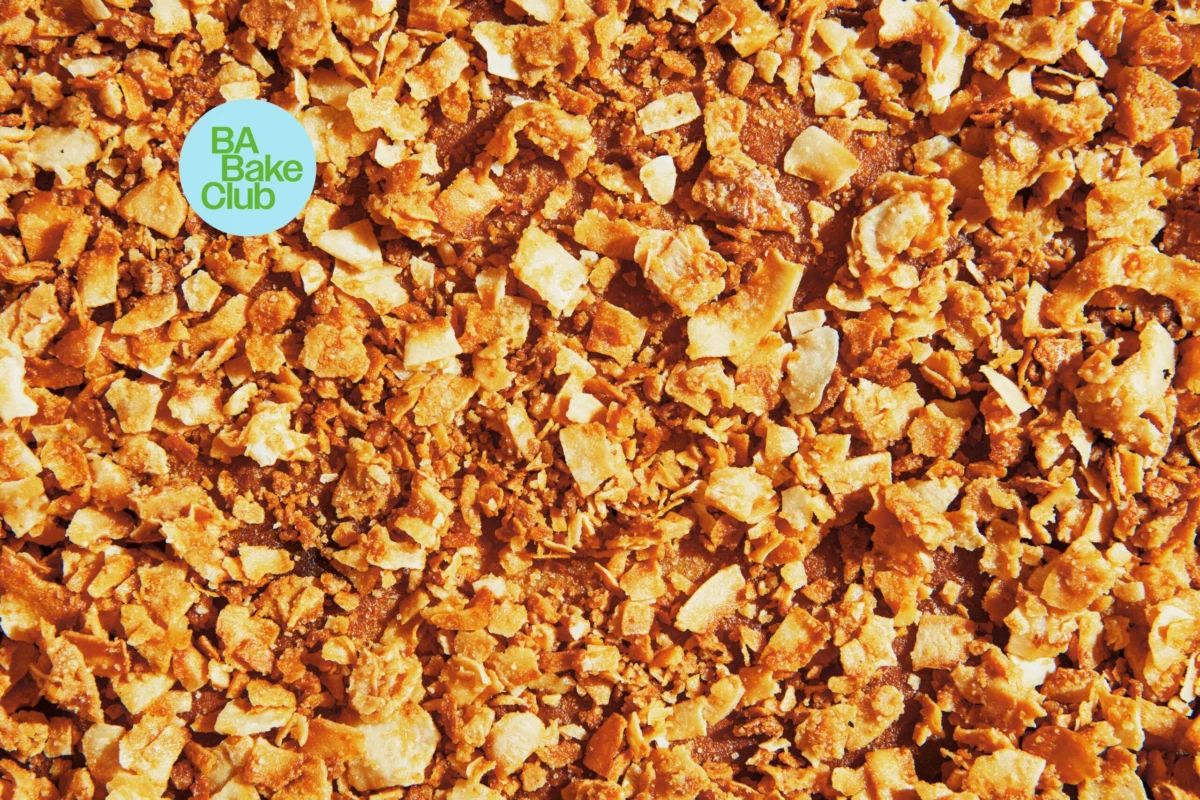
The preparation involves a straightforward blending process for the wet ingredients and corn, followed by folding in the dry components. A distinctive element of the recipe is the addition of a coconut topping, applied about three-quarters of the way through the baking process. This topping, a mixture of coconut flakes, sugar, butter, and milk, caramelizes during the final stages of baking, creating a delightful crunchy layer that complements the soft, chewy interior.
"It’s almost like a coconut feuilletine on top," commented Szewczyk, appreciating the textural contrast. The visual presentation, while described by Uskokovic as "understated" and "not a looker," belies the rich flavor profile of corn and caramelized coconut.
The Science and Art of Mochi
Understanding the nuances of mochi is crucial to appreciating this recipe. Traditionally, mochi is a Japanese confection made from short-grain rice that is steamed and then pounded into a sticky paste. This labor-intensive process results in a distinctly chewy and soft texture. While traditional mochi can be filled or coated, "butter mochi" represents a more contemporary, often Hawaiian-influenced, variation.
Butter mochi is generally attributed to Hawaii, believed to have evolved from the mochi-making traditions brought by Japanese immigrants. Unlike traditional mochi, butter mochi typically utilizes shelf-stable ingredients like sweetened condensed milk, and its origin is also theorized to have connections with Portuguese and Indian desserts that share similar chewy textures.
Uskokovic emphasized that the Bake Club recipe is a spin on this Hawaiian classic, retaining the foundational elements while experimenting with the liquid components. The use of mochiko, or glutinous rice flour, is paramount. This specific type of rice flour, despite its name, is naturally gluten-free and is responsible for the characteristic chewy, gelatinous consistency. Regular rice flour would yield a dry, crumbly texture, entirely different from the desired mochi experience.
Navigating Topping Challenges and Baker Feedback
The development process for the coconut topping also presented its own set of challenges, illustrating the iterative nature of recipe creation. Uskokovic initially drew inspiration from Danish dream cake, aiming to amplify the natural crust of mochi cake. While a coconut topping was successful, a tasting panel member raised concerns about it overpowering the corn flavor. This feedback led to an experimental phase, including an attempt to use cornflakes as a topping.
However, the cornflake topping proved problematic. "They sogged out a lot," noted Uskokovic, explaining that the timing of application was critical. The topping needed to adhere without sinking to the bottom of the batter. The cornflakes, when applied at the right stage, caramelized well but ultimately detached from the cake, forming a separate layer. This experience reinforced the adage that sometimes, the original solution is the best. "Sometimes you just can’t fit a square peg in a round hole," Uskokovic reflected, ultimately returning to the more reliable coconut topping.
The success of the recipe is further evidenced by the feedback from Bake Club members. Michelle Q. shared her delight, stating, "Shilpa, you made me look like a baking genius." However, she also raised a pertinent question about a slightly gritty texture, attributing it to the corn. Uskokovic suggested that this could be due to the blending power of the appliance used. "I almost always tested this in a very high-powered blender like a Vitamix," she noted, implying that a less powerful blender might not fully pulverize the corn. She also advised considering the tenderness of the corn used, suggesting that older, more mature corn might contribute to a coarser texture.
Mark, another Bake Club member, inquired about the baking time and pan size. Uskokovic clarified that while the recipe can be adapted for an eight-inch pan, the original testing was predominantly done with a nine-inch pan, which influences baking time. Crucially, she reassured bakers that mochi cake is remarkably forgiving regarding over-baking. "You can actually not really over bake it unless you’re completely negligent," she stated, advising that it’s generally better to err on the side of slightly longer baking to ensure the desired texture.
Katie, facing a similar topping quandary, reported that her topping got pushed off as the cake rose. Uskokovic surmised this might indicate the cake needed slightly longer in the oven before the topping was applied, allowing it to set more firmly. She also offered insights into the optimal flake size for the coconut topping, noting that a "Goldilocks flake size" offers the best adhesion.
Rachel’s experience highlighted the "harrowing" but ultimately successful flip required to present the cake with its caramelized topping facing upwards. Uskokovic offered a practical tip: allowing the cake to cool completely in the pan before inverting can significantly reduce anxiety.
The Savory Revelation: Mochi as a Side Dish
Perhaps one of the most surprising and celebrated aspects of the Bake Club’s reception of the Sweet Corn Butter Mochi was Jason P.’s unconventional pairing of the cake with barbecue pork and summer vegetable slaw. This act transformed the dessert into a savory accompaniment, drawing parallels to cornbread. "Jason, you (beep) me up with this one, I’ll be honest," admitted Uskokovic, both impressed and slightly taken aback by the innovative application. This bold move earned Jason P. the coveted "Baker of the Month" award, recognizing his imaginative approach and willingness to redefine culinary categories. The incident serves as a powerful testament to the versatility of the recipe and the adventurous spirit of the Bake Club community.
A Culinary Journey to Hawaii with Katherine Yang
The podcast episode also provided a platform for an illuminating conversation with Katherine Yang, an esteemed pastry chef currently leading the culinary vision at Mille Fête in Honolulu. Yang’s career spans decades, including significant tenures with culinary giants like Daniel Boulud and Thomas Keller, before establishing her own successful bakery, Gigi Blue. Her relocation to Hawaii marked a new chapter, driven by a desire for collaboration and a renewed passion for the craft.
Yang described the baking and dessert scene in Hawaii as "robust," noting its deep cultural roots influenced by a strong gift-giving tradition and a significant Japanese heritage. She highlighted the prevalence of bakeries and home baking, emphasizing that gatherings and celebrations are often accompanied by meticulously prepared baked goods. The cross-cultural influences, from Asian flavors to traditional viennoiseries and breads, create a vibrant and diverse culinary landscape.
Her philosophy centers on creating "delicious food that people love to eat," eschewing overly precious presentations for accessible and enjoyable creations. This ethos resonates deeply with the Bake Club’s mission of making baking approachable and rewarding.
Discussing butter mochi, Yang shared a personal connection, noting its similarity to a Chinese New Year dessert, nian gao, which evokes a sense of "home" and familiar comfort. For Yang, the hallmark of an exceptional butter mochi lies in its "QQ" texture – a term from Taiwanese culture signifying perfect chewiness – and, crucially, the development of a crisp, caramelized "sugar skin" on the edges. This contrast between the crispy exterior and the soft, chewy interior, she asserts, is best experienced when the mochi is served immediately after baking. Her practical tip for achieving this optimal crust involves using brownie pans, which are designed to bake edges more intensely.
Yang also addressed concerns about over-baking mochi, echoing Uskokovic’s sentiment that it is a resilient dessert. "I’ve never over-baked butter mochi," she stated confidently, emphasizing that the goal is often to achieve that desired crust, which requires sufficient baking time. She also provided clarity on the distinction between evaporated milk and sweetened condensed milk, a common point of confusion in baking recipes, highlighting their non-interchangeable nature due to the presence of sugar in condensed milk.
Looking Ahead: The August Bake Club Recipe
As the July episode drew to a close, Szewczyk and Uskokovic introduced the August Bake Club recipe: a Plum Cheesecake Karpatka. Described as a "magnificent mountain of a dessert," this Polish classic involves two discs of choux pastry sandwiching a no-bake cheesecake filling ribboned with plum jam. The recipe promises a dramatic and make-ahead-friendly spectacle, requiring gelatin powder and, ideally, two nine-inch round cake pans.
The Bake Club continues to foster a vibrant community of bakers, encouraging experimentation and celebrating the joy of culinary discovery. The success of the Sweet Corn Butter Mochi cake stands as a testament to the power of curiosity and the shared passion for exploring the delicious possibilities that arise when tradition meets innovation.

0 Comments