
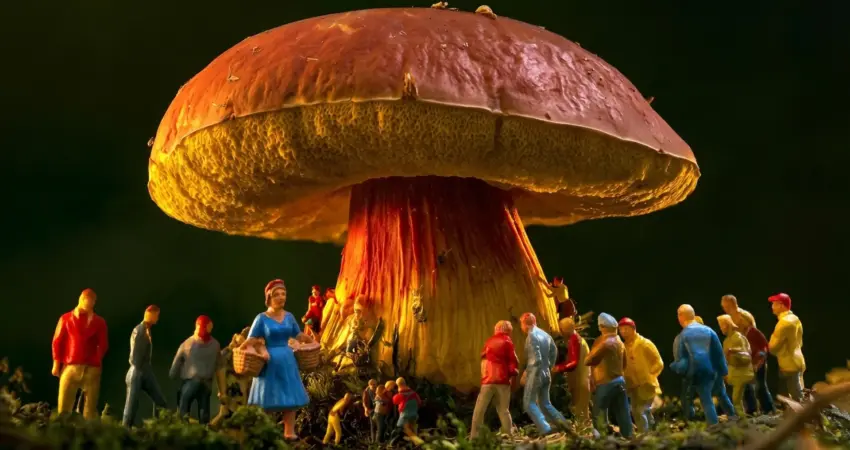
The perplexing phenomenon of Lilliputian hallucinations, where individuals report seeing miniature human figures after consuming specific wild mushrooms, has long baffled scientists and captivated the public imagination. These vivid, often startling visions, named after the diminutive inhabitants of Jonathan Swift’s classic novel "Gulliver’s Travels," have been reported independently across vastly different cultures and geographical locations for nearly a century. Now, groundbreaking research conducted by scientists at the University of Utah (U) has provided compelling evidence for a biological explanation, identifying a specific mushroom species, Lanmaoa asiatica, as the likely culprit. This discovery not only sheds light on a peculiar neurological effect but also opens new avenues for understanding the human brain and the potential of unexplored fungal compounds.
The Enduring Enigma of Miniature Visions
The scientific quest to understand Lilliputian hallucinations began in 1934, when Western researchers first learned of these extraordinary experiences among people in Papua New Guinea. The phenomenon, then colloquially termed "mushroom madness," described individuals who, after ingesting wild mushrooms, would perceive tiny, fully formed human-like figures interacting with their environment. These visions were remarkably consistent: the miniature beings were typically described as being between 3 and 30 centimeters tall, often resembling elves, clowns, or fairy-like characters adorned in brightly colored attire. Crucially, these figures were not ethereal apparitions but seemed to obey the laws of physics, walking around obstacles, climbing surfaces, and even falling from ledges, adding to their uncanny realism.
During the 1950s and 1960s, anthropologists and mycologists embarked on expeditions to Papua New Guinea to investigate these reports. Their research pointed towards several species within the Boletaceae (bolete) family as potential sources. However, extensive chemical analyses of these mushrooms proved fruitless. Even Albert Hofmann, the renowned chemist who first isolated psilocybin and discovered LSD, examined samples and could not identify any known psychoactive compounds that could account for the hallucinations. The lack of a chemical explanation led some researchers to question the direct role of the mushrooms, suggesting that cultural beliefs and folklore might be responsible for the shared descriptions. By the late 1960s, scientific interest in the phenomenon waned, leaving the mystery largely unresolved.
A Resurgence of Interest and a Global Connection
The enigma resurfaced in the 1990s when reports emerged from Yunnan Province in Southwest China describing similar hallucinations following the consumption of bolete mushrooms. While the precise species remained elusive, researchers began to suspect a recently described mushroom, Lanmaoa asiatica, as a potential candidate. This suspicion was significantly bolstered in 2024 when Colin Domnauer, a doctoral student at the University of Utah, learned of analogous experiences within an Indigenous community in the remote Northern Cordillera region of the Philippines.
Community members there described a wild edible mushroom, locally known as "Sedesdem," which could induce visions of miniature human figures. This mushroom bore striking similarities to those known as "Nonda" in Papua New Guinea and "Jian shou qing" in Yunnan. These mushrooms hold significant cultural and culinary importance in their respective regions, but a crucial detail emerged: consuming them without thorough cooking could trigger the unusual hallucinations. The Philippine accounts represented a third, independent report of wild mushrooms causing remarkably similar visions of tiny people, reinforcing the likelihood of a shared biological origin rather than disparate cultural influences.
Unraveling the Mushroom’s Identity
Driven by the compelling convergence of these anecdotal reports, Domnauer, in collaboration with Bryn Dentinger, a mycologist affiliated with the University of Utah and the Natural History Museum of Utah, initiated a comprehensive investigation. Domnauer traveled to Yunnan, China, and the Philippines, where he conducted interviews with local residents and collected specimens of Lanmaoa asiatica and other related mushrooms from the Lanmaoa genus. This fieldwork included the first scientific survey of fungi in the northern Philippines, contributing valuable data to mycology.
The collected specimens underwent rigorous DNA sequencing and analysis to ascertain their precise identities and evolutionary relationships. The results were both surprising and illuminating. The mushrooms identified as "Jian shou qing" in China and "Sedesdem" in the Philippines were definitively identified as Lanmaoa asiatica. This finding was particularly unexpected, as scientists had previously believed the species was endemic to China.
Dentinger also attempted to collect specimens from Papua New Guinea, hoping to verify the original source of the mystery. However, unusually dry weather conditions thwarted these efforts, preventing genetic comparison of the specimens from that region. Despite this setback, the accumulated evidence from China and the Philippines, linking two distinct geographical cases to a single mushroom species and mirroring a third independent report, strongly suggested a common chemical and neurological explanation.
A Unique Hallucinogenic Compound
A key aspect of the research focused on the nature of the hallucinations themselves. Domnauer noted that approximately 90% of individuals experiencing these visions reported figures resembling elves, clowns, or other fairy-like characters, often dressed in vibrant clothing. The level of detail and the seemingly realistic interactions of these miniature beings set them apart from many other forms of drug-induced hallucinations. One anecdotal account described tiny humans leaping from a spoon into a bowl of soup, swimming, and remaining visible even when the person ate. This level of perceived physical interaction underscored the unusual nature of the phenomenon.
In parallel with the species identification, the research team conducted extensive chemical analyses to determine if Lanmaoa asiatica contained any known psychoactive compounds. Utilizing both chemical testing and genetic analysis, they meticulously searched for established hallucinogens such as psilocybin, mescaline, and DMT, commonly found in other psychedelic mushrooms. The results were definitive: no trace of these familiar compounds was detected.
This absence of known psychoactive substances was particularly intriguing. It suggested that Lanmaoa asiatica might produce an entirely novel hallucinogenic compound, one that operates through an as-yet-undiscovered mechanism. The chemical structure and precise mode of action of this potential new substance remain unknown, as it has not yet been isolated or identified. The discovery of such a compound could revolutionize our understanding of how certain chemicals influence visual perception and alter consciousness.
Implications for Neurological Research
While Lanmaoa asiatica appears to be a consistent trigger for Lilliputian hallucinations, the phenomenon itself is not solely limited to mushroom consumption. Tales of miniature beings are woven into folklore across the globe, and similar visual disturbances have been documented in individuals experiencing alcohol withdrawal, dementia, macular degeneration, and other neurological conditions. These diverse contexts suggest that Lilliputian hallucinations may stem from a fundamental aspect of how the human brain processes visual information, a process that can be disrupted or altered under various physiological and pathological conditions.
However, the precise neurological mechanisms underlying these experiences, and effective treatments for them in clinical settings, remain poorly understood. This is where the unique properties of Lanmaoa asiatica offer a significant advantage. Unlike the often sporadic and less predictable occurrence of Lilliputian hallucinations in medical conditions, this mushroom provides a more consistent and controllable trigger. If researchers can successfully isolate and identify the mysterious psychoactive compound within L. asiatica, it could serve as an invaluable tool for probing the brain circuits and processes responsible for generating complex visual experiences.
Such research has the potential to significantly advance our understanding of hallucinations associated with neurological diseases, offering new insights into their causes and potentially leading to the development of more effective therapeutic interventions. The next critical step for the research team is the isolation and identification of this elusive compound.
Expanding Our Understanding of Fungal Biodiversity
Beyond its direct implications for neuroscience, the investigation into Lanmaoa asiatica also yielded significant discoveries concerning fungal biodiversity. Domnauer and Dentinger conducted the first comprehensive genomic analysis of the entire Lanmaoa genus, examining 53 mushroom specimens from various global collections. This extensive analysis revealed 17 distinct species within the genus, including four that were previously unknown to science. Remarkably, two of these newly identified species had been present in existing collections in the United States for years, their unique identities only becoming apparent through modern DNA sequencing.
The genomic study also confirmed that Lanmaoa asiatica is the only species within the genus currently known to possess psychoactive properties. Scientists are now working to reconstruct the evolutionary history of the Lanmaoa genus, aiming to understand how this unique chemical trait evolved and whether closely related species might produce similar compounds. This research underscores the immense value of biological collections, demonstrating how specimens preserved for decades can harbor significant scientific discoveries that only become accessible with the application of advanced analytical techniques. The discovery of hidden diversity within these collections serves as a potent reminder that countless species and potentially vital biological characteristics remain undiscovered, even among organisms already cataloged.
The Untapped Potential of Fungi
The broader implications of this research extend far beyond the realm of peculiar hallucinations. Fungi represent one of the least explored kingdoms of life, and their vast chemical diversity is believed to hold immense potential for scientific and medical advancements. The discovery of penicillin, the life-saving antibiotic derived from a fungus, stands as a testament to this potential, revolutionizing the treatment of bacterial infections and becoming one of the most significant medical breakthroughs of the 20th century.
Continued exploration of fungal biodiversity holds the promise of uncovering other medically valuable compounds and previously unknown biological processes. The intriguing effects of Lanmaoa asiatica serve as a compelling illustration of how much remains to be learned about the fungal kingdom. A mushroom long consumed by communities in Asia may hold the key to unlocking new understandings of the human brain and the intricate mechanisms that construct our conscious experience, highlighting the profound and often surprising connections between the natural world and human cognition.
The research was supported by funding from the National Science Foundation (award #DEB-2114785).

0 Comments