
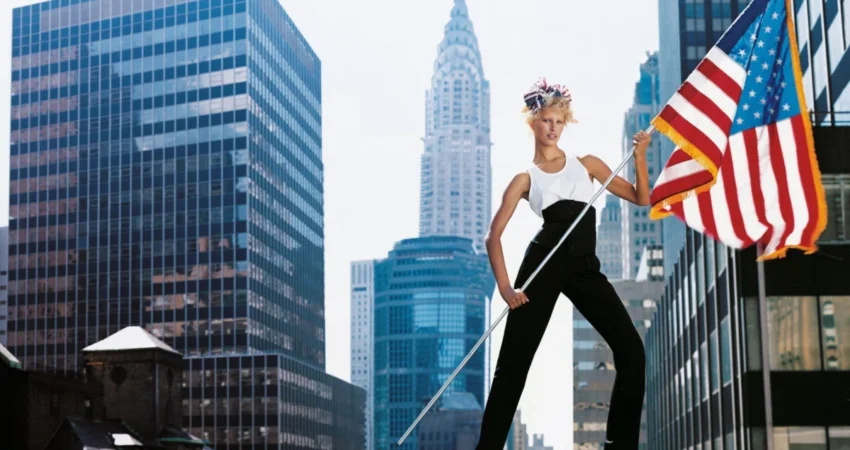
The American fashion industry, centered in the heart of New York City, underwent a profound and somber transformation in the autumn of 2001. In an unprecedented move, the industry’s leading publication, Vogue, deviated from its standard editorial practice of showcasing only immediately available merchandise to offer an early preview of the Spring 2002 collections. This decision was not merely a stylistic choice but a response to a national tragedy that halted the traditional rhythm of the global fashion calendar. The collections, which under normal circumstances would have been celebrated with theatrical flair under the tents in Bryant Park, were instead presented through a lens of optimism, vivacity, and resolve. This shift marked a pivotal moment in American design, moving away from the irony and spectacle of the late 20th century toward a more grounded, essentialist philosophy.

The Intersection of Tragedy and the Fashion Calendar
The New York collections for the Spring/Summer 2002 season began in early September 2001 with the usual mixture of avant-garde experimentation and high-society exclusivity. Early shows, such as those by Imitation of Christ, challenged traditional runway norms by having models sit in the front row while editors walked the catwalk. Meanwhile, established labels like Marc Jacobs continued to maintain the high-pressure, celebrity-laden atmosphere that had come to define the modern fashion show.
This atmosphere of "giddiness and tedium" was abruptly terminated on the morning of Tuesday, September 11. As the terrorist attacks on the World Trade Center unfolded, the immediate vicinity of the Garment District and the Bryant Park show space was transformed into a zone of crisis. All remaining scheduled shows were canceled instantly. The industry, which serves as a major economic engine for New York City, faced an existential question: how, and if, to proceed in a city defined by grief and a nation mobilized for war.

Chronology of an Industry in Transition
The timeline of the weeks following the attacks illustrates a gradual, sober return to professional activity. While international editors and buyers largely fled the city in the days following September 11, the domestic industry remained.
- September 7–10, 2001: The initial days of New York Fashion Week (NYFW) proceed as planned, featuring high-concept runways and significant media presence.
- September 11, 2001: The attacks occur. The Council of Fashion Designers of America (CFDA) and "7th on Sixth" organizers cancel all events.
- September 12–16, 2001: A period of mourning and logistical paralysis. Many designers consider abandoning their collections entirely for the season.
- Late September 2001: Designers begin inviting small groups of editors and buyers to no-frills showroom presentations. These events are characterized by a lack of music, celebrity guests, and "goodie bags."
- November 2001: Vogue publishes its retrospective and preview, signaling a symbolic "reopening" of the American fashion narrative.
This transition from the public "tents" to the private "showrooms" forced a re-evaluation of the clothing itself. Without the distractions of lighting, sound, and staging, the focus returned to the construction, fabric, and utility of American sportswear.

Economic and Cultural Supporting Data
The fashion industry’s resilience was a critical component of New York City’s broader economic recovery. In 2001, the apparel industry was one of the city’s largest manufacturing employers. The cancellation of the major runway shows represented a significant loss in tourism revenue and global media exposure. According to industry estimates from that period, the semi-annual fashion weeks contributed hundreds of millions of dollars to the local economy through hotel stays, dining, and transportation.
Beyond the financial impact, the cultural shift was measurable in the design aesthetic. There was a notable move toward "investment pieces"—clothing that offered a sense of permanence and security. Data from retail analysts in late 2001 suggested a decline in interest for "disposable" or highly ironic fashion, with consumers gravitating toward classic silhouettes and durable materials. This was reflected in the Spring 2002 previews, which emphasized the white shirt, the trench coat, and the versatile day dress.

Official Responses and Designer Perspectives
The return to work was not presented as a "business as usual" scenario but as an act of patriotic resolve. Designers utilized their showroom presentations to express solidarity with the city. Donna Karan, whose presentation coincided with the anniversary of her late husband’s wedding, noted the emotional weight of the moment. Her collection, featuring light-as-air trench coats, was presented alongside somber musical choices that resonated deeply with an audience still processing collective trauma.
Designers like Michael Kors and Marc Jacobs pivoted from the theatrical to the practical. The consensus among the "home team" of American designers was that fashion should serve the wearer during times of stress. This sentiment was echoed across the industry: the clothing was meant to be "unbeatable basics" that solved the problem of what to wear when more significant global events demanded one’s attention. The rhetoric shifted from "fashion as fantasy" to "fashion as a functional tool for living."

Analysis of Design Trends: The Return of American Sportswear
The Spring 2002 collections highlighted what many critics consider the core strength of American fashion: the refinement of sportswear. While Paris is often associated with couture and Milan with sensual luxury, New York reasserted itself as the capital of high-quality, wearable separates.
The Reimagined Trench and the White Shirt
Key pieces for the season included the corset-backed trench by Narciso Rodriguez and the skinny poplin shirts of Carolina Herrera. These items represented a "total lack of fuss and bother." By stripping away unnecessary ornamentation, designers provided a wardrobe that felt appropriate for a more serious world.

The Low-Key Dress
The essential item for the season was identified as the "dress and go" silhouette. Michael Kors looked to the legacy of Halston with stretch-silk halters, while Calvin Klein utilized plum tulle and 1930s-style seaming to create layered sheaths. These garments were characterized by an "uncluttered prettiness" that avoided being overly precious or "twee."
Homespun Finishes and Craftsmanship
A surprising counterpoint to the slick, narrow silhouettes was the emergence of "homespun" textures. Designers incorporated lace, eyelet, and quilting—fabrics typically associated with the domestic sphere and comfort. Ralph Lauren’s romantic prairie skirts and the Battenberg lace used by Miguel Adrover suggested a desire for the familiar and the handcrafted. This "warm, friendly, and domestic" mood served as a psychological balm to the harshness of the urban environment post-9/11.

Broader Impact and Implications for the Future
The events of September 2001 are often cited as the "end of irony" in American popular discourse. In the decade preceding the attacks, fashion had frequently leaned into subversive, cynical, or "ugly-chic" aesthetics. The Spring 2002 previews suggested that such detachment was no longer tenable.
The implications for the industry were twofold. First, there was a renewed appreciation for the intrinsic beauty of design over the "too-cool" military or urban warrior trends that had dominated previous seasons. While combat boots and utilitarian jackets remained in the wardrobe, they were recontextualized as items of genuine utility rather than ironic costumes.

Second, the crisis solidified the importance of the American designer as a pillar of the national identity. The "Amazing Grace" of the season lay in the industry’s ability to find a balance between mourning and movement. By focusing on optimism, vivacity, and confidence, the fashion community provided a visual language for resilience.
The Spring 2002 season proved that fashion is not a peripheral industry but a mirror of the human condition. In the face of unprecedented tragedy, American designers did not offer defeatist aesthetics. Instead, they returned to the fundamentals of their craft, proving that even in the most unusual of times, the act of "dressing and going" remains a vital, defiant assertion of life. This era defined a new standard for the industry: one where beauty is found in simplicity, and strength is found in the refusal to abandon the creative spirit.

0 Comments