
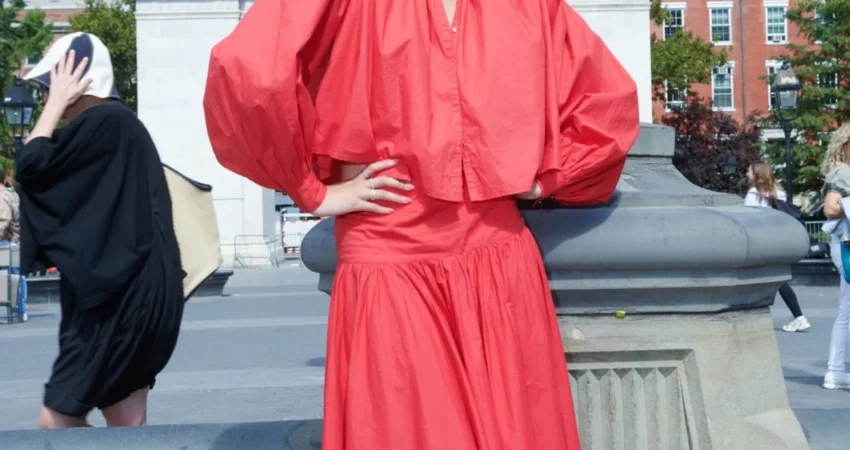
On a sweltering Wednesday afternoon in Manhattan, designer Batsheva Hay bypassed the traditional confines of New York Fashion Week to stage a spontaneous, guerrilla-style runway presentation that utilized the city’s public spaces as a living stage. Eschewing the high costs and exclusive gatekeeping of traditional studio visits or rented venues, Hay led a procession of models from her NoLIta storefront to the historic environs of Washington Square Park. The event, which transitioned from the cobblestone streets to the subterranean depths of the New York City subway system, signaled a strategic shift toward experiential, public-facing fashion that prioritizes raw urban energy over curated industry intimacy.
The Strategic Shift to Guerrilla Presentation
For the Spring 2027 season, Batsheva Hay sought to challenge the established norms of the fashion industry by removing the barrier between the audience and the art. The decision to move the show into the public sphere was born from a desire to embrace the unpredictable nature of the city. According to Hay, while her previous shows have leaned into "wacky" themes within controlled environments or directly in front of her retail space, the most radical move for the current season was to perform without a prepared audience. By utilizing the city as a stage, the designer tapped into the "unfazed" nature of New Yorkers, creating a spectacle that existed simultaneously as a high-fashion shoot and a mundane part of the daily commute.
This approach reflects a growing trend among independent designers who find the traditional runway model increasingly cost-prohibitive and creatively restrictive. Industry data suggests that a standard runway show during New York Fashion Week can cost anywhere from $50,000 to over $200,000, depending on venue, lighting, and staffing. By opting for a public park and the MTA subway system, Batsheva effectively democratized the viewing experience while significantly reducing overhead, allowing the focus to remain squarely on the garments and the movement of the models.
Chronology of the Event: From NoLIta to the Underground
The afternoon began at the Batsheva storefront in NoLIta, where a diverse group of models—comprised of personal friends of the designer, familiar faces from previous campaigns, and individuals cast directly from the streets—underwent their final preparations. The aesthetic direction was described as "Paris meets Troll Doll," a juxtaposition of European high-fashion silhouettes with playful, neon-colored wigs that added a psychedelic layer to the presentation.
At approximately 2:00 PM, the group departed the store, moving in a single-file line toward Washington Square Park. Observers noted that the models resembled a row of "psychedelic ducklings," their neon hair contrasting sharply with the neutral tones of the city’s architecture. Upon arriving at the park, the models circled the iconic central fountain. Despite the visual intensity of the sheer organza plaids and vibrant florals, many park-goers remained notably indifferent—a reaction that Hay cited as a quintessential element of the New York experience.
Following the park circuit, the ensemble made a brief stop at a Mister Softee ice cream truck located at the park’s edge. This moment of levity served as a bridge between the two halves of the show. The final phase of the presentation took place within the New York City subway system. The models descended into the station to stage a secondary "underground" show and photoshoot, integrating the Spring 2027 collection into the grit and bustle of the city’s transit infrastructure.
Collection Analysis: 1980s Inspiration and Experimental Sheerness
The Spring 2027 collection showcased Hay’s ability to blend historical references with modern, often subversive, sensibilities. The centerpiece of the season was a drop-waist circle skirt, an item directly inspired by a 1980s design by Norma Kamali. Hay, who has been frequently seen wearing the vintage Kamali style herself, translated the silhouette into her own signature vocabulary. The drop-waist theme continued with a series of 1920s-inspired dresses, which offered an "easy" fit that contrasted with the more structured, corseted trends seen elsewhere in contemporary fashion.
Technical details of the collection included:
- Fabrication: Heavy use of sheer organza, often featuring plaid patterns, and the designer’s hallmark "ditsy" floral prints.
- Silhouettes: Cropped sailor tops and full-sleeved button-down blouses provided a "cutesy" counterpoint to the more experimental pieces.
- Lingerie Influence: For the first time, Hay introduced a small batch of lingerie-inspired items. These pieces utilized transparency and delicate construction, marking an evolution in the designer’s exploration of femininity and the "private vs. public" nature of dress.
The pairing of these garments with neon wigs and street-side interactions served to de-contextualize the "prairie" aesthetic that initially brought Hay to prominence. By placing these romantic, vintage-inspired clothes in the harsh light of a New York summer and the fluorescent glare of the subway, the designer highlighted their versatility and resilience.
The Role of Washington Square Park as a Cultural Backdrop
Choosing Washington Square Park as the primary venue was a deliberate nod to the location’s history as a hub for avant-garde art and social gathering. For decades, the park has served as a crossroads for various subcultures, making it the ideal setting for a collection that draws from disparate eras like the 1920s and the 1980s.
The "waterless fountain" served as a makeshift amphitheater, providing a focal point for the models without requiring the construction of a physical runway. This use of existing urban infrastructure aligns with the "found space" movement in performance art, where the environment dictates the flow of the presentation. The presence of tourists, students, and locals—many of whom documented the event on their mobile devices—ensured that the show reached a digital audience in real-time, effectively bypassing the traditional delay between a fashion show and its media coverage.
Economic and Industry Implications
The guerrilla format adopted by Batsheva Hay reflects broader shifts in the fashion industry’s marketing and distribution models. As digital platforms like Instagram and TikTok become the primary drivers of brand visibility, the necessity for a traditional, seated audience of editors and buyers is being called into question.
- Viral Potential: Public spectacles are inherently more "shareable" than private shows. The visual of models eating ice cream or riding the subway in high-fashion organza is designed to resonate on social media, providing the brand with organic reach that exceeds the traditional PR cycle.
- Brand Authenticity: By casting friends and street-stars, Hay reinforces a brand identity rooted in community and accessibility. This contrasts with the often-criticized exclusivity of major luxury houses.
- Logistical Agility: Staging a show in a public space allows a designer to react to the city’s current mood. The "hot Wednesday afternoon" and the "Mister Softee" break were not just incidental; they were integrated into the narrative of the brand, making the collection feel "lived-in" rather than static.
Broader Impact on New York Fashion Week
Batsheva’s Spring 2027 presentation adds to a growing discourse regarding the future of New York Fashion Week (NYFW). While the Council of Fashion Designers of America (CFDA) continues to organize a centralized calendar, an increasing number of designers are choosing to operate on the fringes. This decentralization allows for a more diverse range of expressions and ensures that the "fashion week" energy permeates the entire city rather than being confined to a few select zip codes.
The "unfazed" reaction of the New York public, as noted during the Washington Square Park segment, serves as a reminder of the city’s status as a perpetual fashion show. In a metropolis where extreme personal style is a daily occurrence, a designer must go to great lengths to truly "buck the norm." Hay’s success in doing so—through the use of neon "Troll Doll" aesthetics and subterranean shoots—reaffirms her position as one of the city’s most inventive and resilient creative forces.
As the ensemble disappeared into the subway for the final leg of their journey, the event concluded not with a bow on a stage, but as a part of the city’s ongoing movement. The Spring 2027 collection, with its mix of 1980s nostalgia and experimental sheerness, was thus successfully launched into the public consciousness, proving that sometimes the best way to stand out in the fashion world is to simply walk out the front door and join the crowd.

0 Comments