
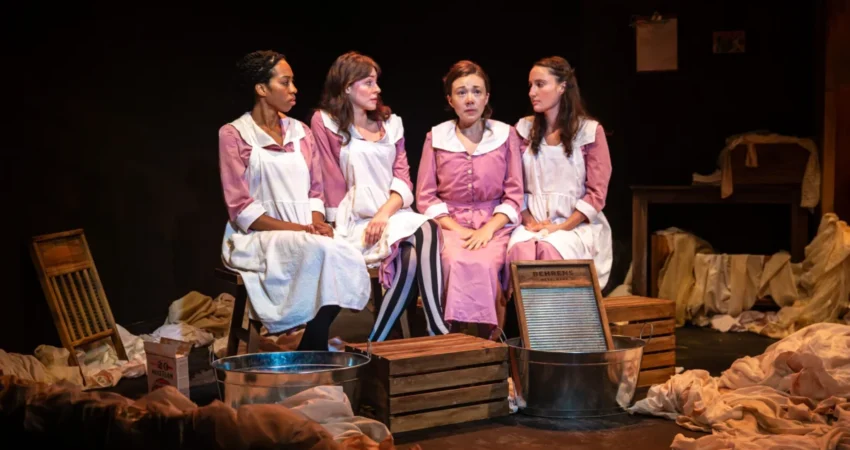
The latest theatrical production from playwright Sophie McIntosh, titled Benevolent, offers a harrowing and meticulously researched glimpse into the lives of four young women confined within Inwood’s Benevolent Home in 1917. Staged at the IATI Theater in New York City’s East Village, the play is directed by McIntosh’s longtime collaborator Nina Goodheart and produced by the Good Apples Collective. Set against the backdrop of the Progressive Era, the narrative centers on a "reformatory house for fallen and friendless girls," a term used historically to categorize women who deviated from the rigid social and moral codes of the early 20th century. The production, which runs through September 5, serves as both a historical interrogation and a contemporary commentary on hierarchy, reproductive autonomy, and the systemic policing of marginalized bodies.
The Setting and Narrative Structure of Benevolent
The action of Benevolent is confined entirely to a basement laundry room, a setting that functions as both a literal place of labor and a metaphor for the "cleansing" of social sins. The four protagonists—wards of the state or their families—are tasked with the endless scrubbing of soiled linens on manual washboards. This drudgery is punctuated by the arrival of new laundry through a central chute, symbolizing the relentless and dehumanizing nature of the reformatory system.
The play’s four characters represent a cross-section of the era’s marginalized female population:
- Abby (played by Livvy Marcus): A seventeen-year-old from a privileged background whose presence in the home suggests a fall from grace that her father’s status could not prevent.
- Emma (played by Mia Fowler): A Black woman and sex worker from a "50-cent joint," whose experience is shaped by the intersection of racial prejudice and economic necessity.
- Margaret (played by Chani Reese): A brash, white sex worker who previously operated in higher-tier "$10 brothels," highlighting the internal class hierarchies among the residents.
- Sarah (played by Rachel Ravel): A resilient and buoyant individual who supported herself by panhandling on the Coney Island Boardwalk, referred to by moral crusaders of the time as "Sodom by the Sea."
As the play unfolds, these women are forced to confront the disparities in their backgrounds while finding common ground in their shared confinement. The script explores how their varying levels of privilege—granted by race, age, or previous economic status—dictate their treatment within the institution and their prospects for a life beyond its walls.
.jpg)
Historical Context: The Rise of Scientific Reform in New York City
The historical foundation of Benevolent is rooted in the actual institutions that dotted the landscape of Upper Manhattan during the late 19th and early 20th centuries. McIntosh’s research was heavily influenced by the history of the Magdalen Benevolent Society (later known as Inwood House) and the House of Mercy. These organizations were part of the Progressive Era’s broader "social hygiene" movement, which sought to address perceived social ills through a combination of religious moralism and emerging sociological data.
During this period, reformers utilized what they believed to be "scientific" methods to categorize and rehabilitate women. This involved extensive surveys and the collection of personal data to prove a person’s inherent "badness" or likelihood of recidivism. However, as McIntosh notes, these methodologies were often flawed and failed to account for the material conditions that led women into sex work or vagrancy. The reformatories focused on teaching domestic skills, such as laundry and sewing, under the assumption that these women simply needed to be taught "honest" labor. In reality, the economic opportunities for women in 1917 were extremely limited, and many wards returned to their previous professions—labeled as "relapses" by the institutions—out of a necessity for survival.
The Inwood House, specifically, was situated on a hill overlooking the Hudson River, a location that McIntosh utilized for geographic and thematic inspiration. The contrast between the scenic views and the grueling manual labor performed in the basements underscores the hypocrisy of "benevolent" institutions that functioned more like prisons than places of healing.
Developmental Chronology: From Academic Thesis to Professional Production
The journey of Benevolent from concept to stage followed a rigorous developmental path within the New York theater scene. The timeline of its creation illustrates the evolving nature of the script and its thematic priorities:
- Initial Research and Draft (Fall 2024): McIntosh began the project as her graduate thesis, drawing inspiration from the work of local Inwood historian Cole Thompson. The earliest draft included a larger cast and subplots involving spiritualism and séances, reflecting the post-Civil War religious movements that were still prevalent in the early 1900s.
- Academic Workshop: Under the tutelage of acclaimed playwright David Henry Hwang, McIntosh refined the script. The decision was made to remove the supernatural elements to focus on the "grounded, human plane" and the physical toll of manual labor.
- Reading at Theater Row (Spring 2024): A public reading provided critical feedback. During this phase, McIntosh realized that the script’s original race-neutral casting approach was "flattening" the historical reality. This led to a deliberate rewrite to explicitly address the racial dynamics of 1917 New York.
- Production with Good Apples Collective: McIntosh and director Nina Goodheart, co-founders of the Good Apples Collective, brought the play to its current form. The production team was intentionally diverse, hiring a Black dramaturg and stage manager to ensure that conversations regarding race and identity were handled with nuance and shared authority.
The Intersection of Race, Class, and Gender
One of the most striking elements of Benevolent is its refusal to shy away from the racial tensions of the era. By casting Mia Fowler as Emma and incorporating racialized dialogue, including the use of period-accurate slurs, the play highlights how the "fallen woman" narrative was experienced differently across the color line.
.jpg.jpg)
In 1917, Black women in the reformatory system faced a double burden of moral judgment and systemic racism. While white women like Margaret might have had access to more lucrative sex work or a greater chance at "reintegration" into society, Black women were often subjected to harsher labor and fewer resources. The play’s dramaturgical focus on these dynamics prevents the story from becoming a generic tale of sisterhood, instead presenting a complex web of complicity and power.
McIntosh emphasized the importance of this specificity, noting that ignoring race in a period piece often undermines the authenticity of the story. The production sought to create a rehearsal environment where no single individual was the sole representative of their identity, fostering a collaborative space for exploring difficult subject matter.
Reproductive Rights and the Politics of Discomfort
A pivotal and controversial scene in Benevolent depicts a medical abortion performed onstage. While the procedure is historical in context, its inclusion resonates powerfully with contemporary debates surrounding reproductive healthcare in the United States. McIntosh acknowledges the influence of Ruby Rae Spiegel’s Dry Land—a modern play known for its unflinching depiction of abortion—and seeks to pay homage to that level of transparency.
The playwright views the work as inherently political, though she expresses a pragmatic skepticism regarding the ability of art to be "purely" political within a capitalistic theater system. She argues that the need to fill seats and pander to ticket buyers often tempers the radical potential of theater. However, Benevolent leans into the discomfort of its audience, utilizing clear content warnings to allow viewers to choose their level of engagement with the play’s more graphic or traumatic elements.
The timing of the production is particularly poignant. Director Nina Goodheart, a former volunteer at the Manhattan Planned Parenthood, noted the surreal nature of walking past the now-shuttered clinic on the way to the theater. For the creative team, the play is a response to the current post-Roe v. Wade landscape, using the history of 1917 to "holler" against the cyclical nature of gendered control and the restriction of bodily autonomy.
.jpg)
Ethical Production Standards and the Indie Theater Landscape
Beyond its narrative content, Benevolent represents the mission of the Good Apples Collective to reform the culture of theater-making itself. Founded by McIntosh and Goodheart, the collective focuses on stories about power and abuse from queer and gender-marginalized perspectives. A core tenet of the organization is the belief that high-quality art can be produced without the toxic or abusive environments often found in traditional theater hierarchies.
The production of Benevolent at the IATI Theater highlights the vitality of the "downtown indie" scene. While McIntosh expresses a desire for the stability and benefits associated with larger commercial productions, she highlights the creative freedom found in the independent sector. The challenge for such productions remains the "math" of sustainability—balancing the desire to tell difficult, charged stories with the financial necessity of maintaining a run and paying a fair wage to actors.
Broader Impact and Implications
As Benevolent concludes its run, its impact is measured by its contribution to the ongoing dialogue about New York’s hidden histories and the persistence of the "reformatory" impulse in American society. The play suggests that while the institutions of the 1910s have largely disappeared, the underlying desire to categorize, shame, and control women—particularly those who are poor, Black, or "unruly"—remains a potent force in law and culture.
The play’s use of period-accurate language, inspired by court transcripts and propaganda from the Tenement Museum and Columbia University archives, provides a bridge between the past and present. By grounding the "fallen girl" trope in the visceral reality of a basement laundry room, McIntosh and Goodheart have created a work that demands a reckoning with the scientific and religious justifications used to strip individuals of their agency.
In the broader context of American theater, Benevolent stands as a testament to the power of historical drama to act as a mirror. It challenges the industry’s fear of making audiences uncomfortable and asserts that the most meaningful art often arises from the most difficult truths. Whether the play moves to a larger stage or remains a hallmark of the 2024 indie season, it has already succeeded in bringing the ghosts of Inwood House back into the public consciousness, demanding that their stories be heard without the filter of "benevolence."

0 Comments