
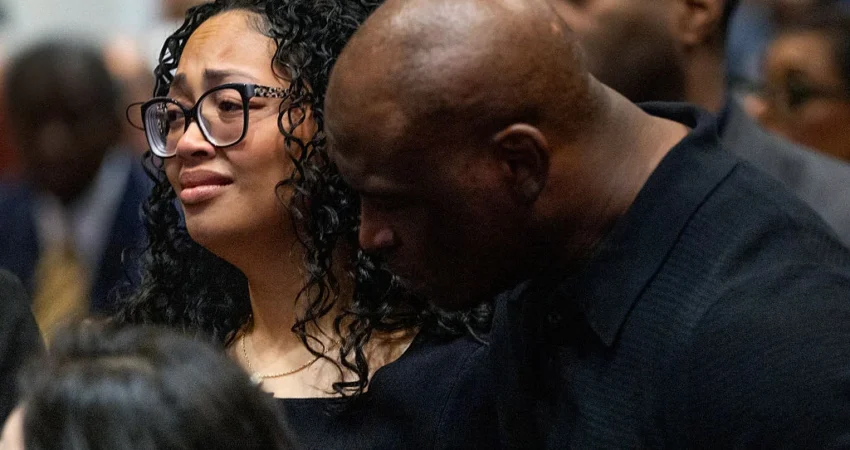
The death of Nolan Wells, an 18-year-old whose body was discovered off the Mississippi Gulf Coast in July, has transitioned from a local tragedy into a national discourse on the judicial system and the pervasive nature of racial bias. During a recent interview with NBC News’ Yasmine Vossoughian, Christine Wells-Wonsley, Nolan’s mother, sparked a significant conversation regarding the "adultification" of Black youth when she corrected the reporter for referring to her late son as a "man." This moment occurred shortly after a Mississippi grand jury declined to bring criminal charges in connection with the teenager’s death, a decision that has left the Wells family and their legal representatives seeking answers and transparency.
The exchange between Wells-Wonsley and Vossoughian highlighted a nuance often overlooked in media coverage of Black victims. When the reporter used the term "man" to describe the 18-year-old, Wells-Wonsley interjected to emphasize his youth. She acknowledged that while the law recognizes 18-year-olds as adults, the social and developmental reality of a teenager should not be erased. "Nolan was a boy. He was a child. He was our child," she stated, urging the public to stop referring to him as a man. This rebuke was not merely a matter of semantics; it was a direct challenge to a documented psychological phenomenon known as adultification bias, which experts argue plays a critical role in how Black victims are perceived by the public, the media, and the legal system.
Chronology of the Nolan Wells Case
The events leading to this national outcry began on July 4, when Nolan Wells joined a group of white friends for a boat trip and a party on an island off the Mississippi Gulf Coast. According to family accounts and initial reports, the excursion was intended to be a holiday celebration. However, Nolan did not return home. His disappearance triggered a search that concluded two days later when his body was recovered from the water.
In the months following the discovery, the Wells family has consistently pushed for a thorough investigation, citing concerns over the circumstances surrounding the boat trip. The Jackson County District Attorney’s office took the case to a grand jury to determine if there was sufficient evidence to warrant criminal indictments against any of the individuals present during the outing. This week, the District Attorney notified Wells-Wonsley via text message that the grand jury had declined to issue an indictment, effectively stalling the criminal pursuit of justice in the state’s hands.
The family’s frustration was compounded by the release of the Mississippi State Medical Examiner’s autopsy report on Thursday. The report listed the cause and manner of Nolan’s death as "undetermined." In forensic pathology, an "undetermined" finding indicates that the medical examiner could not definitively conclude whether the death was accidental, a homicide, a suicide, or due to natural causes. For the Wells family, this lack of clarity, paired with the grand jury’s decision, has created a vacuum of accountability.
Understanding Adultification Bias and its Legal Impact
The reaction to Wells-Wonsley’s interview has brought renewed focus to the research of Dr. Phillip Atiba Solomon (formerly known as Phillip Atiba Goff), the Carl I. Hovland Professor of Black Studies and Professor of Psychology at Yale University. Dr. Solomon, who also serves as the CEO of the Center for Policing Equity, has pioneered research into adultification bias—a stereotype rooted in anti-Black racism that causes adults to perceive Black children as being older, more dangerous, and more responsible for their actions than their white peers.
According to Dr. Solomon’s research, this bias manifests as early as elementary school, where Black children are often disciplined more harshly for the same behaviors as white children. By the time these children reach adolescence, the bias can have lethal consequences. "Black kids are essentially deprived of [adolescence], so that they’re either children, meaning that they are innocent and worthy of protection, or they’re adults, and nothing in between," Solomon explained. He noted that while white young men are often afforded the "boys will be boys" defense—a narrative that frames mistakes as part of a developmental learning curve—Black boys are rarely granted the same grace.
The data supporting these claims is stark. Research from the American Psychological Association and the Georgetown Law Center on Poverty and Inequality suggests that Black boys are consistently perceived as being several years older than they actually are. Furthermore, Black youth are 18 times more likely to be tried as adults than white youth for the same offenses at the same age. This systemic disparity suggests that the "adult" label is often used as a tool to strip Black children of their perceived innocence, making them appear as "appropriate targets" for state-sanctioned violence or legal neglect.

Historical Context and Comparative Cases
The "adultification" of Nolan Wells follows a tragic historical pattern in the United States. Civil rights advocates point to the 2012 death of Trayvon Martin and the 2014 death of Tamir Rice as prime examples of how this bias influences public narrative and legal outcomes. In the case of Tamir Rice, a 12-year-old playing with a toy gun in a Cleveland park, local police descriptions famously referred to him as a "man" and "a 12-year-old in an adult body." This framing was used to justify the officer’s immediate use of lethal force, suggesting that the child’s physical stature somehow negated his developmental status as a minor.
Similarly, when 17-year-old Trayvon Martin was killed, much of the defense’s narrative focused on his height and his "threatening" appearance, effectively "aging him up" in the minds of the jury to make the shooter’s claim of self-defense more plausible. By correcting the reporter, Christine Wells-Wonsley was attempting to prevent this same narrative shift from devaluing her son’s life. She argued that by calling an 18-year-old a "man," the media inadvertently strips him of the vulnerability and protection usually afforded to teenagers.
Official Responses and Public Reaction
The legal team representing the Wells family, led by prominent civil rights attorney Ben Crump, has been vocal about the perceived failures of the Jackson County District Attorney. Crump shared the NBC News exchange on social media, reinforcing the importance of language in the pursuit of justice. "How we talk about our children matters, and Nolan Wells deserves to be remembered exactly as he was," Crump stated. The family has specifically criticized the District Attorney for a perceived "lack of empathy," particularly regarding the decision to communicate the grand jury’s results via text message rather than a formal, in-person meeting.
The public response to the interview has been overwhelmingly supportive of Wells-Wonsley. On platforms like Threads and Instagram, journalists and activists have lauded her for her clarity and strength. Journalist Christian Farías noted that while many grieving mothers have taken their search for justice public, Wells-Wonsley’s specific focus on correcting the "adult" label was "immensely powerful" because of the role journalists play in creating public narratives.
Commenters on social media have also pointed out a perceived double standard in the case’s coverage. Many observed that while Nolan is being called a "man," the white individuals who were with him on the boat—some of whom are around the same age—are frequently referred to as "young boys" or "teens" in various discussions. This disparity highlights the "humanity gap" that Dr. Solomon’s research describes, where innocence is a commodity distributed unevenly along racial lines.
Implications for Future Advocacy
The case of Nolan Wells serves as a critical touchpoint for ongoing efforts to reform how the media and the justice system treat Black youth. The "undetermined" status of the autopsy means the family’s quest for answers is far from over. They continue to call for a more transparent look into the evidence presented to the grand jury and are seeking additional investigations into the events of July 4.
From a sociological perspective, the conversation started by Christine Wells-Wonsley emphasizes the need for "formal dehumanization" to be addressed within institutional frameworks. As Dr. Solomon noted, the lack of media representation showing Black adolescents in "awkward" or "goofy" coming-of-age roles contributes to a culture that only sees Black youth through a lens of threat or maturity.
As the Wells family navigates the aftermath of the grand jury’s decision, their advocacy remains focused on reclaiming Nolan’s identity as a teenager whose life was cut short. By refusing to let her son be "adultified," Wells-Wonsley is demanding that the world see his humanity, his vulnerability, and the inherent value of a life that had only just reached the threshold of adulthood. The case remains a stark reminder that in the eyes of the law and the media, the definition of "childhood" remains a contested territory for Black families in America.

0 Comments