
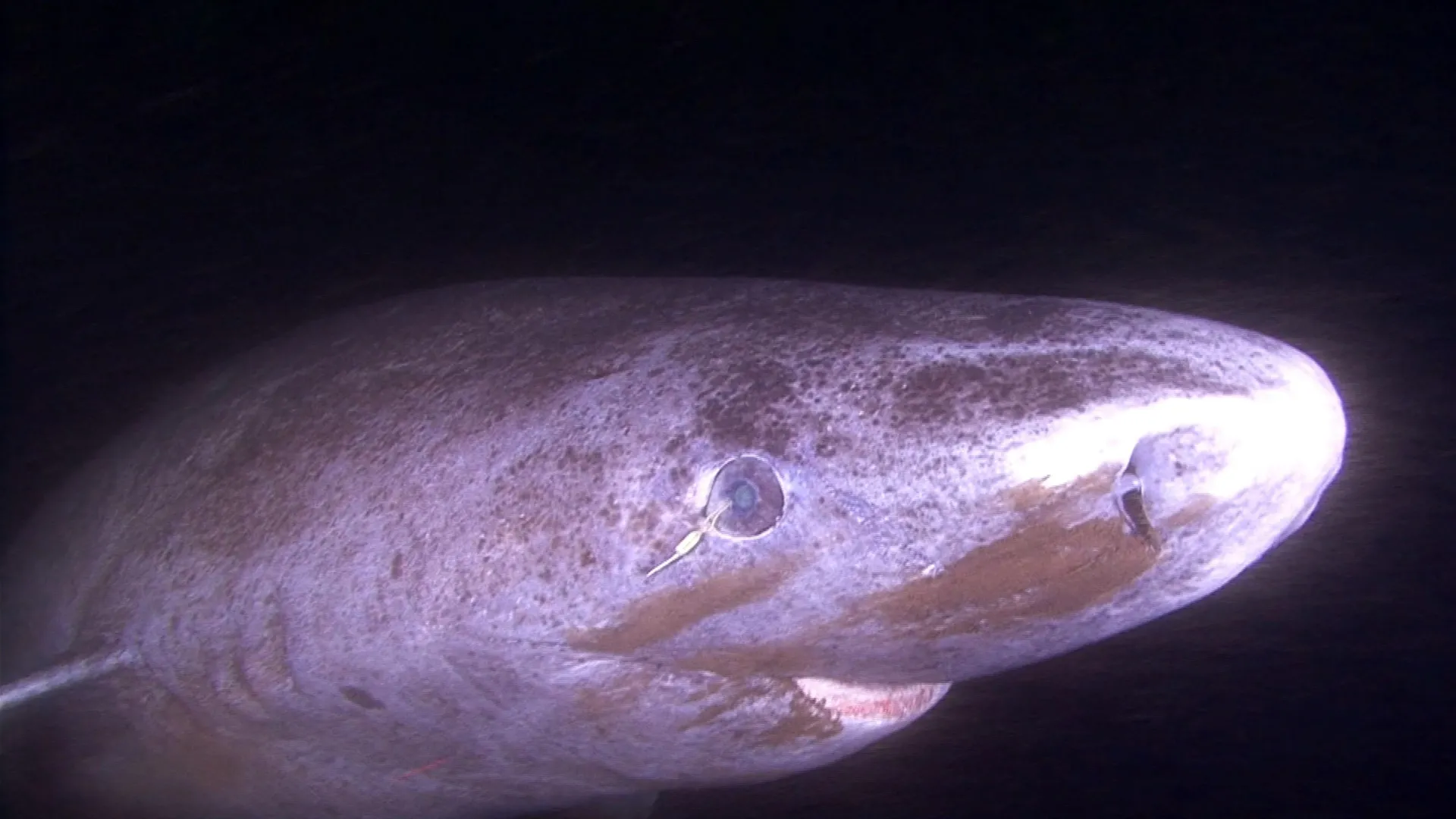
In the hushed, frigid depths of the Arctic Ocean, a creature of myth and scientific intrigue navigates the perpetual twilight. The Greenland shark, a behemoth of the deep, is not only the longest-living vertebrate known to science, with lifespans potentially reaching four centuries, but its very sensory organs have long been a source of profound mystery. Now, groundbreaking research spearheaded by Dorota Skowronska-Krawczyk, an associate professor of physiology and biophysics at the University of California, Irvine, is dismantling long-held assumptions about these ancient mariners, particularly regarding their vision. Far from being functionally blind, as previously theorized, Greenland sharks possess a visual system that is remarkably resilient and exquisitely adapted to their extreme environment, offering tantalizing clues about the fundamental processes of aging and vision preservation.
The prevailing scientific narrative surrounding Greenland sharks painted a picture of compromised eyesight. Their distinctive, cloudy-looking eyes, often appearing listless and frequently host to external parasites, fueled the hypothesis that their vision was severely impaired. These parasites, along with the perpetually dark and murky waters of their habitat, led many researchers to believe that the sharks relied minimally, if at all, on sight. However, a closer examination of their behavior, coupled with cutting-edge molecular and evolutionary analysis, has unveiled a dramatically different reality. Skowronska-Krawczyk’s team, collaborating with Walter Salzburger and Lily G. Fogg from the University of Basel in Switzerland, who brought their expertise in evolutionary biology to the project, has presented evidence suggesting that these sharks possess a sophisticated mechanism for maintaining visual acuity over centuries.
A Glimpse into the Arctic Depths: The Greenland Shark’s Enigma
Greenland sharks (Somniosus microcephalus) are truly remarkable organisms. These slow-moving, cartilaginous fish are endemic to the cold waters of the North Atlantic and Arctic Oceans. Their sheer longevity is unparalleled among vertebrates, with radiocarbon dating of eye lens tissue in some individuals suggesting ages of up to 512 years. This extraordinary lifespan, coupled with their unique physiological adaptations, has made them a prime subject for scientists investigating the biological underpinnings of aging.
The visual challenges presented by their environment are immense. Sunlight penetration in the Arctic Ocean is limited, especially at the depths where these sharks typically reside, which can exceed 2,000 meters. The water itself is often laden with suspended particles, further reducing visibility. Against this backdrop, the visible imperfections in their eyes – the opaque cornea and the ubiquitous copepod parasites (Ommatokoita elongata) that attach to the surface of the eyeball – seemed like clear indicators of visual impairment. For decades, the scientific community largely accepted the notion that these sharks were either blind or possessed only rudimentary vision, akin to a biological consequence of extreme aging and environmental hardship.
Challenging the Paradigm: New Research Illuminates Shark Vision
The pivotal moment that shifted Skowronska-Krawczyk’s perspective, and subsequently the direction of this research, stemmed from a 2016 study published in the journal Science by John Fleng Steffensen of the University of Copenhagen. This paper highlighted the prevalence of eye parasites on Greenland sharks. "One of my takeaway conclusions from the Science paper was that many Greenland sharks have parasites attached to their eyes — which could impair their vision," Skowronska-Krawczyk explained. "Evolutionarily speaking, you don’t keep the organ that you don’t need." This evolutionary logic, however, began to falter when she observed videos of the sharks. "After watching many videos, I realized this animal is moving its eyeball toward the light." This seemingly simple observation of directed eye movement was a powerful counter-argument to the prevailing theory of functional blindness and ignited a quest to understand the underlying biological mechanisms.
The new research, published in the prestigious journal Nature Communications, provides compelling evidence that challenges these long-standing assumptions. The study’s findings suggest that Greenland sharks possess a robust DNA repair mechanism that actively combats retinal degeneration, allowing their visual systems to remain functional for centuries. Furthermore, their visual apparatus appears to be uniquely optimized for the extremely low light conditions prevalent in their Arctic habitat.
From Observation to Investigation: The Scientific Process Unfolds
The journey from initial observation to concrete scientific findings involved a meticulously planned and executed research program. The Greenland sharks utilized in the study were ethically obtained between 2020 and 2024. These specimens were captured using scientific long lines deployed near the University of Copenhagen’s Arctic Station on Disko Island, Greenland. This location is a hub for Arctic research, providing access to the sharks’ natural environment and facilitating collaboration with established marine biology institutions.
Key figures in this endeavor included Professor John Fleng Steffensen, whose earlier work sparked the initial curiosity, alongside Peter G. Bushnell from Indiana University South Bend and Richard W. Brill from the Virginia Institute of Marine Science. These researchers were instrumental in the collection and initial preservation of the shark specimens. Following their capture, the sharks’ eyes were carefully dissected and preserved in a specialized fixative solution. This crucial step ensured the integrity of the delicate ocular tissues, allowing for detailed microscopic and molecular analysis at a later stage.
A Remarkable Specimen: Handling Centuries of Vision
The arrival of preserved Greenland shark eyes at Skowronska-Krawczyk’s laboratory at UC Irvine was an event that left a lasting impression on her team. Emily Tom, a Ph.D. student and physician-scientist in training in Skowronska-Krawczyk’s lab, vividly recalls the moment. "I opened the package, and there was a giant, 200-year-old eyeball sitting on dry ice just staring back at me," she recounted with a laugh. The sheer scale of the specimen was a stark contrast to the tiny mouse eyeballs they typically work with. "We’re used to working with mouse eyeballs, which are the size of a papaya seed, so we had to figure out how to scale up to a baseball-sized eyeball." Tom also highlighted Skowronska-Krawczyk’s hands-on approach to mentorship, a quality she values highly in a research leader.
The process of defrosting and handling such ancient biological material required extreme precision. The lab environment had to be meticulously controlled to prevent the tissue from warming to room temperature, a scenario that could lead to rapid deterioration of cellular structures. The distinct aroma of the Arctic deep sea permeated the lab, a olfactory reminder of the unique origins of their research subjects. "The lab smelled like a fish market," Tom admitted, underscoring the immersive nature of their work.
Unveiling Cellular Resilience: No Signs of Retinal Degeneration
The core of the new research involved rigorous histological and vision-specific analyses of the preserved eye tissues. Emily Tom, armed with her expertise and the careful guidance of Skowronska-Krawczyk, conducted these examinations. The results were groundbreaking. Contrary to expectations of age-related cellular damage, the researchers found no evidence of cell death in the retinal layers of the Greenland shark eyes. This absence of apoptotic activity is a critical indicator of remarkable cellular resilience.
Furthermore, the study identified the active presence of rhodopsin, a vital protein responsible for vision in low-light conditions, within the shark retina. Crucially, this rhodopsin was not merely present; it was found to be specifically tuned to detect blue light. This spectral sensitivity is a significant adaptation, enabling the Greenland shark to perceive the faint blue hues that penetrate the deepest Arctic waters. This molecular fine-tuning of their visual pigment is a testament to their evolutionary optimization for their specific ecological niche.
The implications of these findings are profound. They suggest that the Greenland shark’s extraordinary lifespan is not accompanied by the severe retinal degeneration that one might anticipate in such an aged animal. Instead, their visual system appears to possess intrinsic protective mechanisms that preserve its function over hundreds of years. This challenges the universal understanding of aging as an inherently degenerative process, at least in the context of ocular health.
A Beacon of Hope: What Ancient Sharks Can Teach Humanity About Aging
The research on Greenland shark vision extends far beyond the realm of ichthyology. For Dr. Skowronska-Krawczyk, whose primary research focus is on the molecular processes underlying age-related eye diseases, these findings represent a significant leap forward in understanding how to combat vision loss in humans. "For Skowronska-Krawczyk, the work raises the possibility that understanding how Greenland shark eyes remain healthy for centuries could eventually point researchers toward new strategies for preventing age-related vision loss."
The study’s implications could ripple outwards, offering potential new avenues for research into prevalent human eye conditions such as macular degeneration and glaucoma. These debilitating diseases are characterized by progressive vision loss, often linked to cellular damage and degeneration within the retina. By deciphering the molecular pathways that enable Greenland sharks to maintain retinal integrity over millennia, scientists may unlock novel therapeutic targets and preventive strategies for these conditions.
Moreover, the research prompts broader scientific inquiries into the fundamental mechanisms of aging and tissue maintenance. How do tissues remain functional and robust over such extended periods? What are the evolutionary pressures that drive the development of such extraordinary protective mechanisms? And, critically, could any of these protective mechanisms be translated or adapted for application in human biology? These are complex questions that the study on Greenland sharks has brought to the forefront of scientific inquiry.
Navigating the Future of Research: Funding and Discovery
Despite the exhilarating nature of these discoveries and their potential impact, Dr. Skowronska-Krawczyk acknowledges the persistent challenges facing scientific research, particularly concerning funding. "Skowronska-Krawczyk says uncertainty surrounding federal research funding has created concerns about future support for this type of work, but she remains confident that ‘we will prevail.’" The ability to conduct such pioneering research, which pushes the boundaries of our understanding, is often dependent on sustained financial support. However, her unwavering optimism reflects a deep-seated belief in the importance and eventual success of scientific exploration.
The thrill of being at the forefront of discovery is a powerful motivator for Skowronska-Krawczyk and her team. "What I love about my work is that we are the first in the world to see results — at the forefront, finding new mechanisms, rules and discoveries," she stated, her gaze returning to the paused image of the ancient shark on her computer screen. The collaborative spirit and the joy of sharing these profound insights with her students further underscore the deeply rewarding nature of her work. The Greenland shark, a creature of the deep and a symbol of extreme longevity, has become an unexpected but invaluable teacher, offering humanity a glimpse into the secrets of enduring health and the remarkable resilience of life itself. This research serves as a powerful reminder that some of the most profound answers to our most pressing questions may lie hidden in the most extraordinary corners of the natural world.

0 Comments