
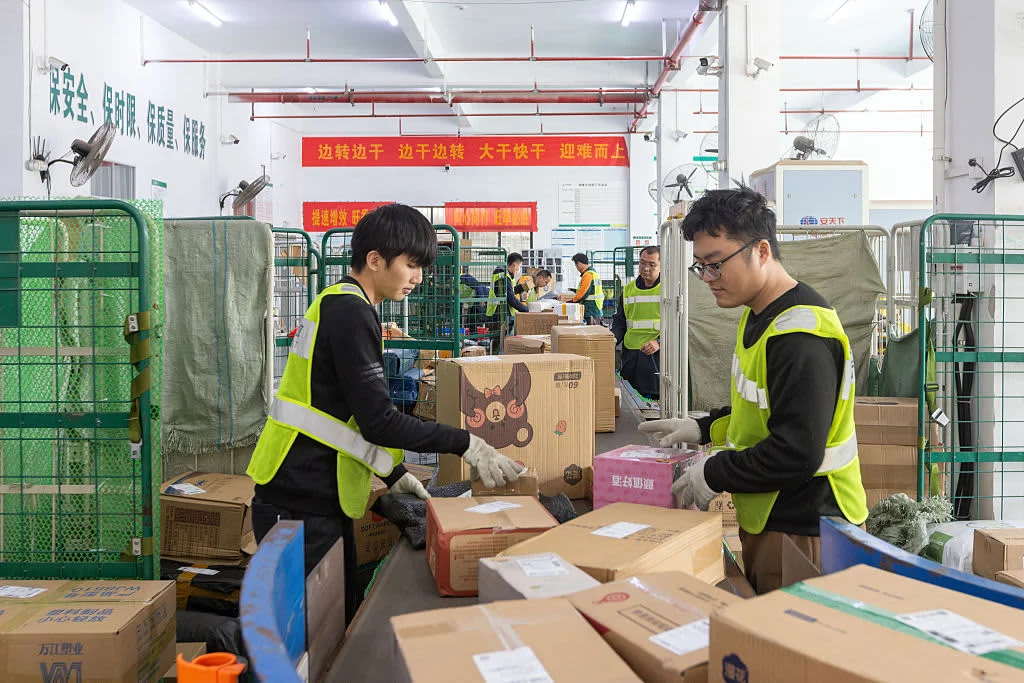
Beijing announced robust economic figures for the first two months of 2026, revealing a start to the year that largely surpassed analysts’ predictions, driven by a surge in holiday spending and sustained external demand. Despite these encouraging signs, underlying structural challenges, particularly in the beleaguered property sector, and escalating geopolitical tensions continue to cast a shadow over the world’s second-largest economy, necessitating a cautious outlook from policymakers.
According to data released by the National Statistics Bureau on Monday, retail sales for January and February collectively rose by 2.8% year-on-year. This performance comfortably exceeded economists’ consensus forecast of a 2.5% growth, signaling a healthier consumer appetite than anticipated. However, a deeper dive into the figures reveals a moderation compared to the 4% increase recorded in the corresponding January-February period of 2025, suggesting that while consumption is growing, its pace has somewhat decelerated from the previous year.
A Boost from Lunar New Year Spending
The primary catalyst for the stronger consumption momentum was undoubtedly the Lunar New Year holiday, which fell in mid-February this year. This extended festive period traditionally sees a significant uptick in consumer activity across the nation. Yuhan Zhang, principal economist at The Conference Board’s China center, highlighted the holiday’s impact, pointing to notable gains in various categories, including tobacco and alcohol sales, which typically surge during celebrations. Furthermore, spending on luxury items like gold and jewelry experienced a significant boost, reflecting both cultural traditions and a potential hedge against economic uncertainties for some consumers.
The holiday translated into a widespread increase in spending, encompassing a broad spectrum of services and goods. Reports indicated a steady rise in hotel bookings, domestic and international tourism, and duty-free shopping, particularly in popular travel destinations. This surge in consumer activity, while welcome, has also tempered expectations for immediate, large-scale stimulus measures from Beijing, as policymakers might interpret the current momentum as a sign of organic recovery, at least in the short term. The resilience in consumer spending during this crucial period offers a glimmer of hope that domestic demand could provide a more stable foundation for economic growth going forward, even as the government aims to rebalance the economy away from its traditional reliance on investment and exports.
Industrial Output Defies Expectations
Parallel to the consumption figures, China’s industrial output demonstrated remarkable resilience, climbing by an impressive 6.3% in the first two months of the year. This figure significantly outstripped the 5% jump estimated by a Reuters poll, underscoring the enduring strength of China’s manufacturing sector. Industrial production has consistently been a relative bright spot for the Chinese economy, a trend that appears to be extending into 2026. This sustained performance is largely attributable to resilient external demand, particularly from key trading partners in European and Southeast Asian nations, which continue to import a wide range of Chinese goods.
The momentum in China’s export sector also continued unabated, with outbound shipments surging by nearly 22% in the first two months of 2026. This robust export performance comes despite growing criticism from various trade partners regarding China’s perceived "excess capacity" in certain manufacturing sectors, particularly in areas like electric vehicles, solar panels, and steel. The strong export data suggests that global demand, even amidst trade tensions and protectionist sentiments, remains sufficiently robust to absorb China’s industrial output. The diversification of China’s export markets, alongside its established position as a global manufacturing hub, has enabled it to navigate complex international trade dynamics and maintain its competitive edge. This has also been supported by continuous upgrades in manufacturing capabilities, particularly in high-tech and value-added sectors, which command strong international interest.
The Persistent Shadow of the Property Crisis
While consumption and industrial data painted a largely optimistic picture, the Achilles’ heel of the Chinese economy—the property sector—continued to drag on overall performance. Investment in fixed assets (FAI), a broad measure that includes infrastructure, manufacturing, and property, rose by 1.8% from a year earlier. This figure, while positive, contrasted with earlier estimates that had projected a 2.1% drop, indicating that other sectors were actively offsetting the property downturn.
However, a closer examination within FAI reveals the depth of the ongoing crisis. Investment in real estate development continued its prolonged decline, falling by 11.1% in January and February. While this represented a moderation from the steeper 17.2% drop observed in 2025, it nevertheless underscores the persistent challenges faced by developers and the broader real estate market. The property crisis, which began several years ago with regulatory tightening and developer debt issues, continues to be a major headwind for economic stability and household wealth. Many developers are grappling with liquidity crises, project delays, and declining sales, leading to a ripple effect across the construction, financial, and local government sectors.
Further compounding these concerns, separate data released on Monday showed that the prolonged decline in China’s home prices across 70 major cities worsened in February. New-home prices dropped by 3.2% from a year earlier, marking the steepest decline in eight months, according to Reuters. This sustained fall in housing values erodes household wealth, dampens consumer confidence, and exacerbates the financial strain on developers and local governments, many of whom rely heavily on land sales for revenue. The government has implemented various measures to stabilize the sector, including easing financing for developers and encouraging home purchases, but these efforts have yet to yield a decisive turnaround.
Excluding property development, investment showed a more encouraging trend, rising by 5.2% year-over-year. This growth was primarily supported by robust inflows into infrastructure projects and manufacturing capacity expansion. Government-led infrastructure spending, a traditional tool for economic stabilization, appears to be playing a crucial role in offsetting the property slump. Furthermore, investment in high-tech manufacturing and strategic industries aligns with Beijing’s long-term goals of technological self-sufficiency and industrial upgrading. This rebalancing of investment away from property and towards productive assets is a key component of China’s structural economic reform agenda. It is worth noting that fixed asset investments saw a historic slump in 2025, declining 3.8% year over year, as the deepening property downturn and tighter constraints on local governments’ borrowing significantly hampered one of China’s traditional growth drivers. The current rebound in non-property FAI is therefore a critical development.

Broader Economic Context and Policy Directives
The urban unemployment rate stood at 5.3% in the first two months of 2026, slightly above the average rate of 5.2% recorded in 2025. While still within a manageable range, this figure highlights the ongoing need for job creation, particularly for graduates and migrant workers, as the economy undergoes structural adjustments. The government’s emphasis on fostering new industries and supporting small and medium-sized enterprises is partly aimed at addressing these employment challenges.
Just last week, Chinese leadership unveiled its annual economic goals for 2026, setting a GDP growth target range of 4.5% to 5%. This target is notable as it represents the least ambitious goal since the early 1990s, signaling Beijing’s recognition of the complex domestic and international environment. It suggests a strategic pivot towards prioritizing quality of growth, structural reforms, and risk mitigation over simply pursuing high headline growth rates. This includes addressing systemic financial risks, fostering innovation, and promoting green development.
Geopolitical Headwinds and Energy Security
Despite the mixed but generally resilient economic data, government officials openly acknowledged growing headwinds to the economy, stemming from intensifying geopolitical tensions and deep-rooted problems inherent in its existing growth model. These factors have exerted considerable pressure on corporate profitability and long-term investment sentiment.
"We should be aware that the evolving external environment is exerting a great impact on China and the geopolitical risks keep rising," the Statistics Bureau cautioned in its official statement. This acknowledgment underscores Beijing’s awareness of the intricate link between global stability and domestic economic performance. Spokesperson Fu Linghui further assured reporters on Monday that China’s energy supply capacity remained sufficient to cope with the heightened volatility in global oil prices, emphasizing that Beijing would closely monitor its impact on inflation.
The ongoing crisis in the Middle East, particularly the potential for disruptions in the Strait of Hormuz, has emerged as a significant global concern. However, data suggests that Beijing may be more insulated from a potential Hormuz closure than many other major economies. This relative insulation is largely due to China’s proactive strategy over the past two decades to diversify its energy sources and meticulously build its strategic reserves. As of January, China reportedly held an estimated 1.2 billion barrels of onshore crude stockpiles, a volume deemed sufficient to meet domestic demand for three to four months, providing a crucial buffer against supply shocks.
According to Rush Doshi, director of China Strategy Initiative at the Council on Foreign Relations, seaborne oil imports through the Hormuz waterway now account for less than half of China’s total oil shipments. Further analysis by Nomura estimated that oil flows through Hormuz represent a mere 6.6% of China’s total energy consumption. These figures highlight China’s successful efforts to broaden its energy import corridors, including pipelines from Central Asia and Russia, and to increase domestic production and alternative energy sources, thereby reducing its vulnerability to disruptions in critical maritime chokepoints.
That said, the escalating crisis in the Middle East could still pose a significant demand shock to China’s export-reliant economy. Higher global energy costs inevitably feed into inflationary pressures worldwide, disrupt intricate global supply chains, and dampen consumer and business spending across China’s key trading partners in Europe and Asia. Such a scenario would ultimately reduce demand for Chinese exports, regardless of its direct energy security.
"The turmoil in the Middle East is set to show its impact on the global economy in the coming months," commented Zhiwei Zhang, president and chief economist at Pinpoint Asset Management. He anticipates that Chinese policymakers will "watch the development closely and respond through fiscal policy if necessary," indicating a readiness to deploy counter-cyclical measures if global conditions deteriorate further.
In light of these global uncertainties, Goldman Sachs on Friday trimmed its China real GDP growth forecast by 0.1 percentage point, attributing the adjustment to anticipated higher energy costs. Notably, this reduction was smaller than the 0.3 to 0.5 percentage point cuts the firm forecasted for other regional economies, reflecting China’s comparatively stronger position. Goldman also revised its annual consumer inflation outlook for China upward to 0.9% from an earlier forecast of 0.6%, and projected that factory-gate prices (Producer Price Index) would rebound by 0.8% this year as higher oil prices ripple through the supply chain.
In summary, China’s economy has commenced 2026 with a dual narrative: signs of stronger-than-expected consumption and industrial output providing an immediate uplift, juxtaposed against the persistent drag of a struggling property sector and the looming specter of geopolitical instability. Beijing’s leadership is navigating a complex landscape, balancing the imperative for economic growth with the need for structural reform and risk management in an increasingly uncertain global environment. The coming months will reveal the extent to which domestic resilience can buffer against external shocks and how effectively policymakers can steer the economy towards sustainable, high-quality growth.
— CNBC’s Evelyn Cheng contributed to the story.

0 Comments