
The tomahawk, a tool synonymous with the American frontier, occupies a unique space in both historical reality and popular imagination. While cinematic depictions often portray the weapon being hurled through the air during the heat of battle, historical records from the 18th and 19th centuries suggest a far more nuanced reality. For the early residents of North America, including indigenous tribes and the European "mountain men" who followed, the tomahawk was primarily a tool of utility and hand-to-hand combat rather than a projectile. To throw one’s primary weapon in a life-or-death struggle was to risk immediate disarmament, a tactical error few seasoned warriors were willing to make. Instead, the practice of throwing the tomahawk evolved as a test of skill, a form of recreation, and a centerpiece of social gatherings known as the "rendezvous."
Historical Misconceptions and the Combat Reality
The popular image of the throwing tomahawk is largely a product of 20th-century media, yet the historical truth is rooted in pragmatism. Indigenous peoples of North America originally crafted "celts" or monolithic axes from stone, which were later replaced by iron and steel heads through trade with European settlers. These metal-headed "trade hawks" became essential multi-purpose tools for chopping wood, skinning game, and self-defense.
In a combat scenario, the tomahawk was valued for its versatility in close quarters. Military historians note that while a tomahawk could be thrown with lethal force, the risks outweighed the rewards. If a warrior missed his target, he not only lost his weapon but provided his opponent with a fresh means of retaliation. Consequently, throwing was reserved for specific tactical circumstances or, more frequently, for demonstrations of prowess outside of active warfare.
The transition of the tomahawk from a weapon of war to a competitive implement occurred during the 19th-century fur trade era. This period saw the rise of the "mountain man," a class of trappers and explorers who spent the majority of the year in the wilderness. Their primary social outlet was the annual rendezvous—a massive, temporary camp where trappers traded pelts for supplies and engaged in various contests of skill.
The Cultural Significance of the 19th-Century Rendezvous
Between 1825 and 1840, the rendezvous served as the economic and social heart of the American West. These gatherings, often held in locations such as the Green River Valley or the Wind River Mountains, brought together a diverse cross-section of society, including French-Canadian voyagers, American trappers, and members of various Native American tribes, such as the Shoshone, Nez Perce, and Flathead.
The rendezvous was a site of intense competition. Men who spent months in isolation used these events to prove their physical superiority through wrestling, horse racing, marksmanship, and tomahawk throwing. For the indigenous tribes who originated the tomahawk, these contests were an extension of traditional games that honed the hand-eye coordination necessary for survival. The "buckskin-clad mountain men" adopted these practices, creating a shared cultural space where the "thunk" of a blade burying into a stump became a hallmark of the frontier experience.
The Technical Evolution of the Tomahawk
The modern tomahawk differs significantly from the standard camp axe or hatchet. Understanding these differences is crucial for mastering the throw. A traditional tomahawk features a straight handle, typically made of hickory, and a head that is friction-fitted rather than wedged or pinned. This design allows the head to slide off the handle if it hits a target incorrectly, preventing the wood from snapping under the stress of a "bad" hit.
Anatomical Components of the Throwing Hawk:
- The Blade (Bit): The sharpened edge that must make contact with the target.
- The Poll (Butt): The back of the head, which provides balance.
- The Eye: The hole in the head through which the handle (haft) passes.
- The Handle (Haft): Usually 16 to 19 inches long, designed to facilitate a smooth release.
Unlike modern axes used in commercial "axe-throwing" venues, which often have heavy, wide blades, the traditional tomahawk is lightweight and balanced for rotation. This balance is what allows a thrower to achieve accuracy through finesse rather than brute strength.
Mastering the Mechanics: Physics and Finesse
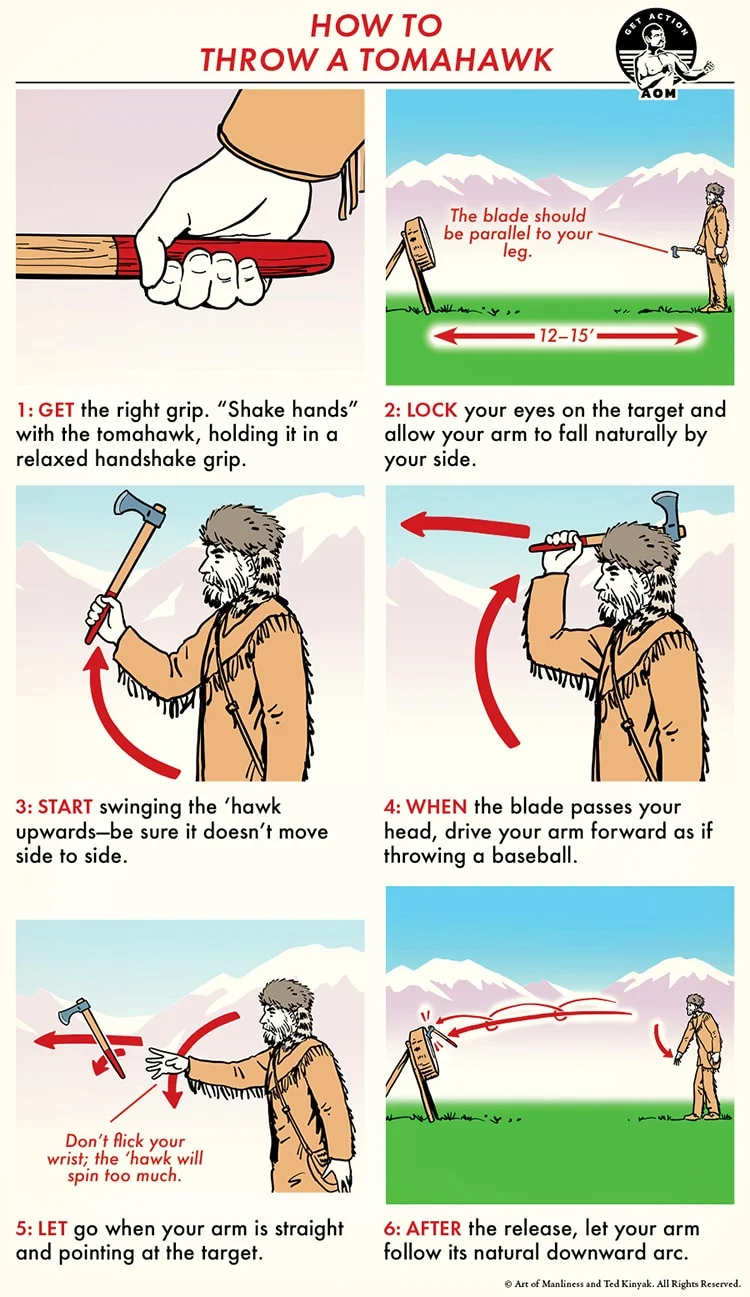
Throwing a tomahawk is a study in rotational physics. Success depends on the relationship between the distance from the target and the speed of the weapon’s rotation. According to enthusiasts and instructors, the most common distance for a single-rotation throw is approximately five to six paces (roughly 12 to 15 feet) from the target.
The Grip and Stance
The foundation of a successful throw is a relaxed grip. Professionals describe the ideal grip as similar to a firm handshake. The thumb should be placed along the side of the handle rather than on the back, as a thumb on the back can inadvertently push the weapon off-course during the release. The stance should be comfortable, with the non-dominant foot forward, pointing toward the target, providing a stable base for the throwing motion.
The Motion and Release
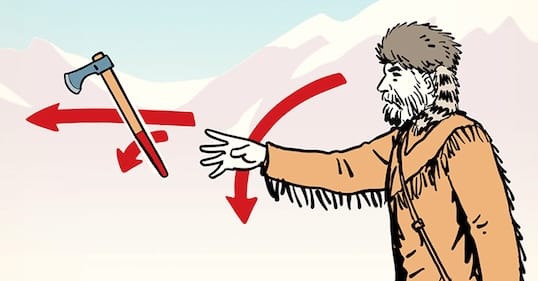
The throwing motion is an overhand arc, initiated from behind the head. It is essential that the wrist remains "locked" or stiff; "flicking" the wrist is a common beginner’s error that adds unpredictable rotation, making it nearly impossible to time the blade’s impact correctly. The release occurs when the handle is vertical, allowing the tomahawk to slide out of the hand and begin its natural rotation.
The "Thunk": Analyzing the Impact
The goal is for the tomahawk to complete exactly one full rotation before the blade strikes the target perpendicularly. If the top of the handle hits the target (over-rotation), the thrower should move slightly closer. If the bottom of the handle hits (under-rotation), the thrower should step back. This iterative process allows the participant to find their "sweet spot," where the mechanics of their body match the physics of the weapon.
The Modern Resurgence: From Frontier Skill to Urban Sport
In the 21st century, tomahawk throwing has moved from the backcountry to the mainstream. The last decade has seen an explosion in the popularity of axe-throwing as a social activity, with hundreds of commercial venues opening across North America and Europe. While many of these establishments use specialized throwing axes, the traditional tomahawk remains a favorite for purists and historical reenactors.
The growth of the sport is evidenced by the formation of governing bodies such as the World Axe Throwing League (WATL) and the International Axe Throwing Federation (IATF). These organizations have standardized rules, target dimensions, and safety protocols, elevating the practice from a "just for fun" activity to a competitive sport with televised tournaments and international rankings.
Market data suggests that the "social throwing" industry has become a multi-million dollar sector. Venues often combine the activity with food and beverage services, marketing it as a unique alternative to traditional outings like bowling or darts. This commercialization has introduced the tomahawk to a demographic far removed from the 19th-century mountain man, yet the core appeal—the visceral satisfaction of a successful stick—remains unchanged.
Safety Protocols and Equipment Standards
As with any activity involving bladed implements, safety is the primary concern for both backyard practitioners and professional range operators. Modern safety standards are rigorous, focusing on the "lane" system to prevent accidents.
- Clearance Zones: A minimum of six feet of clearance is required behind and to the sides of the thrower.
- Target Material: Targets are typically made of "end-grain" wood, such as pine or cottonwood. Softwoods are preferred because they absorb the impact of the blade more readily, reducing the risk of "bounce-backs."
- Spectator Safety: In professional settings, lanes are enclosed by chain-link fencing or heavy wooden barriers to contain any erratic throws.
- Blade Maintenance: While a tomahawk must be sharp enough to stick into wood, it does not need to be "razor-sharp." An overly sharp edge is prone to chipping and can be dangerous during the retrieval process.
Socio-Economic Impact and Implications
The revival of tomahawk throwing carries broader cultural and psychological implications. Experts in recreational therapy suggest that activities requiring high levels of focus and physical coordination, such as tomahawk throwing, provide significant stress relief. The "mindfulness" required to calibrate a throw offers a temporary reprieve from the digital distractions of modern life.
Furthermore, the activity fosters community building. Whether at a historical reenactment or a modern urban range, the shared experience of learning a difficult skill creates social bonds. For historical organizations, the continued interest in tomahawk throwing ensures the preservation of frontier crafts, including blacksmithing and woodworking, as enthusiasts seek out authentic, hand-forged tools.
Conclusion: Preserving a Frontier Legacy
While the era of the mountain man and the great western rendezvous has long passed, the tomahawk remains a potent symbol of American history. Its transition from a critical survival tool to a modern recreational staple highlights the enduring human desire to master physical skills that require patience, discipline, and a connection to the past.
By mastering the fundamentals of the grip, the arc, and the rotation, modern practitioners do more than just engage in a "just for fun" activity; they participate in a lineage of skill that stretches back centuries. As long as there are stumps to hit and blades to throw, the satisfying "thunk" of the tomahawk will continue to resonate, bridging the gap between the rugged frontiers of the 1800s and the recreational landscapes of the present day.

0 Comments