
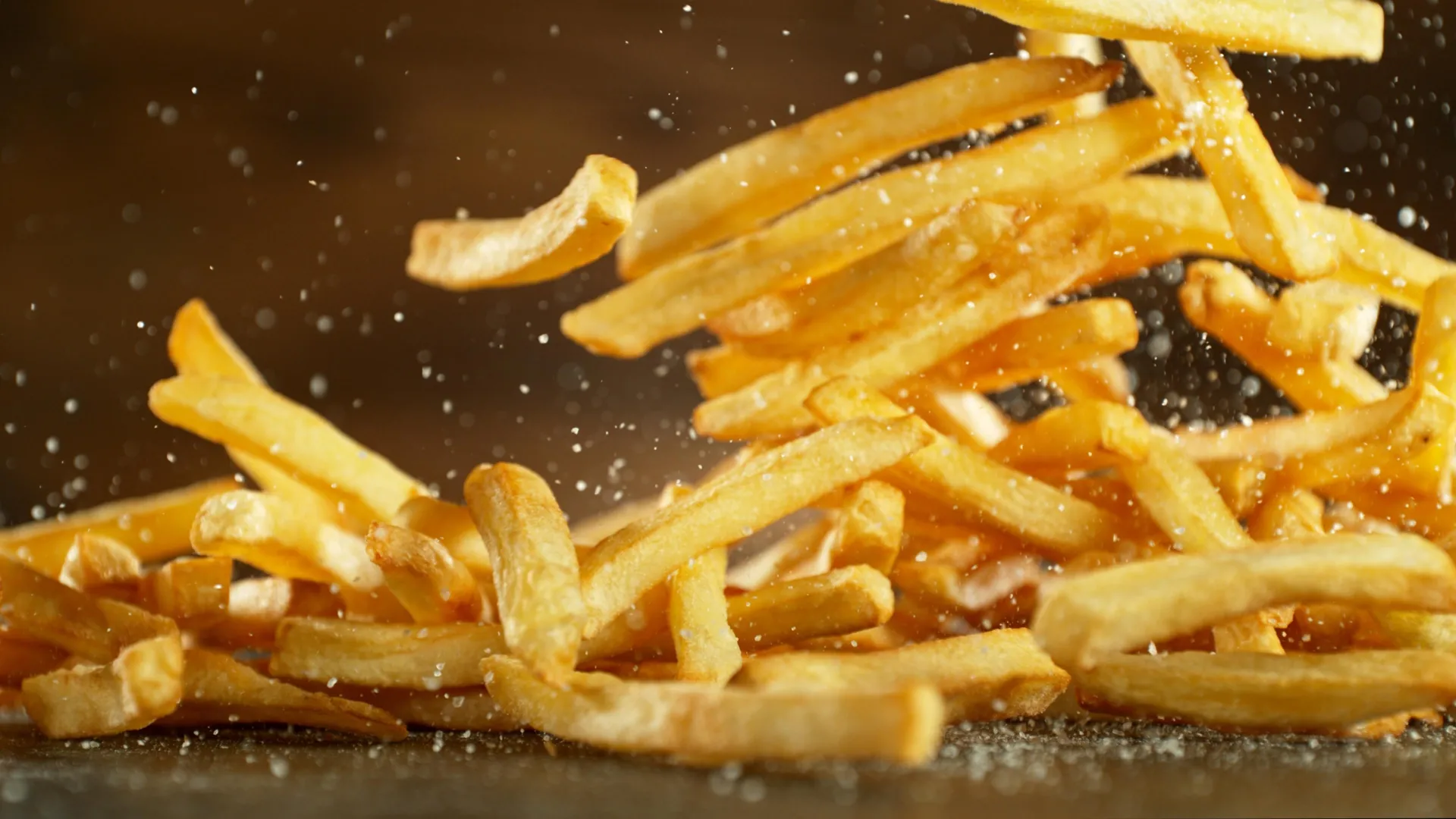
The beloved crunch and savory richness of French fries and other fried delicacies have long been a staple of global cuisine, offering a sensory experience that is hard to replicate. However, this culinary pleasure comes at a cost: the high oil absorption inherent in traditional frying methods significantly elevates the fat and calorie content of these popular foods. This increased consumption of unhealthy fats is a well-documented contributor to prevalent health issues, including obesity and hypertension, prompting a critical need for innovative solutions in food processing. In response to this growing public health concern and consumer demand for healthier options, researchers at the University of Illinois Urbana-Champaign are pioneering a revolutionary approach that could redefine the future of fried foods. Their groundbreaking work explores the potential of microwave energy to drastically reduce oil absorption in French fries without compromising the texture and flavor profiles that consumers crave.
The Quest for Healthier Indulgences
The inherent dilemma for many consumers lies in the conflict between health consciousness and the irresistible appeal of flavorful, texturally satisfying foods. Principal investigator Pawan Singh Takhar, a professor of food engineering in the Department of Food Science and Human Nutrition at the University of Illinois’ College of Agricultural, Consumer and Environmental Sciences, articulated this challenge with precision. "Consumers want healthy foods, but at the time of purchase, their cravings often take over. High oil content adds flavor, but it also contains a lot of energy and calories. My research team studies frying with the aim of obtaining lower fat content without significant differences in taste and texture," Takhar stated, underscoring the dual objective of their research: enhancing nutritional profiles while preserving sensory appeal.
Takhar and his doctoral student, Yash Shah, have meticulously documented their findings in two recent publications, delving into the intricate physical transformations that occur when French fries are subjected to microwave energy during the cooking process. This research represents a significant step forward in understanding and manipulating the science of frying.
A Specialized Approach to Microwave Frying
The initial phase of this pioneering research involved collaboration with scientists at Washington State University, who had developed a specialized microwave fryer. This advanced device possesses the unique capability to operate at two distinct frequencies: 2.45 gigahertz (GHz), a frequency commonly found in household microwave ovens, and 5.8 GHz, a higher frequency that allows for more precise control over energy penetration. Gigahertz, a unit of frequency, quantifies the number of electromagnetic wave cycles per second. Different microwave frequencies exhibit varying capacities to interact with water molecules within food, influencing the speed at which they absorb energy and consequently affecting the cooking process. This understanding of electromagnetic wave behavior is fundamental to unlocking the potential of microwave-assisted frying.
Deconstructing the Frying Mechanism: Pressure, Moisture, and Oil
To gain a comprehensive understanding of how microwave energy influences the frying process, the Illinois research team employed a rigorous methodology. Potatoes were carefully rinsed and peeled before being precisely cut into uniform strips, a crucial step for ensuring consistent cooking results. Subsequently, these potato strips underwent a blanching process, a brief immersion in hot water or steam. Blanching serves a dual purpose: it initiates the softening of potato tissues, preparing them for the subsequent frying stage, and can also help to pre-gelatinize starches on the surface, which can contribute to a desirable crust formation. Following blanching, the potato strips were salted and then introduced to soybean oil heated to a precise temperature of 180 degrees Celsius (356 degrees Fahrenheit), the standard temperature for deep-frying.
Throughout the frying cycle, and in the immediate aftermath, the researchers meticulously collected data on a range of critical parameters. These included internal temperature, internal pressure, volume changes, textural characteristics, moisture content, and crucially, the amount of oil absorbed. By systematically tracking these variables, the team aimed to elucidate the complex interplay between water vapor expulsion and oil infiltration into the potato structure.
A central tenet of traditional frying, as highlighted by Takhar, is the challenge of controlling oil migration into the food. At the outset of the frying process, the internal pores of the potato are largely saturated with water, leaving minimal space for oil. As the potato heats up, this water transforms into steam and begins to escape. This expulsion of water creates voids, and a phenomenon known as negative pressure can develop within the food matrix. This negative pressure acts much like a vacuum, actively drawing oil into the newly formed empty spaces.
Takhar eloquently illustrated this principle using an analogy: "Think about a straw in a drink. If you push air into the straw, it creates positive pressure and any liquid will be pushed out. But if you suck on the straw, the liquid moves upward. Now imagine food materials have lots of tiny straws. When there is positive pressure, the oil stays out. But if there is negative pressure, the oil starts moving in." This pressure differential is a key determinant of how much oil a food item absorbs during frying.
The Pressure Principle: Mitigating Oil Uptake
The research revealed a startling insight: a significant portion of oil absorption, as much as 90%, occurs during periods when the food is under negative pressure. This prolonged suction effect facilitates the ingress of oil into the food. Therefore, an optimal frying process would aim to maintain positive pressure within the food for an extended duration, thereby minimizing the time spent under negative pressure and consequently limiting oil uptake.
This is where microwave energy emerges as a potential game-changer. Unlike conventional frying, where heat is primarily transferred from the external heat source inwards, microwave energy penetrates the food more uniformly, heating water molecules throughout the entire potato structure. As these water molecules absorb microwave energy, they vibrate more vigorously, generating increased amounts of steam. This augmented steam production leads to a rise in internal pressure within the potato. "When we heat something in a conventional oven, the heat moves from outside to inside, but a microwave oven heats from the inside out, because the microwaves penetrate everywhere in the material. The microwaves oscillate water molecules, causing more vapor formation and thus shifting the pressure profile towards the positive side. The higher pressure in microwaves helps reduce oil penetration," Takhar explained. This internal pressure buildup effectively counteracts the negative pressure that drives oil absorption, acting as a barrier against excessive fat uptake.
Hybrid Frying: The Synergy of Conventional and Microwave Energy
The research team’s exploration extended beyond laboratory experiments to sophisticated mathematical modeling. These computational simulations allowed for a deeper analysis of the frying process, enabling researchers to investigate the complex interactions between various parameters and to predict outcomes that might be challenging to measure directly in every physical experiment.
In their comparative analysis, the researchers meticulously examined temperature, pressure, volume, texture, moisture, and oil absorption under three distinct conditions: frying at 2.45 GHz, at 5.8 GHz, and under conventional frying methods. The results were compelling. Across both experimental and simulation data, microwave frying consistently demonstrated a faster rate of moisture expulsion from the potatoes. Furthermore, it led to a reduction in overall cooking time and, most significantly, a substantial decrease in the amount of oil absorbed by the fries.
However, a critical observation emerged: while microwave frying alone was effective in reducing oil absorption and cooking time, it did not yield the desired textural outcome. Fries cooked exclusively with microwave energy tended to be soft and lacked the characteristic crisp exterior that consumers associate with traditional French fries. This realization led to a pivotal conclusion: a hybrid approach, combining the strengths of both conventional and microwave frying, would be necessary to achieve the ideal balance of health benefits and consumer satisfaction.
"However, if you just use microwave frying, you get soggy food. To obtain a crispy texture and taste, you need conventional heating. Therefore, we propose combining the two approaches in the same unit. Conventional heating maintains the crispiness, while microwave heating lowers the oil intake," Takhar emphasized, outlining the proposed solution.
The Future of Fried Foods: A Hybrid Fryer Concept
The envisioned hybrid frying system would strategically leverage the unique capabilities of both heating methods. Conventional heating would be employed to achieve the Maillard reaction and caramelization on the surface of the fries, responsible for browning and the development of that satisfying crunch. Simultaneously, microwave energy would be utilized to rapidly drive moisture out of the interior of the potato and, as previously discussed, to generate internal pressure that inhibits excessive oil penetration.
This integrated approach holds the promise of enabling food manufacturers to produce French fries and other fried products with significantly reduced oil content, all while preserving the rich flavor and appealing texture that have made them so popular. The accelerated cooking times associated with microwave assistance could also translate into enhanced production efficiency for commercial operations, potentially leading to cost savings.
The researchers are optimistic about the practical feasibility of their findings. They noted that existing continuous frying equipment, widely used in large-scale food processing facilities, could be retrofitted to incorporate microwave generators. Given the widespread availability and relatively low cost of these components, the proposed hybrid system appears to be economically viable for commercial implementation.
The foundational research supporting these advancements has been published in two esteemed scientific journals. The first paper, titled "The Effect of Conventional and Microwave Frying on the Quality Characteristics of French Fries," appeared in the Journal of Food Science. The second, "Predicting the quality changes during microwave frying of food biopolymers by solving the hybrid mixture theory-based unsaturated transport, and electromagnetics equations," was published in Current Research in Food Science. This body of work was made possible through the generous funding provided by the USDA National Institute of Food and Agriculture, specifically through awards 2020-67017-31194, ILLU-698-308, and ILLU-698-926. The implications of this research extend beyond French fries, potentially influencing the production of a wide array of fried foods, offering consumers a pathway to enjoy their favorite treats with a significantly improved nutritional profile. The successful integration of this technology could mark a pivotal moment in the food industry’s ongoing effort to balance indulgence with public health imperatives.

0 Comments