
Fire mastery remains one of the most fundamental skills in the repertoire of outdoor enthusiasts, survivalists, and historians alike. While the ability to produce a spark through modern or primitive means is often highlighted in survival literature, the structural engineering of the firewood—known as the fire lay—is the critical factor that determines the longevity, heat output, and efficiency of the flame. Different environmental conditions, such as high winds, heavy rain, or limited fuel availability, necessitate specific configurations to ensure the fire serves its intended purpose, whether that be for warmth, culinary preparation, or signaling.
The Fundamental Physics of Wilderness Combustion
To understand the necessity of diverse fire lays, one must first examine the "Fire Triangle," a scientific model detailing the three elements required for ignition and sustained combustion: heat, fuel, and oxygen. A successful fire lay optimizes the relationship between these elements. For instance, a lay that is too densely packed will stifle oxygen flow, leading to smoldering rather than flaming. Conversely, a lay that is too loose may allow heat to dissipate too rapidly, preventing the fuel from reaching its auto-ignition temperature.
Historical data from search and rescue operations often indicates that the failure to maintain a fire is a leading contributor to hypothermia in wilderness emergencies. Therefore, selecting the appropriate lay is not merely a matter of preference but a calculated decision based on atmospheric conditions and resource availability.
A Chronology of Fire-Building Techniques
The evolution of fire lays mirrors the progression of human civilization. Archeological evidence suggests that early hominids utilized simple "mound" fires, which were inefficient and required constant tending. As nomadic tribes moved into varied climates, specialized lays emerged.
The Star Fire, for example, is deeply rooted in the history of the American frontier, where wood was often scarce on the Great Plains. The Log Cabin and Pyramid lays gained prominence in permanent settlements and organized military camps due to their ability to provide sustained heat for large groups. In the modern era, the focus has shifted toward "Leave No Trace" principles, emphasizing fire lays that minimize soil scorching and maximize fuel efficiency to preserve natural resources.
The Teepee Fire Lay: The Standard for Initial Ignition
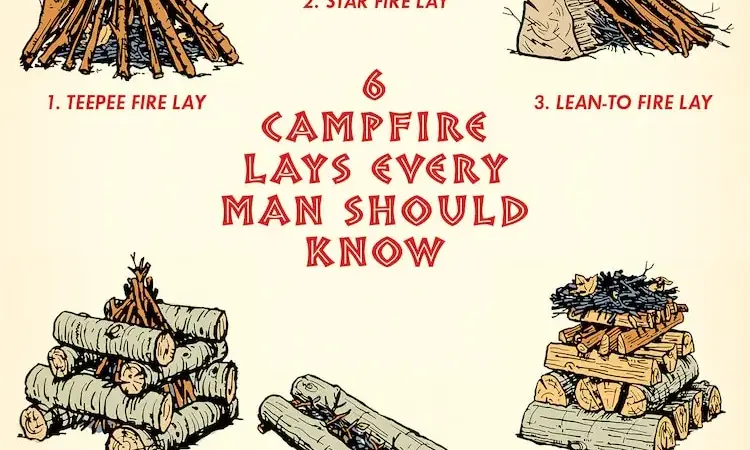
The Teepee lay is arguably the most recognizable configuration in outdoor lore. Its design is based on the principle of the chimney effect, where rising heat creates a vacuum that draws fresh oxygen into the base of the structure.
Structural Methodology:
To construct a Teepee lay, a tinder bundle—consisting of highly flammable materials like dry grass, birch bark, or charred cloth—is placed at the center. Kindling (small twigs) is then leaned against each other in a conical shape above the tinder. As the fire stabilizes, larger sticks are added to the exterior of the cone.
Performance Analysis:
The primary advantage of the Teepee lay is its rapid ignition capability. Because the flames are directed upward toward a central point, it consumes fuel quickly and produces a high, bright flame. However, this high consumption rate is also its primary drawback; the Teepee requires frequent refueling and eventually collapses into a pile of coals, requiring the user to transition to a more stable structure if long-term heat is desired.
The Star Fire Lay: Conservation and Economy
In scenarios where fuel is limited or the user wishes to maintain a low-profile fire for a long duration, the Star Fire—also known as the Indian Fire or Hunter’s Fire—is the optimal choice.
Structural Methodology:
This lay utilizes five or six long logs arranged like the spokes of a wheel. A small Teepee fire is ignited at the "hub" where the ends of the logs meet. Rather than burning the entire log at once, only the tips are consumed.
Expert Insights:
Forestry management experts often recommend the Star Fire for solo campers. As the ends of the logs burn down, the user simply pushes them further into the center. This allows for precise control over the fire’s intensity. If the fire needs to be extinguished quickly, the logs can be pulled apart, immediately depriving the hub of its primary fuel source.
The Lean-to Fire Lay: Engineering for Adverse Weather
Wind and rain are the primary antagonists of a successful campfire. The Lean-to lay addresses these challenges by using a physical barrier to protect the fragile initial flames.
Structural Methodology:
A large "backstop" log or a rock is placed perpendicular to the wind direction. Tinder is placed on the leeward side of the log. Kindling is then leaned against the log at a 45-degree angle, creating a protected "porch" for the fire.

Environmental Application:
This configuration acts as a natural windbreak. Data from wilderness survival instructors suggests that the Lean-to is the most effective lay for beginners in coastal or mountainous regions where gusts are unpredictable. The backstop log also serves as a heat reflector, bouncing thermal radiation back toward the user rather than letting it dissipate into the environment.
The Log Cabin Fire Lay: Stability and Culinary Efficiency
For those requiring a stable platform for cooking or a fire that provides consistent heat for a group, the Log Cabin lay is the preferred architectural choice.
Structural Methodology:
The process begins with a small Teepee lay at the center. Two large fuel logs are placed parallel to each other on either side of the Teepee. Two more logs are placed perpendicularly on top of the first pair, forming a square. This "stacking" continues, mimicking the construction of a traditional log home.
Technical Advantages:
The Log Cabin structure creates a natural chimney that facilitates excellent airflow while providing a flat, stable top. This is ideal for placing cast-iron pans or Dutch ovens. As the inner Teepee burns, it ignites the interior of the cabin walls. Once the structure eventually collapses, it leaves behind a deep, uniform bed of hot coals, which is superior for roasting and baking compared to the erratic flames of a Teepee.
The Parallel or Long Fire Lay: The Trench Method
The Parallel lay is a specialized configuration often used by hunters or in military survival contexts where a long, narrow heat source is required for drying clothes or cooking multiple items simultaneously.
Structural Methodology:
Two large, green (unseasoned) logs are placed parallel to each other, approximately six to eight inches apart. The fire is built in the channel between them. In some variations, a trench is dug into the earth to serve the same purpose.
Functional Analysis:
The parallel logs act as a "stove top," allowing pots to be rested directly on the wood. The narrow channel creates a Venturi effect, accelerating airflow and producing an intense, focused heat. Furthermore, if the logs are positioned correctly, they can block crosswinds, making the fire more resilient in open plains.
The Pyramid Fire Lay: The "Upside-Down" Innovation
Often referred to as the Council Fire or the Self-Feeding Fire, the Pyramid lay is the most sophisticated of the six, designed for maximum duration with minimum maintenance.
Structural Methodology:
Unlike traditional fires where the smallest fuel is at the bottom, the Pyramid lay reverses the order. Large logs are placed at the base, followed by a layer of slightly smaller logs placed perpendicularly. This continues for several layers until the smallest kindling and tinder are placed at the very top.
Thermodynamic Benefits:
When the fire is lit at the top, it slowly burns downward. This "top-down" method is highly efficient because the heat from the top layer pre-dries and pre-heats the fuel below it.
Official Recommendations:
Wilderness safety organizations often advocate for the Pyramid lay for overnight warmth. Because the fire feeds itself as the upper layers turn to coals and fall into the gaps of the lower layers, it can burn for several hours without human intervention. This reduces the risk of a user having to leave a warm sleeping bag in freezing temperatures to tend the hearth.
Broader Impact and Environmental Responsibility
While the ability to build these fires is a vital skill, modern forestry experts emphasize the importance of "Leave No Trace" (LNT) ethics. The impact of campfires on the ecosystem can be significant, including soil sterilization, the depletion of local downed wood which serves as habitat, and the risk of catastrophic wildfires.
Data on Wildfire Prevention:
According to the National Interagency Fire Center (NIFC), nearly 85% of wildfires in the United States are caused by humans, with unattended or improperly constructed campfires being a primary contributor. To mitigate this, experts suggest:
- Using Established Rings: Whenever possible, use pre-existing fire pits to prevent further soil damage.
- The "Mound Fire" Technique: If a pit is unavailable, building a fire on a mound of mineral soil (sand or gravel) can protect the underlying organic earth.
- Complete Extinguishment: Fires should be burned to white ash. Water should be added until the "hissing" stops, and the ashes must be cool to the touch before the site is abandoned.
Conclusion
The selection of a campfire lay is a technical decision that influences everything from fuel consumption to personal safety. From the rapid ignition of the Teepee to the long-lasting warmth of the Pyramid, understanding the mechanics of these six structures allows individuals to adapt to the unpredictable nature of the outdoors. As recreational trekking and wilderness survival training continue to grow in popularity, the dissemination of these traditional skills remains essential for fostering a safe and responsible relationship with the natural world.

0 Comments