
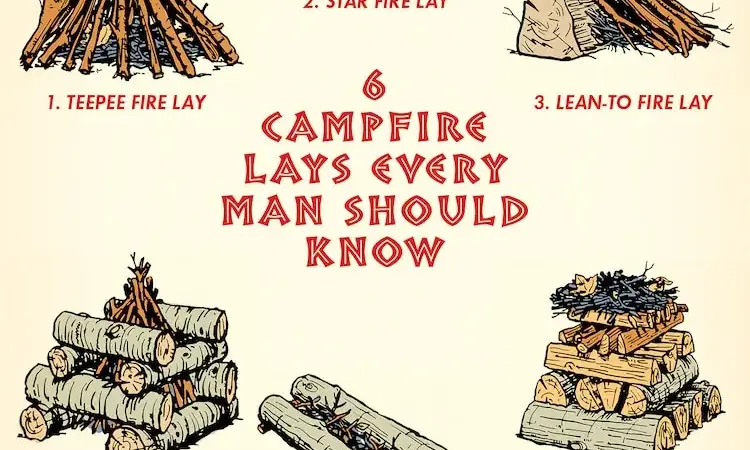
The mastery of fire remains the most pivotal skill in the history of human development, serving as the cornerstone of survival, community, and technological advancement. While modern conveniences have relegated fire-building to a recreational pastime for many, the ability to construct a functional fire lay remains a critical competency for outdoorsmen, emergency responders, and survivalists. Understanding the nuances of fire architecture—specifically the "lay," or the strategic arrangement of wood—is essential because environmental conditions, fuel availability, and specific needs for heat or light dictate which structure is most effective. According to wilderness survival experts, a "one-size-fits-all" approach to fire building is often the primary reason for failure in the field. By analyzing the six most common campfire lays—the Teepee, Star, Lean-to, Log Cabin, Parallel, and Pyramid—individuals can ensure they are prepared for any backcountry scenario, from high-wind ridges to damp forest floors.
The Physics of Combustion: Understanding the Foundation
Before examining specific lays, it is necessary to understand the thermodynamics that govern all fire structures. Fire requires three elements: heat, fuel, and oxygen. The effectiveness of a fire lay is determined by how well it manages these components. The "Fire Triangle" dictates that if any one of these elements is restricted, the fire will fail.
In a survival or camping context, fuel is categorized into three stages: tinder (easily ignitable material like dry grass or birch bark), kindling (small twigs and split wood), and fuel logs (large, slow-burning timber). A successful fire lay facilitates the transition of heat from the tinder to the kindling, and finally to the fuel logs, while maintaining a consistent flow of oxygen. Scientific analysis of fire behavior suggests that the geometry of the wood arrangement significantly impacts the "chimney effect," where rising hot air draws in fresh oxygen from the base, accelerating combustion.
The Teepee Fire Lay: The Standard for Initial Ignition
The Teepee fire lay is perhaps the most recognizable configuration in outdoor lore. It is characterized by a conical structure of kindling and fuel logs surrounding a central tinder bundle. This design is highly favored for its efficiency in getting a fire started quickly. Because heat rises, the Teepee structure focuses the flames from the tinder directly onto the kindling above it, creating a concentrated column of heat.
To construct a Teepee lay, one must place a tinder bundle on a dry surface. Kindling is then leaned against each other in a circular pattern, meeting at a point at the top. It is imperative to leave an opening on the windward side of the structure to allow oxygen to enter. As the fire gains strength, larger fuel logs are added in the same conical shape. Data from survival instructors indicate that while the Teepee is the most effective for rapid ignition, it is also the least fuel-efficient. The vertical orientation causes the wood to burn through quickly, requiring constant maintenance and a large supply of wood.
The Star Fire Lay: Conservation and Longevity
The Star fire lay, often associated with historical depictions of the American West, is designed for environments where fuel is scarce. Unlike the Teepee, which burns wood rapidly, the Star lay is a slow-burning, economical configuration. It consists of several long logs arranged like the spokes of a wheel, with their ends meeting at a central point.
The ignition process begins with a small Teepee fire in the center of the "star." Once the center is established, the tips of the logs catch fire. As the ends of the logs are consumed, the user manually pushes the logs further into the center. This method allows for a controlled, low-heat fire that can last for hours with minimal fuel. According to historical records of nomadic cultures, this lay was preferred because it allowed for a fire that could be easily extinguished and restarted, and it prevented the waste of large logs that were difficult to transport or harvest in arid regions.
The Lean-to Fire Lay: Engineered for Inclement Weather
In regions prone to high winds or steady rainfall, the Lean-to fire lay provides a protective barrier for the initial flame. This structure utilizes a large "backlog" or a natural rock face as a windbreak. The tinder bundle is placed against the base of this windbreak, and kindling is leaned against the log at a 45-degree angle.
The Lean-to serves a dual purpose: it shields the delicate tinder from being extinguished by gusts and provides a reflective surface that bounces heat back toward the user. However, search and rescue data suggest that the Lean-to can be difficult to oxygenate if the kindling is packed too tightly against the backlog. Proper construction requires a balance between protection and airflow. This lay is frequently cited as a favorite among backpackers in the Pacific Northwest and other temperate rainforest climates.
The Log Cabin Fire Lay: Stability and Radiant Heat
For those seeking a long-lasting fire that requires minimal tending, the Log Cabin lay is the preferred choice. This structure is built by placing two large logs parallel to each other, then stacking two more logs perpendicularly on top, creating a square frame. This process is repeated until a cabin-like structure is formed around a central Teepee of kindling.

The Log Cabin lay is prized for its structural integrity. As the inner Teepee burns, it ignites the surrounding "walls" of the cabin. Eventually, the structure collapses inward, creating a dense bed of hot coals. This makes it an excellent choice for cooking and for providing consistent radiant heat throughout the night. Environmental impact studies note that because the Log Cabin produces a significant coal bed, it is vital to ensure the fire is built on mineral soil or a fire ring to prevent the heat from damaging the organic layers of the earth.
The Parallel or Long Fire Lay: The Culinary Standard
The Parallel fire lay, also known as the Long fire, is specifically designed for cooking and heat distribution across a larger area. It involves placing two large, green (unseasoned) logs side-by-side, approximately six inches apart. A fire is then built in the trench between the logs.
This configuration acts as a natural stove. The two logs support pots, pans, or skewers, while the narrow channel between them creates a localized draft that intensifies the heat. For survivalists, the Long fire is also used to provide warmth for a person sleeping alongside it, as the heat is distributed linearly rather than from a single point. If logs are unavailable, a trench can be dug into the ground to achieve a similar effect, which is a technique often used in "Stealth" camping to hide the light of the flames.
The Pyramid Fire Lay: The "Upside-Down" Efficiency
The Pyramid lay, also referred to as the Council fire or the Upside-Down fire, represents a departure from traditional fire-building logic. In this configuration, the largest fuel logs are placed on the bottom in a solid layer. Successive layers of smaller logs are stacked perpendicularly on top, finishing with a small Teepee of kindling at the very peak.
The fire is lit from the top. As the top layer burns, it creates a bed of coals that falls through the gaps to ignite the layer below. This "top-down" burn is significantly more efficient and produces less smoke because the smoke from the lower layers must pass through the flames above, resulting in more complete combustion. Forest service data indicates that the Pyramid lay is the safest for overnight heat, as it can burn for up to eight hours without requiring additional wood, reducing the risk of a camper having to tend a fire while drowsy.
Safety, Regulations, and Environmental Impact
While the ability to build these fires is a vital skill, it must be balanced with modern environmental realities. The National Interagency Fire Center (NIFC) reports that nearly 85% of wildfires in the United States are caused by humans, many resulting from improperly managed or extinguished campfires.
"The choice of a fire lay should be dictated not only by your needs but by the environment," states a representative from the Leave No Trace (LNT) Center for Outdoor Ethics. "In high-risk fire zones, the use of a fire pan or a mound fire is recommended to prevent scarring the landscape. Furthermore, every fire must be ‘dead out’—cool to the touch—before it is abandoned."
The chronology of fire management has shifted from a focus on "survival at all costs" in the mid-20th century to a "sustainable bushcraft" model in the 21st century. This evolution reflects a growing understanding of the fragility of wilderness ecosystems. For instance, the use of "green" logs for Parallel fires is now discouraged in high-traffic areas to preserve living timber, with survivalists instead being taught to use dead-and-downed wood.
Conclusion: The Strategic Importance of Fire Knowledge
The selection of a fire lay is a strategic decision that impacts safety, comfort, and resource management. The Teepee provides quick heat, the Star conserves wood, the Lean-to defies the wind, the Log Cabin offers stability, the Parallel fire facilitates cooking, and the Pyramid fire ensures a restful night.
In a broader sense, the resurgence of interest in these traditional skills reflects a cultural desire to reconnect with the fundamental elements of human existence. As technology becomes more pervasive, the tactile, objective reality of building a fire—balancing the physics of air and wood—remains a grounding and potentially life-saving endeavor. For the modern outdoorsman, mastering these six lays is not merely about warmth; it is about maintaining a vital link to a heritage of self-reliance and environmental stewardship. By understanding the data, the science, and the techniques behind these structures, individuals can navigate the wilderness with greater confidence and a smaller ecological footprint.

0 Comments