
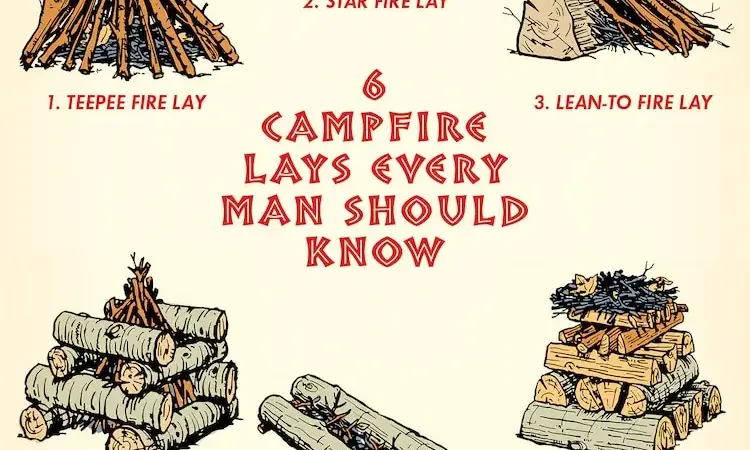
The mastery of fire-making remains one of the most critical competencies in the repertoire of outdoor survival and recreational woodcraft, serving as a cornerstone for thermoregulation, culinary preparation, and psychological fortitude in the wilderness. While the ability to produce a spark is a vital first step, the structural arrangement of fuel—known as the fire lay—determines the efficiency, longevity, and purpose of the resulting flame. Expertise in fire craft requires more than the ability to ignite tinder; it necessitates a sophisticated understanding of how different configurations interact with environmental variables such as wind, moisture, and fuel availability. By analyzing the six primary fire lays—the Teepee, Star, Lean-to, Log Cabin, Parallel, and Pyramid—outdoorsmen can adapt to diverse conditions, ensuring safety and resource conservation in any environment.
The Structural Mechanics of the Primary Fire Lays
The selection of a fire lay is rarely arbitrary; it is a tactical decision based on the immediate needs of the camp and the prevailing meteorological conditions. Each of the following six configurations offers unique advantages in terms of heat projection, ease of ignition, and fuel economy.
The Teepee Fire Lay: The Foundation of Ignition
The Teepee lay is perhaps the most recognizable configuration in outdoor lore, favored for its exceptional drafting capabilities. By leaning kindling and fuel wood against one another in a conical shape, the practitioner creates a natural chimney. As the tinder bundle at the center ignites, the heat rises vertically, drawing oxygen in through the base and funneling it upward through the fuel. This creates a concentrated "hot spot" that is ideal for quickly igniting larger logs. However, the Teepee is notoriously high-maintenance; as the structural supports burn through, the cone inevitably collapses, requiring constant attention and a steady supply of fuel to maintain its height and heat.
The Star Fire Lay: Economy in Arid Environments
Historically associated with the American frontier and indigenous practices in wood-scarce regions, the Star fire lay—also known as the "Lazy Man’s Fire"—prioritizes fuel conservation over raw heat output. By arranging five or six long logs like the spokes of a wheel, the fire is maintained only at the central hub. Instead of chopping logs into smaller pieces, the user simply pushes the logs inward as the ends are consumed. This method provides a low, steady heat suitable for overnight warmth without the labor-intensive process of heavy wood processing.
The Lean-to Fire Lay: Shielding Against the Elements
In environments plagued by high winds or light precipitation, the Lean-to lay serves as a functional windbreak. By driving a large "backlog" into the ground or utilizing a fallen log as a structural anchor, the user leans smaller kindling against the windward side. This creates a protected pocket for the tinder bundle, shielding the nascent flame from being extinguished by gusts while allowing enough airflow for combustion. While it limits 360-degree heat radiation, it is an essential technique for survival in suboptimal weather conditions.
The Log Cabin Fire Lay: Stability and Sustained Heat
The Log Cabin lay is engineered for stability and the creation of a long-lasting coal bed. By stacking logs in a square perimeter around an internal Teepee starter, the structure creates a "chimney effect" while providing a sturdy platform. As the inner fire burns, it eventually ignites the surrounding "walls" of the cabin. This configuration is particularly effective for group settings where a large, bright, and self-sustaining fire is required for several hours. The resulting collapse of the structure produces a deep bed of coals, which is the gold standard for Dutch oven cooking or roasting.
The Parallel or Long Fire Lay: The Woodsman’s Kitchen
The Parallel lay, often constructed with two large green logs or within a hand-dug trench, is designed specifically for thermodynamics and culinary utility. By placing fuel wood in a narrow channel, the heat is directed upward in a concentrated line. This allows for multiple cooking vessels to be placed across the logs simultaneously, effectively creating a rustic stove top. Additionally, the side logs act as a buffer against wind, making it an efficient choice for exposed ridgelines or coastal camps.
The Pyramid (Upside-Down) Fire Lay: The Self-Feeding Hearth
Often referred to as the "Council Fire," the Pyramid lay defies conventional fire-starting logic by placing the largest logs on the bottom and the smallest tinder on the top. This "top-down" burn method allows the fire to consume itself slowly. As the top layer turns to embers, they fall through the gaps to ignite the larger logs below. This is the ultimate "set it and forget it" fire, capable of burning for six to eight hours without manual intervention, making it the preferred choice for maintaining warmth throughout the night.

A Chronology of Fire Management and Technological Evolution
The evolution of fire lays mirrors the progression of human civilization and the refinement of thermodynamic understanding.
- Pre-Industrial Era: Early hearths were largely disorganized piles. The development of the Star lay and the Teepee represented a shift toward oxygen management and fuel efficiency among nomadic tribes and early settlers.
- The Frontier Era (18th-19th Century): The Log Cabin and Parallel lays became staples of the fur trade and western expansion, where fires were used not just for survival, but as industrial tools for blacksmithing and large-scale food preservation.
- The Modern Survival Movement (20th Century): With the rise of organized scouting and wilderness education, these lays were codified into "essential skills." The Pyramid lay gained popularity in the mid-20th century as a sophisticated method for managing heat in permanent camps.
- The 21st Century "New Fire" Era: Today, the focus has shifted toward "Leave No Trace" (LNT) principles. Modern fire craft emphasizes the use of fire pans or mound fires to prevent soil sterilization, integrating traditional lays into ecologically responsible frameworks.
Supporting Data: Thermodynamics and Fuel Efficiency
To understand why certain lays outperform others, one must look at the data regarding combustion and wood types. According to thermal dynamics studies, the efficiency of a fire is dictated by the "Fire Triangle": fuel, oxygen, and heat.
- Thermal Output: A well-constructed Log Cabin fire can reach internal temperatures exceeding 1,100 degrees Fahrenheit, whereas a Star fire may hover around 600-800 degrees, focusing heat only at the core.
- Moisture Impact: Fuel with a moisture content above 20% requires significantly more energy to ignite. The Teepee lay is the most effective at "pre-drying" damp wood through its vertical heat convection.
- Oxygen Ratios: The Parallel lay increases airflow velocity by approximately 15-20% compared to a standard pile, which facilitates a more complete combustion of the wood gases, resulting in less smoke and a hotter flame.
Official Responses and Expert Perspectives
Wilderness safety organizations and forestry officials emphasize that the choice of fire lay is also a matter of public safety. "The most common mistake we see is the ‘bonfire’ mentality," states a representative from the National Park Service’s Fire Management Division. "An oversized, unstructured fire is a liability. Learning specific lays like the Star or the Pyramid allows campers to get the heat they need with half the wood and twice the control."
Survival instructors frequently advocate for the "Two-Fire System": using a Teepee to establish a coal base and then transitioning into a Log Cabin or Pyramid for the night. This hybrid approach is now a standard teaching point in advanced wilderness first responder courses, where fire is treated as a medical tool for treating hypothermia.
Broader Impact and Environmental Implications
The implications of mastering fire lays extend beyond personal comfort; they intersect with global environmental concerns. In an era of increasing wildfire risk, the ability to build a small, efficient, and contained fire is an act of ecological stewardship.
The Leave No Trace (LNT) Imperative
Modern fire craft is increasingly defined by its footprint. The use of the "Mound Fire"—where a fire lay is built on a pedestal of mineral soil or sand—prevents the heat from killing the microorganisms in the organic soil layer below. Experts argue that the Pyramid lay is the most "LNT-friendly" for long-duration fires because its self-contained nature prevents logs from rolling out of the fire ring and reduces the likelihood of sparks jumping into surrounding duff.
Psychological Resilience
Beyond the physical benefits, the "Hearth Effect" is a documented psychological phenomenon. Research in evolutionary psychology suggests that sitting around a structured, flickering fire reduces blood pressure and promotes social cohesion. In a survival situation, the act of methodically building a Log Cabin or Teepee lay provides a sense of agency and order, which can be the difference between panic and survival.
Conclusion: The Enduring Relevance of Fire Craft
In a world of high-tech camping gear and portable butane stoves, the primitive skill of fire-laying remains a vital link to our ancestral past and a necessary safety net for the future. Whether it is the resource-saving Star lay of the plainsman or the high-output Log Cabin of the winter woodsman, these structures are more than just piles of wood; they are the result of centuries of human ingenuity applied to the most fundamental of elements. Mastery of these six lays ensures that regardless of the wind, the rain, or the scarcity of fuel, the fire—and the life it sustains—will continue to burn.

0 Comments